Gonçalves Rafaella Araujo, Wijesekara Nadeeja, Fraser Paul E, De Felice Fernanda G
Centre for Neuroscience Studies, Queen's University, Kingston, ON, Canada.
Tanz Centre for Research in Neurodegenerative Diseases, University of Toronto, Toronto, ON, Canada.
Front Cell Neurosci. 2019 Feb 5;13:17. doi: 10.3389/fncel.2019.00017. eCollection 2019.
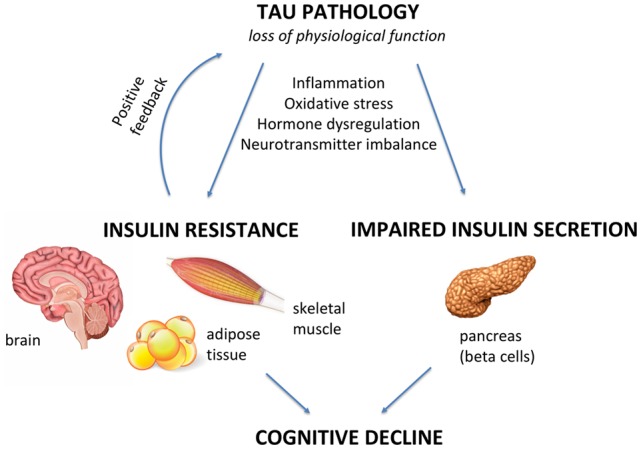
The microtubule-associated protein tau (MAPT) is mainly identified as a tubulin binding protein essential for microtubule dynamics and assembly and for neurite outgrowth. However, several other possible functions for Tau remains to be investigated. Insulin signaling is important for synaptic plasticity and memory formation and therefore is essential for proper brain function. Tau has recently been characterized as an important regulator of insulin signaling, with evidence linking Tau to brain and peripheral insulin resistance and beta cell dysfunction. In line with this notion, the hypothesis of Tau pathology as a key trigger of impaired insulin sensitivity and secretion has emerged. Conversely, insulin resistance can also favor Tau dysfunction, resulting in a vicious cycle of these events. In this review article, we discuss recent evidence linking Tau pathology, insulin resistance and insulin deficiency. We further highlight the deleterious consequences of Tau pathology-induced insulin resistance to the brain and/or peripheral tissues, suggesting that these are key events mediating cognitive decline in Alzheimer's disease (AD) and other tauopathies.
微管相关蛋白tau(MAPT)主要被认为是一种对微管动力学、组装以及神经突生长至关重要的微管蛋白结合蛋白。然而,tau的其他一些可能功能仍有待研究。胰岛素信号传导对突触可塑性和记忆形成很重要,因此对正常脑功能至关重要。tau最近被确定为胰岛素信号传导的重要调节因子,有证据表明tau与脑和外周胰岛素抵抗以及β细胞功能障碍有关。与此观点一致,tau病理学作为胰岛素敏感性和分泌受损的关键触发因素的假说已经出现。相反,胰岛素抵抗也会促进tau功能障碍,导致这些事件的恶性循环。在这篇综述文章中,我们讨论了将tau病理学、胰岛素抵抗和胰岛素缺乏联系起来的最新证据。我们进一步强调了tau病理学诱导的胰岛素抵抗对脑和/或外周组织的有害后果,表明这些是介导阿尔茨海默病(AD)和其他tau蛋白病认知衰退的关键事件。