Department of Family Medicine, Shengjing Hospital, China Medical University, Shenyang, Liaoning, China.
Department of Informatics, Shengjing Hospital, China Medical University, Shenyang, Liaoning, China.
J Diabetes Res. 2019 Jan 22;2019:4248218. doi: 10.1155/2019/4248218. eCollection 2019.
Diabetes mellitus is a chronic disease with a steadfast increase in prevalence. Due to the chronic course of the disease combining with devastating complications, this disorder could easily carry a financial burden. The early diagnosis of diabetes remains as one of the major challenges medical providers are facing, and the satisfactory screening tools or methods are still required, especially a population- or community-based tool.
This is a retrospective cross-sectional study involving 15,323 subjects who underwent the annual check-up in the Department of Family Medicine of Shengjing Hospital of China Medical University from January 2017 to June 2017. With a strict data filtration, 10,436 records from the eligible participants were utilized to develop a prediction model using the J48 decision tree algorithm. Nine variables, including age, gender, body mass index (BMI), hypertension, history of cardiovascular disease or stroke, family history of diabetes, physical activity, work-related stress, and salty food preference, were considered.
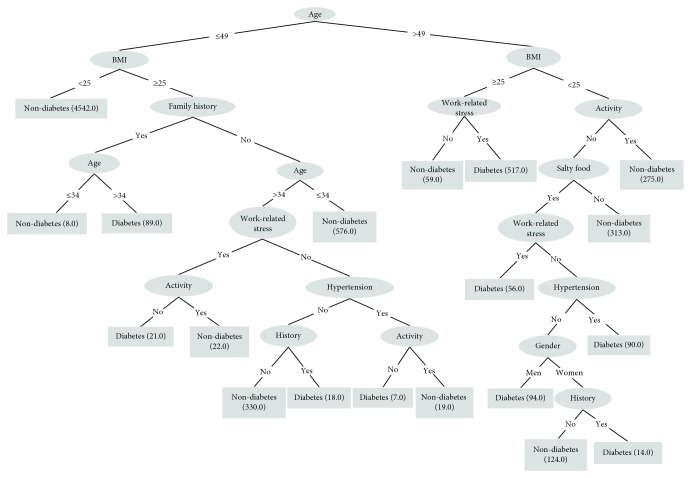
The accuracy, precision, recall, and area under the receiver operating characteristic curve (AUC) value for identifying potential diabetes were 94.2%, 94.0%, 94.2%, and 94.8%, respectively. The structure of the decision tree shows that age is the most significant feature. The decision tree demonstrated that among those participants with age ≤ 49, 5497 participants (97%) of the individuals were identified as nondiabetic, while age > 49, 771 participants (50%) of the individuals were identified as nondiabetic. In the subgroup where people were 34 < age ≤ 49 and BMI ≥ 25, when with positive family history of diabetes, 89 (92%) out of 97 individuals were identified as diabetic and, when without family history of diabetes, 576 (58%) of the individuals were identified as nondiabetic. Work-related stress was identified as being associated with diabetes. In individuals with 34 < age ≤ 49 and BMI ≥ 25 and without family history of diabetes, 22 (51%) of the individuals with high work-related stress were identified as nondiabetic while 349 (88%) of the individuals with low or moderate work-related stress were identified as not having diabetes.
We proposed a classifier based on a decision tree which used nine features of patients which are easily obtained and noninvasive as predictor variables to identify potential incidents of diabetes. The classifier indicates that a decision tree analysis can be successfully applied to screen diabetes, which will support clinical practitioners for rapid diabetes identification. The model provides a means to target the prevention of diabetes which could reduce the burden on the health system through effective case management.
糖尿病是一种患病率稳步上升的慢性病。由于疾病的慢性病程加上毁灭性的并发症,这种疾病很容易带来经济负担。糖尿病的早期诊断仍然是医疗服务提供者面临的主要挑战之一,仍需要满意的筛查工具或方法,尤其是基于人群或社区的工具。
这是一项回顾性横断面研究,共纳入 2017 年 1 月至 6 月在中国医科大学盛京医院家庭医学科接受年度检查的 15323 名受试者。经过严格的数据筛选,从合格参与者中利用 J48 决策树算法开发预测模型,共使用了 10436 条记录。考虑了 9 个变量,包括年龄、性别、体重指数(BMI)、高血压、心血管疾病或中风史、糖尿病家族史、身体活动、工作相关压力和喜欢吃咸的食物。
该模型识别潜在糖尿病的准确率、精确率、召回率和受试者工作特征曲线下面积(AUC)值分别为 94.2%、94.0%、94.2%和 94.8%。决策树的结构表明年龄是最重要的特征。决策树表明,在年龄≤49 岁的参与者中,97%的 5497 名个体被识别为非糖尿病患者,而年龄>49 岁的参与者中,771 名个体(50%)被识别为非糖尿病患者。在年龄 34<年龄≤49 和 BMI≥25 的亚组中,当有阳性糖尿病家族史时,97 名个体中有 89 名(92%)被识别为糖尿病患者,而没有家族史时,576 名个体中有 58%(58%)被识别为非糖尿病患者。工作相关压力被确定与糖尿病有关。在年龄 34<年龄≤49 和 BMI≥25 且无糖尿病家族史的个体中,22 名(51%)工作相关压力高的个体被识别为非糖尿病患者,而 349 名(88%)工作相关压力低或中等的个体被识别为没有糖尿病。
我们提出了一种基于决策树的分类器,该分类器使用患者的九个易于获得和非侵入性的特征作为预测变量来识别潜在的糖尿病事件。该分类器表明,决策树分析可成功用于筛查糖尿病,这将为临床医生提供快速识别糖尿病的手段。该模型提供了一种针对糖尿病预防的方法,可以通过有效的病例管理来减轻卫生系统的负担。
