Menegueti Mayra Gonçalves, Ciol Marcia A, Bellissimo-Rodrigues Fernando, Auxiliadora-Martins Maria, Gaspar Gilberto Gambero, Canini Silvia Rita Marin da Silva, Basile-Filho Anibal, Laus Ana Maria
Nursing School of Ribeirão Preto.
Department of Rehabilitation Medicine, School of Medicine, University of Washington, Seattle, Washington.
Medicine (Baltimore). 2019 Feb;98(8):e14417. doi: 10.1097/MD.0000000000014417.
Removing an indwelling urinary catheter as soon as possible is the cornerstone of catheter-associated urinary tract infections (CAUTI) prevention. However, implementing this measure may be challenging in clinical settings. To evaluate the impact of implementing a healthcare workers (HCWs) educational program and a daily checklist for indwelling urinary catheter indications among critical patients on the incidence of CAUTI.
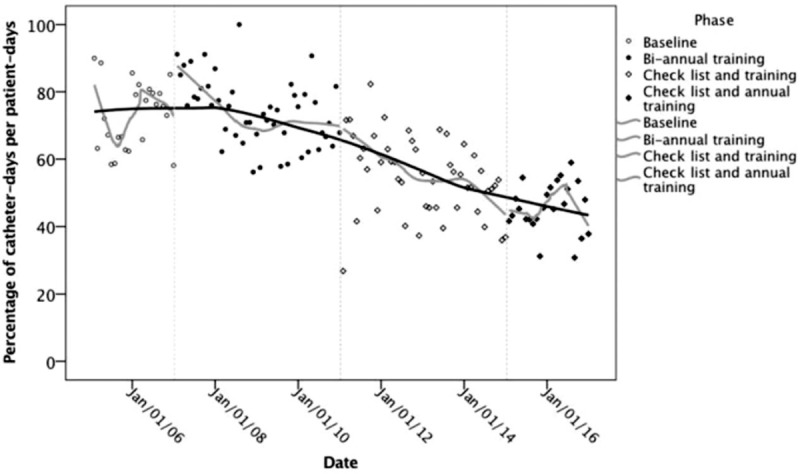
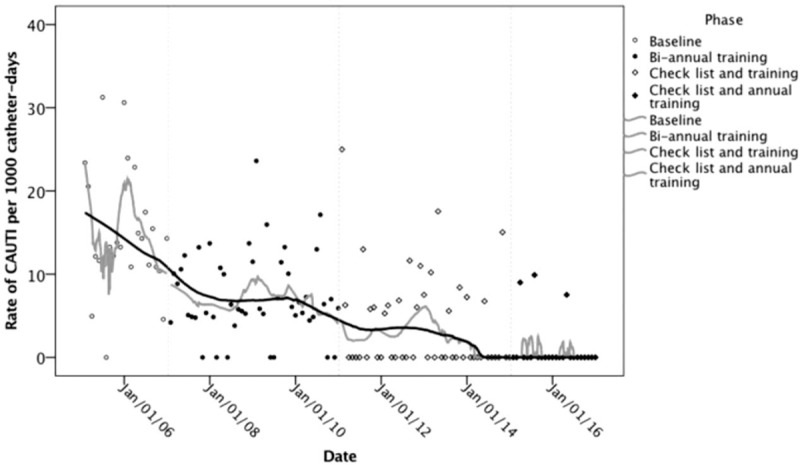
This was a quasi-experimental study performed in a general intensive care unit of a tertiary-care hospital over a 12 years period, from January 1, 2005 to December 31, 2016. Rates of urinary catheter use and incidence density of CAUTI were monthly evaluated following the Centers for Disease Control and Prevention (CDC) criteria throughout the study period. Phase I (2005-2006) was the pre-intervention period. In phase II (2007-2010), HCWs routine training on CAUTI prevention was performed twice-a-year. In phase III (2011-2014), we implemented a daily checklist for indwelling urinary catheter indications, in addition to the biannual training. In phase IV, (2015-2016) the biannual training was replaced by training only newly hired HCWs and the daily checklist was maintained.
The mean rate of urinary catheter utilization decreased from phase I to phase IV (73.1%, 74.1%, 54.9%, and 45.6%, respectively). Similarly, the incidence density of CAUTI decreased from phase I to phase IV (14.9, 7.3, 3.8, and 1.1 per 1000 catheter-days, respectively).
HCWs education and daily evaluation of indwelling urinary catheter indications were highly effective in reducing the rates of catheter utilization as well as the incidence density of CAUTI.
尽早拔除留置导尿管是预防导尿管相关尿路感染(CAUTI)的基石。然而,在临床环境中实施这一措施可能具有挑战性。为了评估实施医护人员教育计划和重症患者留置导尿管指征每日检查表对CAUTI发病率的影响。
这是一项在一家三级医院的综合重症监护病房进行的为期12年的准实验研究,从2005年1月1日至2016年12月31日。在整个研究期间,按照疾病控制与预防中心(CDC)的标准每月评估导尿管使用情况和CAUTI的发病密度。第一阶段(2005 - 2006年)为干预前期。在第二阶段(2007 - 2010年),医护人员每年进行两次CAUTI预防常规培训。在第三阶段(2011 - 2014年),除了每半年一次的培训外,我们实施了留置导尿管指征每日检查表。在第四阶段(2015 - 2016年),每半年一次的培训被仅对新入职医护人员的培训所取代,并且每日检查表得以保留。
从第一阶段到第四阶段,导尿管平均使用率下降(分别为73.1%、74.1%、54.9%和45.6%)。同样,CAUTI的发病密度从第一阶段到第四阶段也有所下降(分别为每1000导尿管日14.9、7.3、3.8和1.1)。
医护人员教育和留置导尿管指征的每日评估在降低导尿管使用率以及CAUTI的发病密度方面非常有效。