Simanjuntak Tigor Peniel, Hatta Mochammad, Tahir Andi M, Sirait Robert H, Karo Marni B, Tambaib Titus, Dwiyanti Ressy, Noviyanthi Rizki Amelia, Junita Ade Rifka
Department of Obstetrics and Gynecology, Faculty of Medicine, Christian University of Indonesia, Jakarta, Indonesia.
Department of Microbiology, Molecular Biology and Immunology Laboratory and Faculty of Medicine, Hasanuddin University, Makassar,, Indonesia.
J Glob Infect Dis. 2019 Jan-Mar;11(1):25-29. doi: 10.4103/jgid.jgid_28_18.
has strong anti-inflammatory effect. This study aims to evaluated the level of anti-Toxoplasma immunoglobulin G and immunoglobulin M (IgG-IgM) antibody after intervention with extract in early pregnant mice with acute toxoplasmosis.
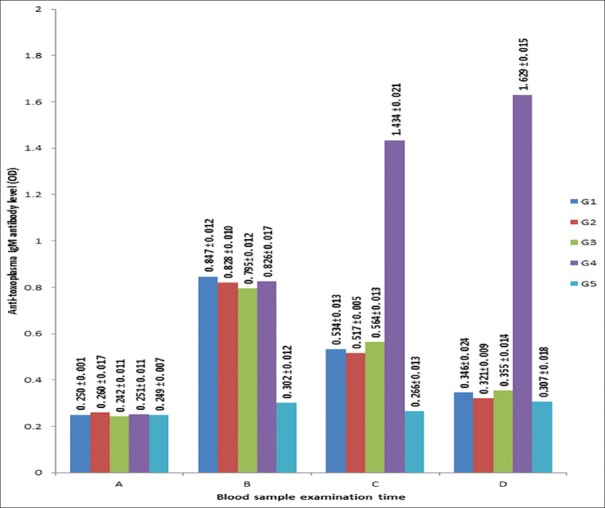
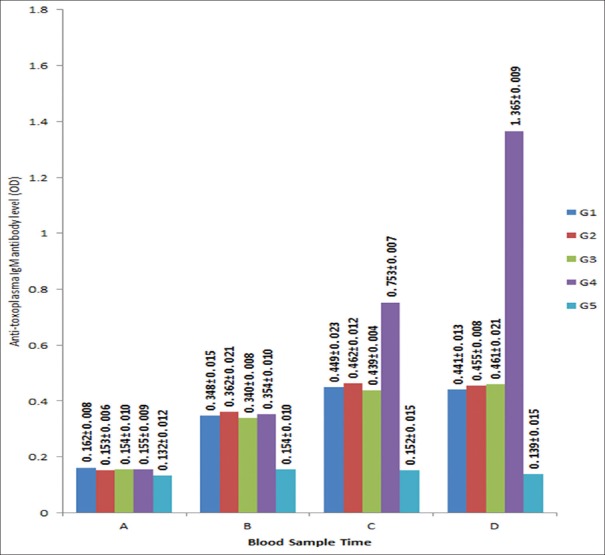
We evaluated 20 early pregnant mice that were divided into five groups, four mice in each. Group 1-4 received injections of tachyzoites. Three days later, G1 and G2 were given orally 125 mg/kg/day and 500 mg/kg/day of extract, respectively. G3 was given 60 mg/kg/day of spiramycin (positive control), and G4 was given 0.2 ml of distilled water (negative control). G5 underwent no intervention at all. Blood samples were obtained serially (before and 3 days after injection of tachyzoites, 3 days and 7 days after intervention) to assess anti-Toxoplasma IgG-IgM antibody levels by enzyme-linked immunosorbent assay methods.
Anti-Toxoplasma IgG-IgM antibody levels increased significantly 3 days after injection of tachyzoites ( < 0.05), but decreased significantly ( < 0.05) 3 days, and 7 days after administration of extract dose 125 mg, 500 mg, and spiramycin 60 mg, and there was no significant difference between these three groups. Anti-Toxoplasma IgG-IgM antibody levels increased significantly ( < 0.05) 3 days, 6 days, and 10 days after injections of tachyzoites on G4. The IgG-IgM antibody levels fluctuated on G5 and considered as insignificant ( > 0.05).
The administration of extract at a dose of 125 mg/kg/day for 7 days effectively decreased anti-Toxoplasma IgG-IgM antibody level in early pregnant mice with acute toxoplasmosis.
具有强大的抗炎作用。本研究旨在评估提取物干预急性弓形虫病的早孕小鼠后抗弓形虫免疫球蛋白G和免疫球蛋白M(IgG-IgM)抗体水平。
我们评估了20只早孕小鼠,将其分为五组,每组四只。第1-4组注射速殖子。三天后,G1和G2分别口服125毫克/千克/天和500毫克/千克/天的提取物。G3给予60毫克/千克/天的螺旋霉素(阳性对照),G4给予0.2毫升蒸馏水(阴性对照)。G5未进行任何干预。连续采集血样(注射速殖子前、注射后3天、干预后3天和7天),通过酶联免疫吸附测定法评估抗弓形虫IgG-IgM抗体水平。
注射速殖子3天后抗弓形虫IgG-IgM抗体水平显著升高(P<0.05),但在给予125毫克、500毫克提取物剂量以及60毫克螺旋霉素后3天和7天显著降低(P<0.05),这三组之间无显著差异。G4组在注射速殖子后3天、6天和10天抗弓形虫IgG-IgM抗体水平显著升高(P<0.05)。G5组的IgG-IgM抗体水平波动,认为无统计学意义(P>0.05)。
以125毫克/千克/天的剂量给予提取物7天可有效降低急性弓形虫病早孕小鼠的抗弓形虫IgG-IgM抗体水平。