Europa Eduardo, Gitelman Darren R, Kiran Swathi, Thompson Cynthia K
Roxelyn and Richard Pepper Department of Communication Sciences and Disorders, Northwestern University, Evanston, IL, United States.
Advocate Lutheran General Hospital, Park Ridge, IL, United States.
Front Hum Neurosci. 2019 Feb 13;13:27. doi: 10.3389/fnhum.2019.00027. eCollection 2019.
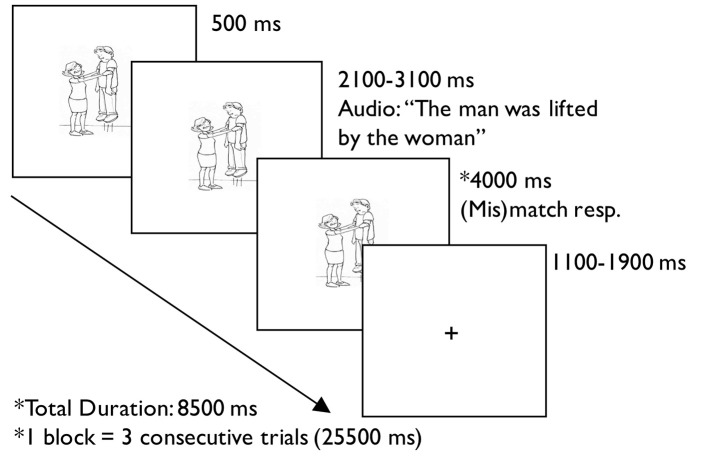
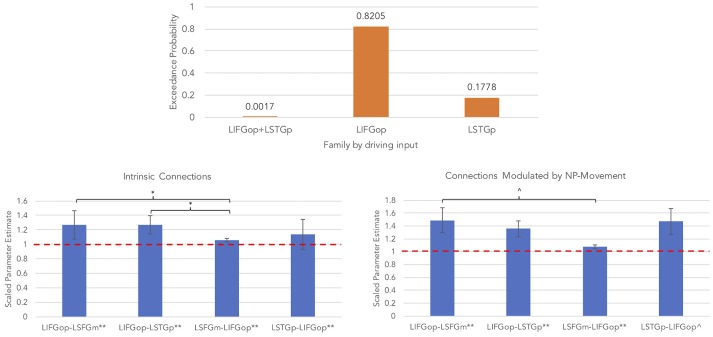
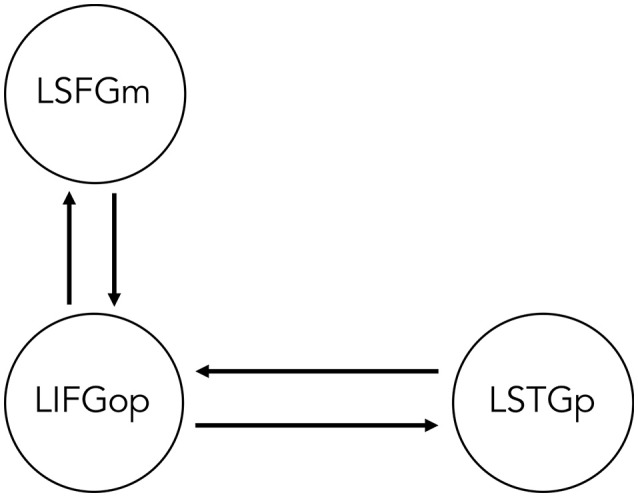
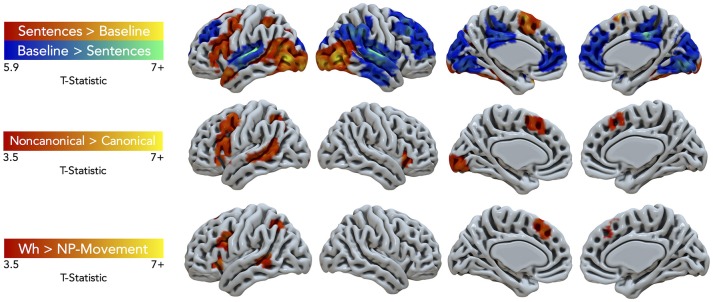
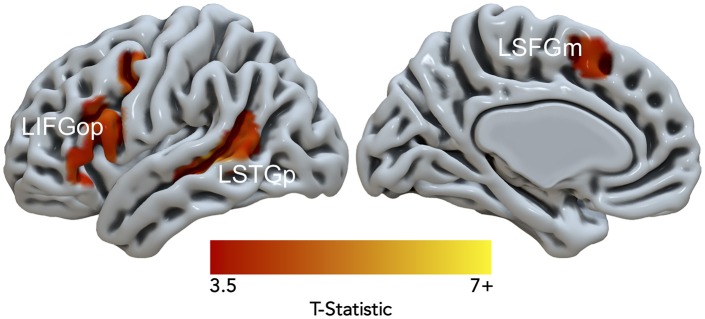
Linguistic theory suggests non-canonical sentences subvert the dominant order in English via displacement of sentence constituents to argument (NP-movement) or non-argument positions (wh-movement). Both processes have been associated with the left inferior frontal gyrus and posterior superior temporal gyrus, but differences in neural activity and connectivity between movement types have not been investigated. In the current study, functional magnetic resonance imaging data were acquired from 21 adult participants during an auditory sentence-picture verification task using passive and active sentences contrasted to isolate NP-movement, and object- and subject-cleft sentences contrasted to isolate wh-movement. Then, functional magnetic resonance imaging data from regions common to both movement types were entered into a dynamic causal modeling analysis to examine effective connectivity for wh-movement and NP-movement. Results showed greater left inferior frontal gyrus activation for > , but no activation for > . Both types of movement elicited activity in the opercular part of the left inferior frontal gyrus, left posterior superior temporal gyrus, and left medial superior frontal gyrus. The dynamic causal modeling analyses indicated that neither movement type significantly modulated the connection from the left inferior frontal gyrus to the left posterior superior temporal gyrus, nor vice-versa, suggesting no connectivity differences between wh- and NP-movement. These findings support the idea that increased complexity of wh-structures, compared to sentences with NP-movement, requires greater engagement of cognitive resources via increased neural activity in the left inferior frontal gyrus, but both movement types engage similar neural networks.
语言理论表明,非规范句子通过将句子成分移位到论元位置(名词短语移位)或非论元位置(wh移位)来颠覆英语中的主导语序。这两个过程都与左下额回和后颞上回有关,但尚未研究不同移位类型之间神经活动和连接性的差异。在本研究中,21名成年参与者在一项听觉句子-图片验证任务中接受功能磁共振成像数据采集,该任务使用被动句和主动句进行对比以分离名词短语移位,使用宾语分裂句和主语分裂句进行对比以分离wh移位。然后,将两种移位类型共有的区域的功能磁共振成像数据输入动态因果模型分析,以检验wh移位和名词短语移位的有效连接性。结果显示,对于[具体情况未明确给出],左下额回激活更强,但对于[具体情况未明确给出]则无激活。两种移位类型均在左下额回的岛盖部、左后颞上回和左额上回中部引发了活动。动态因果模型分析表明,两种移位类型均未显著调节从左下额回到左后颞上回的连接,反之亦然,这表明wh移位和名词短语移位之间不存在连接性差异。这些发现支持了这样一种观点,即与具有名词短语移位的句子相比,wh结构复杂性的增加需要通过左下额回神经活动的增加来更多地调动认知资源,但两种移位类型都涉及相似的神经网络。