Rodríguez-Celma Jorge, Chou Hsuan, Kobayashi Takanori, Long Terri A, Balk Janneke
Department of Biological Chemistry, John Innes Centre, Norwich, United Kingdom.
School of Biological Sciences, University of East Anglia, Norwich, United Kingdom.
Front Plant Sci. 2019 Feb 13;10:98. doi: 10.3389/fpls.2019.00098. eCollection 2019.
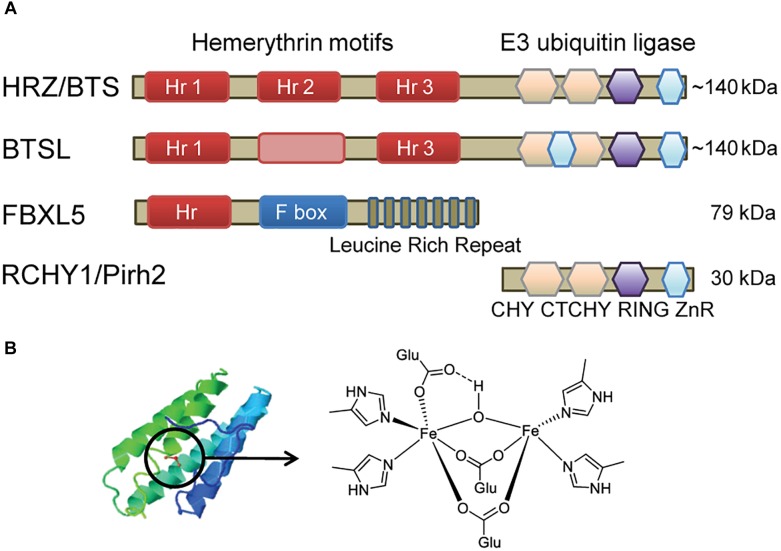
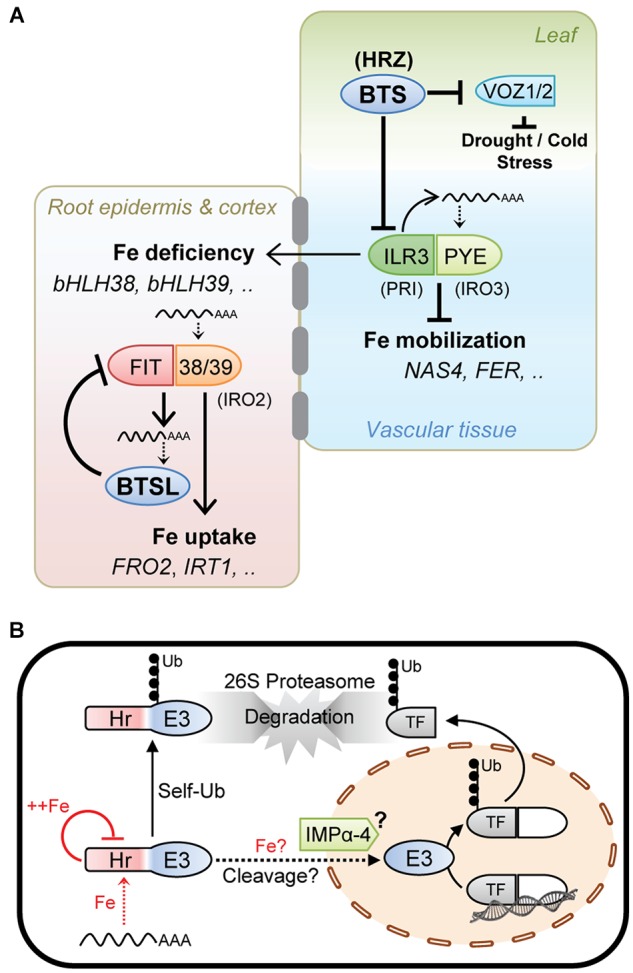
Iron (Fe) is an essential nutrient for plants, but at the same time its redox properties can make it a dangerous toxin inside living cells. Homeostasis between uptake, use and storage of Fe must be maintained at all times. A small family of unique hemerythrin E3 ubiquitin ligases found in green algae and plants play an important role in avoiding toxic Fe overload, acting as negative regulators of Fe homeostasis. Protein interaction data showed that they target specific transcription factors for degradation by the 26S proteasome. It is thought that the activity of the E3 ubiquitin ligases is controlled by Fe binding to the N-terminal hemerythrin motifs. Here, we discuss what we have learned so far from studies on the HRZ (Hemerythrin RING Zinc finger) proteins in rice, the homologous BTS (BRUTUS) and root-specific BTSL (BRUTUS-LIKE) in Arabidopsis. A mechanistic model is proposed to help focus future research questions towards a full understanding of the regulatory role of these proteins in Fe homeostasis in plants.
铁(Fe)是植物必需的营养元素,但同时其氧化还原特性可能使其在活细胞内成为危险毒素。必须始终维持铁吸收、利用和储存之间的平衡。在绿藻和植物中发现的一小类独特的血蓝蛋白E3泛素连接酶在避免铁的毒性过载方面发挥着重要作用,作为铁稳态的负调节因子。蛋白质相互作用数据表明,它们靶向特定转录因子,使其被26S蛋白酶体降解。据认为,E3泛素连接酶的活性受铁与N端血蓝蛋白基序结合的控制。在此,我们讨论目前从对水稻中HRZ(血蓝蛋白RING锌指)蛋白、拟南芥中同源的BTS(BRUTUS)和根特异性BTSL(类BRUTUS)的研究中学到的内容。我们提出了一个机制模型,以帮助将未来的研究问题聚焦于全面理解这些蛋白在植物铁稳态中的调节作用。