Lopes Jaqueline Santos Silva, Machado Aryane Flauzino, Micheletti Jéssica Kirsch, de Almeida Aline Castilho, Cavina Allysiê Priscila, Pastre Carlos Marcelo
University Center of the Araguaia Valley (UNIVAR), Barra do Garças, Brazil; Department of Health Sciences, Faculty of Medicine, Federal University of Mato Grosso, Cuiabá, Brazil.
Department of Physiotherapy, Faculty of Sciences and Technology, São Paulo State University, Presidente Prudente, Brazil.
SAGE Open Med. 2019 Feb 19;7:2050312119831116. doi: 10.1177/2050312119831116. eCollection 2019.
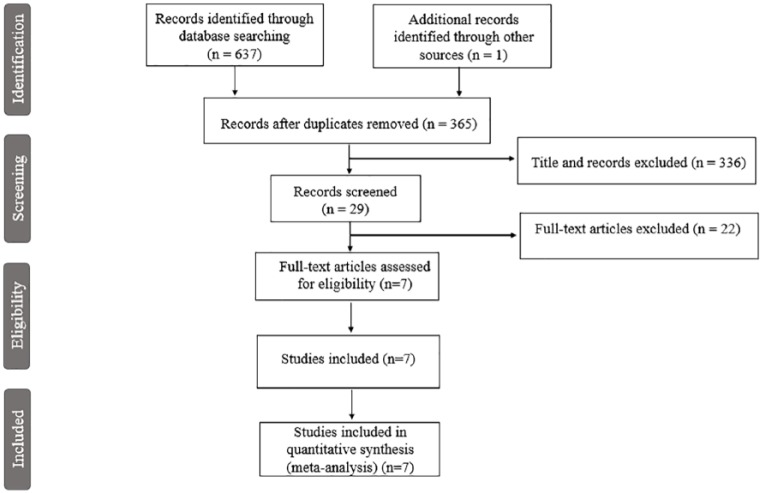
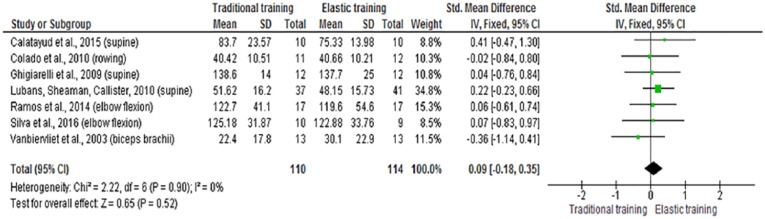
Given the practicality and low cost of using elastic resistance in training for different populations and its effectiveness in a range of outcomes, a comparison with conventional devices could clarify and quantify the benefits provided by both mode. To compare the effects of resistance training with elastic devices (tubes and Thera-Bands) and conventional devices (weight machines and dumbbells) on the outcome muscular strength. A search was performed in the databases PubMed/MEDLINE, EMBASE, PEDro (Physiotherapy Evidence Database), and CENTRAL (Cochrane Central Register of Controlled Trials) from the earliest records up to 20 December 2017. Data were pooled into a meta-analysis and described as standardized mean difference with a 95% confidence interval (registration number: CRD42016042152). Eight studies were included. The results of the meta-analysis demonstrated no superiority between the methods analyzed for lower limb (SMD = -0.11, 95% CI -0.40, 0.19, p = 0.48) or upper limb muscular strength (SMD=0.09; 95% CI -0.18, 0.35; p = 0.52) [corrected]. Elastic resistance training is able to promote similar strength gains to conventional resistance training, in different population profiles and using diverse protocols.
鉴于在不同人群的训练中使用弹力阻力具有实用性且成本较低,并且在一系列结果中都具有有效性,与传统器械进行比较可以阐明并量化两种方式所带来的益处。为了比较使用弹力器械(弹力带和弹力管)和传统器械(力量训练器械和哑铃)进行抗阻训练对肌肉力量这一结果的影响。我们在PubMed/MEDLINE、EMBASE、PEDro(物理治疗证据数据库)和CENTRAL(Cochrane对照试验中心注册库)数据库中进行了检索,检索时间从最早记录到2017年12月20日。数据被汇总进行荟萃分析,并以标准化均数差值及95%置信区间的形式呈现(注册号:CRD42016042152)。纳入了八项研究。荟萃分析结果表明,在分析下肢(标准化均数差值=-0.11,95%置信区间-0.40,0.19,p=0.48)或上肢肌肉力量(标准化均数差值=0.09;95%置信区间-0.18,0.35;p=0.52)[校正后]时,所分析的方法之间不存在优越性。弹力抗阻训练在不同人群和使用不同方案的情况下,能够促进与传统抗阻训练相似的力量增长。