Wang Zhang, Saha Somdutta, Van Horn Stephanie, Thomas Elizabeth, Traini Christopher, Sathe Ganesh, Rajpal Deepak K, Brown James R
Computational Biology Target Sciences GlaxoSmithKline Research and Development (R&D) Collegeville PA USA.
Present address: Solid Biosciences Cambridge MA USA.
Endocrinol Diabetes Metab. 2017 Dec 28;1(1):e00009. doi: 10.1002/edm2.9. eCollection 2018 Jan.
Metformin and glucagon-like peptide-1 (GLP-1) agonists are widely used for treating type two diabetes mellitus (T2DM). While recent studies suggest these drugs might modify the gastrointestinal tract (GIT) microbiome, further confirmation is required from human clinical trials.
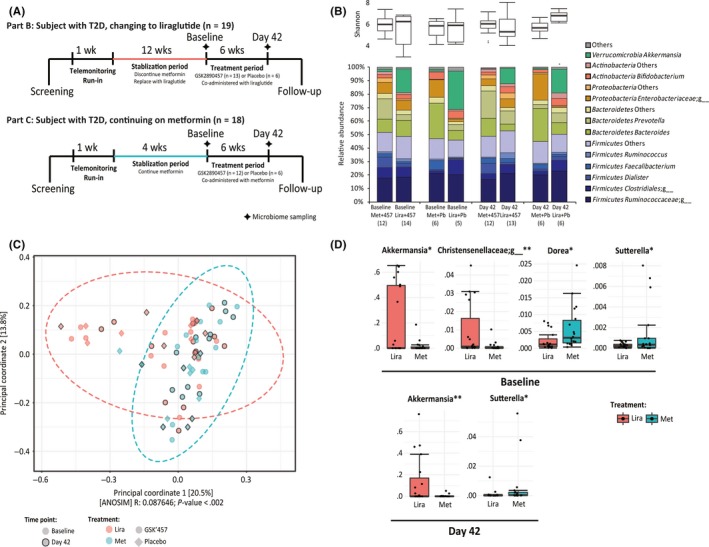
Here, we compare, in patients with T2DM, the effects of metformin (n=18 subjects) and liraglutide (n=19), a GLP-1 agonist, on their GIT microbiomes over a 42 day period (n=74 samples) using 16S ribosomal RNA (rRNA) sequencing.
We found that these drugs had markedly different effects on the microbiome composition. At both baseline and Day 42, subjects taking metformin had a significant increase (Baseline adj. =.038, Day 42 adj. =.041) in the relative abundance of the bacterial genus , whereas liraglutide dosing is associated with a significant increase (Baseline adj. =.048, Day 42 adj. =.003) in the genus , a GIT bacteria positively associated with gut barrier homoeostasis. and relative abundances were also significantly associated with duration of subject diabetes (adj <.05). Specifically, there was a significantly higher abundance of in subjects with short and medium durations than those with long duration of diabetes.
To our knowledge, this is the first report of GLP-1 agonist-associated changes in the human microbiome and its differentiating effects to metformin. Our study suggests that modulation of the GIT microbiome is a potentially important component in the mechanism of action of these drugs.
二甲双胍和胰高血糖素样肽-1(GLP-1)激动剂被广泛用于治疗2型糖尿病(T2DM)。虽然最近的研究表明这些药物可能会改变胃肠道(GIT)微生物群,但仍需要人体临床试验的进一步证实。
在此,我们使用16S核糖体RNA(rRNA)测序,比较了T2DM患者中二甲双胍(n = 18名受试者)和GLP-1激动剂利拉鲁肽(n = 19)在42天内(n = 74个样本)对其GIT微生物群的影响。
我们发现这些药物对微生物群组成有明显不同的影响。在基线和第42天时,服用二甲双胍的受试者细菌属的相对丰度显著增加(基线调整后 =.038,第42天调整后 =.041),而利拉鲁肽给药与属的显著增加相关(基线调整后 =.048,第42天调整后 =.003),该属是一种与肠道屏障稳态呈正相关的GIT细菌。 和 的相对丰度也与受试者糖尿病病程显著相关(调整后 <.05)。具体而言,糖尿病病程短和中等的受试者中 的丰度明显高于病程长的受试者。
据我们所知,这是关于GLP-1激动剂对人类微生物群的相关变化及其与二甲双胍的差异作用的首次报告。我们的研究表明,调节GIT微生物群是这些药物作用机制中一个潜在的重要组成部分。