Helmholtz Zentrum München-German Research Center for Environmental Health, Institute of Computational Biology, Neuherberg, 85764, Germany.
Chair of Mathematical Modeling of Biological Systems, Center for Mathematics, Technische Universität München, Garching, 85748, Germany.
Sci Rep. 2019 Feb 28;9(1):3002. doi: 10.1038/s41598-019-38907-x.
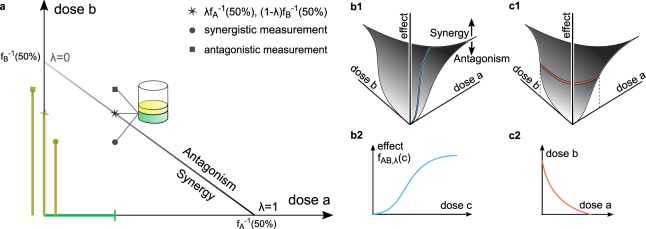
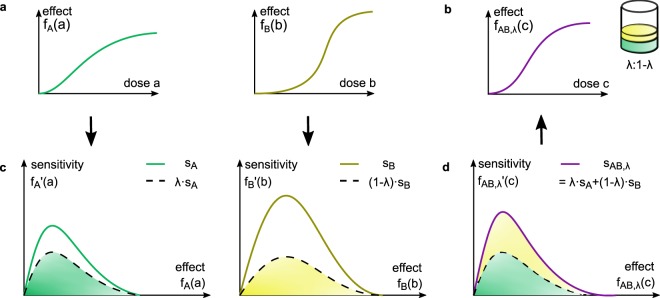
Null models for the effect of combination therapies are widely used to evaluate synergy and antagonism of drugs. Due to the relevance of null models, their suitability is continuously discussed. Here, we contribute to the discussion by investigating the properties of five null models. Our study includes the model proposed by David J. Hand, which we refer to as Hand model. The Hand model has been introduced almost 20 years ago but hardly was used and studied. We show that the Hand model generalizes the principle of dose equivalence compared to the Loewe model and resolves the ambiguity of the Tallarida model. This provides a solution to the persisting conflict about the compatibility of two essential model properties: the sham combination principle and the principle of dose equivalence. By embedding several null models into a common framework, we shed light in their biochemical validity and provide indications that the Hand model is biochemically most plausible. We illustrate the practical implications and differences between null models by examining differences of null models on published data.
组合疗法效果的零模型被广泛用于评估药物的协同作用和拮抗作用。由于零模型的相关性,它们的适用性一直在被讨论。在这里,我们通过研究五个零模型的特性来为讨论做出贡献。我们的研究包括 David J. Hand 提出的模型,我们称之为 Hand 模型。该模型在近 20 年前就被提出了,但几乎没有被使用和研究过。我们证明,与 Loewe 模型相比,Hand 模型推广了剂量等效的原则,并解决了 Tallarida 模型的歧义性。这为两种基本模型特性的兼容性问题提供了一个解决方案:假组合原则和剂量等效原则。通过将几个零模型嵌入到一个通用框架中,我们研究了它们在生化方面的有效性,并指出 Hand 模型在生化上是最合理的。我们通过研究发表数据上零模型之间的差异,阐明了零模型在实际应用中的差异。