Department of Nuclear Medicine, Klinikum rechts der Isar, Technical University Munich, Munich, Germany.
Department of Nuclear Medicine, Graduate School of Medicine of Hokkaido University, Sapporo, Japan.
PLoS One. 2019 Feb 28;14(2):e0213111. doi: 10.1371/journal.pone.0213111. eCollection 2019.
Hypoxia can induce radiation resistance and is an independent prognostic marker for outcome in head and neck cancer. As 18F-FMISO (FMISO), a hypoxia tracer for PET, is far less common than 18F-FDG (FDG) and two separate PET scans result in doubled cost and radiation exposure to the patient, we aimed to predict hypoxia from FDG PET with new techniques of voxel based analysis and texture analysis.
Thirty-eight patients with head-and-neck cancer underwent consecutive FDG and FMISO PET scans before any treatment. ROIs enclosing the primary cancer were compared in a voxel-by-voxel manner between FDG and FMISO PET. Tumour hypoxia was defined as the volume with a tumour-to-muscle ratio (TMR) > 1.25 in the FMISO PET and hypermetabolic volume was defined as >50% SUVmax in the FDG PET. The concordance rate was defined as percentage of voxels within the tumour which were both hypermetabolic and hypoxic. 38 different texture analysis (TA) parameters were computed based on the ROIs and correlated with presence of hypoxia.
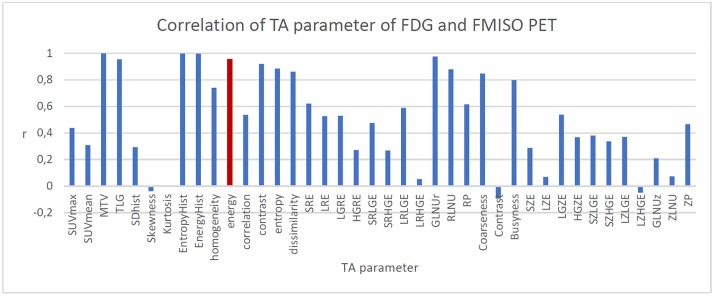
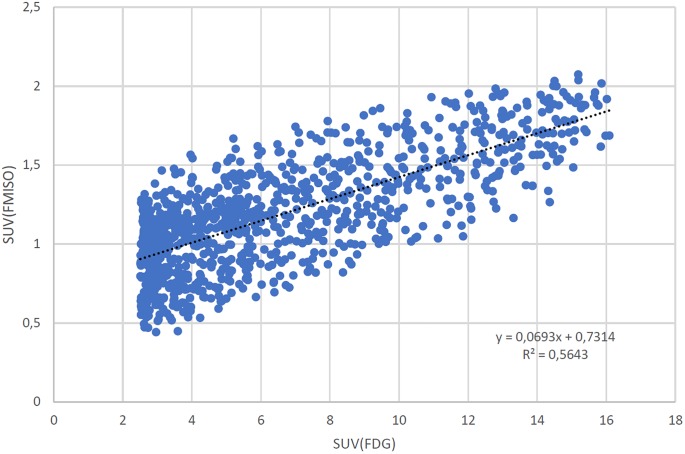
Within the hypoxic tumour regions, the FDG uptake was twice as high as in the non-hypoxic tumour regions (SUVmean 10.9 vs. 5.4; p<0.001). A moderate correlation between FDG and FMISO uptake was found by a voxel-by-voxel comparison (r = 0.664 p<0.001). The average concordance rate was 25% (± 22%). Entropy was the TA parameter showing the highest correlation with hypoxia (r = 0.524 p<0.001).
FDG uptake was higher in hypoxic tumour regions than in non-hypoxic regions as expected by tumour biology. A moderate correlation between FDG and FMISO PET was found by voxel-based analysis. TA yielded similar results in FDG and FMISO PET. However, it may not be possible to predict tumour hypoxia even with the help of texture analysis.
缺氧可诱导辐射抗性,是头颈部癌症预后的独立预测标志物。由于 18F-FMISO(FMISO)作为 PET 的缺氧示踪剂远不如 18F-FDG(FDG)常见,并且两次单独的 PET 扫描会使患者的成本和辐射暴露增加一倍,因此我们旨在通过基于体素的分析和纹理分析的新技术来预测 FDG PET 中的缺氧。
38 例头颈部癌症患者在任何治疗前均接受连续 FDG 和 FMISO PET 扫描。在 FDG 和 FMISO PET 之间以体素为单位比较原发性癌症的 ROI。FMISO PET 中肿瘤与肌肉比值(TMR)>1.25 的肿瘤定义为缺氧,FDG PET 中>50%SUVmax 的肿瘤定义为高代谢。一致性率定义为肿瘤内既是高代谢又是缺氧的体素百分比。基于 ROI 计算了 38 种不同的纹理分析(TA)参数,并与缺氧的存在相关。
在缺氧肿瘤区域内,FDG 摄取量是无缺氧肿瘤区域的两倍(SUVmean 10.9 比 5.4;p<0.001)。通过体素比较发现 FDG 和 FMISO 摄取之间存在中度相关性(r = 0.664,p<0.001)。平均一致性率为 25%(±22%)。熵是与缺氧相关性最高的 TA 参数(r = 0.524,p<0.001)。
正如肿瘤生物学所预期的那样,缺氧肿瘤区域的 FDG 摄取量高于无缺氧区域。通过基于体素的分析发现 FDG 和 FMISO PET 之间存在中度相关性。TA 在 FDG 和 FMISO PET 中均产生相似的结果。然而,即使借助纹理分析,也可能无法预测肿瘤缺氧。