• 文献检索
  • 文档翻译
  • 深度研究
  • 学术资讯
  • Suppr Zotero 插件Zotero 插件
  • 邀请有礼
  • 套餐&价格
  • 历史记录
应用&插件
Suppr Zotero 插件Zotero 插件浏览器插件Mac 客户端Windows 客户端微信小程序
定价
高级版会员购买积分包购买API积分包
服务
文献检索文档翻译深度研究API 文档MCP 服务
关于我们
关于 Suppr公司介绍联系我们用户协议隐私条款
关注我们

Suppr 超能文献

核心技术专利:CN118964589B侵权必究
粤ICP备2023148730 号-1Suppr @ 2026

文献检索

告别复杂PubMed语法,用中文像聊天一样搜索,搜遍4000万医学文献。AI智能推荐,让科研检索更轻松。

立即免费搜索

文件翻译

保留排版,准确专业,支持PDF/Word/PPT等文件格式,支持 12+语言互译。

免费翻译文档

深度研究

AI帮你快速写综述,25分钟生成高质量综述,智能提取关键信息,辅助科研写作。

立即免费体验

阳离子壳聚糖-蜂胶纳米粒子通过调节基因表达改变表皮葡萄球菌的 ζ 电位,抑制生物膜形成,并与抗生素表现出协同作用。

Cationic chitosan-propolis nanoparticles alter the zeta potential of S. epidermidis, inhibit biofilm formation by modulating gene expression and exhibit synergism with antibiotics.

机构信息

School of Postgraduate Studies, International Medical University, Kuala Lumpur, Malaysia.

Division of Applied Biomedical Sciences and Biotechnology, School of Health Sciences, International Medical University, Kuala Lumpur, Malaysia.

出版信息

PLoS One. 2019 Feb 28;14(2):e0213079. doi: 10.1371/journal.pone.0213079. eCollection 2019.

DOI:10.1371/journal.pone.0213079
PMID:30818374
原文链接:https://pmc.ncbi.nlm.nih.gov/articles/PMC6394969/
Abstract

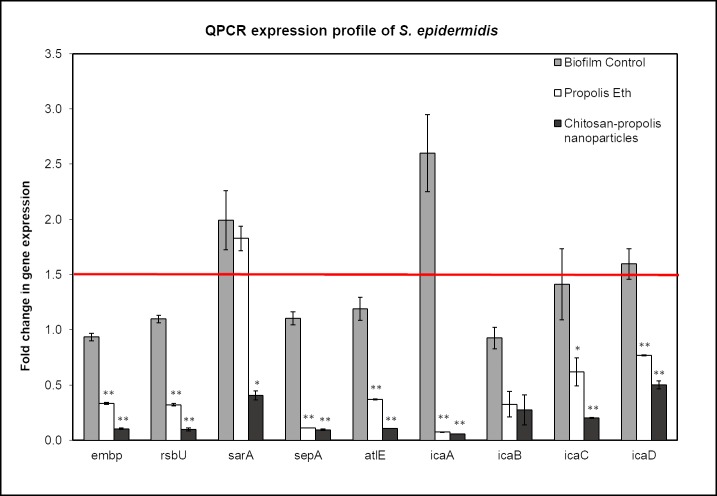
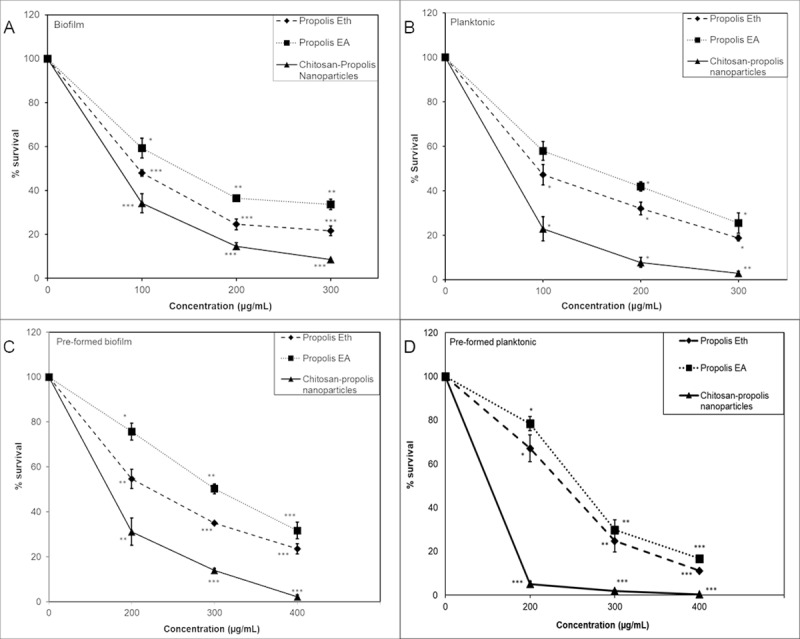
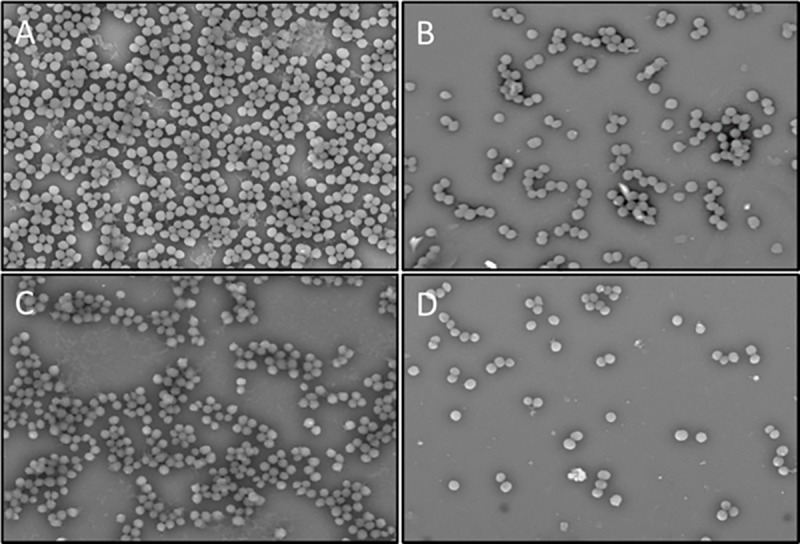
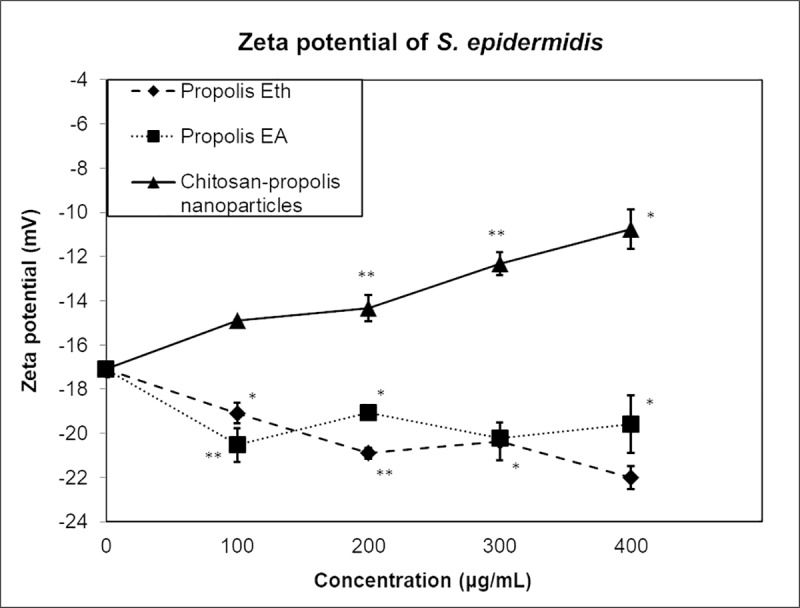
Staphylococcus epidermidis, is a common microflora of human body that can cause opportunistic infections associated with indwelling devices. It is resistant to multiple antibiotics necessitating the need for naturally occurring antibacterial agents. Malaysian propolis, a natural product obtained from beehives exhibits antimicrobial and antibiofilm properties. Chitosan-propolis nanoparticles (CPNP) were prepared using Malaysian propolis and tested for their effect against S. epidermidis. The cationic nanoparticles depicted a zeta potential of +40 and increased the net electric charge (zeta potential) of S. epidermidis from -17 to -11 mV in a concentration-dependent manner whereas, ethanol (Eth) and ethyl acetate (EA) extracts of propolis further decreased the zeta potential from -17 to -20 mV. Confocal laser scanning microscopy (CLSM) depicted that CPNP effectively disrupted biofilm formation by S. epidermidis and decreased viability to ~25% compared to Eth and EA with viability of ~60-70%. CPNP was more effective in reducing the viability of both planktonic as well as biofilm bacteria compared to Eth and EA. At 100 μg/mL concentration, CPNP decreased the survival of biofilm bacteria by ~70% compared to Eth or EA extracts which decreased viability by only 40%-50%. The morphology of bacterial biofilm examined by scanning electron microscopy depicted partial disruption of biofilm by Eth and EA extracts and significant disruption by CPNP reducing bacterial number in the biofilm by ~90%. Real time quantitative PCR analysis of gene expression in treated bacteria showed that genes involved in intercellular adhesion such as IcaABCD, embp and other related genes were significantly downregulated by CPNP. In addition to having a direct inhibitory effect on the survival of S. epidermidis, CPNP showed synergism with the antibiotics rifampicin, ciprofloxacin, vancomycin and doxycycline suggestive of effective treatment regimens. This would help decrease antibiotic treatment dose by at least 4-fold in combination therapies thereby opening up ways of tackling antibiotic resistance in bacteria.

摘要

表皮葡萄球菌是人体常见的微生物菌群,可引起与留置装置相关的机会性感染。它对多种抗生素具有耐药性,因此需要使用天然存在的抗菌剂。马来西亚蜂胶是一种从蜂巢中提取的天然产物,具有抗菌和抗生物膜特性。壳聚糖-蜂胶纳米粒子(CPNP)是用马来西亚蜂胶制备的,并测试其对表皮葡萄球菌的作用。阳离子纳米粒子的表面电位为+40,并以浓度依赖的方式将表皮葡萄球菌的净电荷(表面电位)从-17 增加到-11 mV,而蜂胶的乙醇(Eth)和乙酸乙酯(EA)提取物则进一步将表面电位从-17 降低到-20 mV。共聚焦激光扫描显微镜(CLSM)显示,CPNP 可有效破坏表皮葡萄球菌生物膜的形成,并使细胞活力降低至约 25%,而 Eth 和 EA 则使细胞活力降低至约 60-70%。与 Eth 和 EA 相比,CPNP 更有效地降低浮游和生物膜细菌的活力。在 100 μg/mL 浓度下,CPNP 使生物膜细菌的存活率降低了约 70%,而 Eth 或 EA 提取物仅降低了 40%-50%的存活率。扫描电子显微镜检查细菌生物膜的形态显示,Eth 和 EA 提取物部分破坏了生物膜,而 CPNP 则显著破坏了生物膜,使生物膜中的细菌数量减少了约 90%。用处理过的细菌进行实时定量 PCR 分析基因表达显示,细胞间黏附相关基因如 IcaABCD、embp 和其他相关基因的表达显著下调。CPNP 不仅对表皮葡萄球菌的存活有直接抑制作用,还与抗生素利福平、环丙沙星、万古霉素和强力霉素表现出协同作用,提示有效的治疗方案。这将有助于在联合治疗中至少将抗生素治疗剂量减少 4 倍,从而为解决细菌的抗生素耐药性开辟途径。
https://cdn.ncbi.nlm.nih.gov/pmc/blobs/1a8a/6394969/852f320bf3f7/pone.0213079.g005.jpg
https://cdn.ncbi.nlm.nih.gov/pmc/blobs/1a8a/6394969/edcae8af7cfc/pone.0213079.g001.jpg
https://cdn.ncbi.nlm.nih.gov/pmc/blobs/1a8a/6394969/056de6c895f6/pone.0213079.g002.jpg
https://cdn.ncbi.nlm.nih.gov/pmc/blobs/1a8a/6394969/4bc79ab0487e/pone.0213079.g003.jpg
https://cdn.ncbi.nlm.nih.gov/pmc/blobs/1a8a/6394969/145de22bc359/pone.0213079.g004.jpg
https://cdn.ncbi.nlm.nih.gov/pmc/blobs/1a8a/6394969/852f320bf3f7/pone.0213079.g005.jpg
https://cdn.ncbi.nlm.nih.gov/pmc/blobs/1a8a/6394969/edcae8af7cfc/pone.0213079.g001.jpg
https://cdn.ncbi.nlm.nih.gov/pmc/blobs/1a8a/6394969/056de6c895f6/pone.0213079.g002.jpg
https://cdn.ncbi.nlm.nih.gov/pmc/blobs/1a8a/6394969/4bc79ab0487e/pone.0213079.g003.jpg
https://cdn.ncbi.nlm.nih.gov/pmc/blobs/1a8a/6394969/145de22bc359/pone.0213079.g004.jpg
https://cdn.ncbi.nlm.nih.gov/pmc/blobs/1a8a/6394969/852f320bf3f7/pone.0213079.g005.jpg

相似文献

1
Cationic chitosan-propolis nanoparticles alter the zeta potential of S. epidermidis, inhibit biofilm formation by modulating gene expression and exhibit synergism with antibiotics.阳离子壳聚糖-蜂胶纳米粒子通过调节基因表达改变表皮葡萄球菌的 ζ 电位,抑制生物膜形成,并与抗生素表现出协同作用。
PLoS One. 2019 Feb 28;14(2):e0213079. doi: 10.1371/journal.pone.0213079. eCollection 2019.
2
Chitosan-propolis nanoparticle formulation demonstrates anti-bacterial activity against Enterococcus faecalis biofilms.壳聚糖-蜂胶纳米颗粒制剂对粪肠球菌生物膜具有抗菌活性。
PLoS One. 2017 Mar 31;12(3):e0174888. doi: 10.1371/journal.pone.0174888. eCollection 2017.
3
Anti-Biofilm Perspectives of Propolis against Infections.蜂胶对抗感染的抗生物膜作用。
Biomolecules. 2024 Jun 29;14(7):779. doi: 10.3390/biom14070779.
4
The use of quaternised chitosan-loaded PMMA to inhibit biofilm formation and downregulate the virulence-associated gene expression of antibiotic-resistant staphylococcus.使用季铵化壳聚糖负载 PMMA 抑制生物膜形成并下调抗生素耐药葡萄球菌的毒力相关基因表达。
Biomaterials. 2012 Jan;33(2):365-77. doi: 10.1016/j.biomaterials.2011.09.084. Epub 2011 Oct 20.
5
Confocal laser scanning microscopy analysis of S. epidermidis biofilms exposed to farnesol, vancomycin and rifampicin.对暴露于法尼醇、万古霉素和利福平的表皮葡萄球菌生物膜进行共聚焦激光扫描显微镜分析。
BMC Res Notes. 2012 May 16;5:244. doi: 10.1186/1756-0500-5-244.
6
Effect of cinnamon oil on icaA expression and biofilm formation by Staphylococcus epidermidis.肉桂油对表皮葡萄球菌icaA 表达和生物膜形成的影响。
Appl Environ Microbiol. 2009 Nov;75(21):6850-5. doi: 10.1128/AEM.00875-09. Epub 2009 Sep 11.
7
Chitosan propolis nanocomposite alone or in combination with apramycin: an alternative therapy for multidrug-resistant in rabbits: and study.壳聚糖蜂胶纳米复合材料单独或联合应用阿普拉霉素治疗兔多药耐药性 : 与 研究。
J Med Microbiol. 2021 Oct;70(10). doi: 10.1099/jmm.0.001412.
8
The effect of nanoliposomal formulations on Staphylococcus epidermidis biofilm.纳米脂质体制剂对表皮葡萄球菌生物膜的影响。
Drug Dev Ind Pharm. 2015 Mar;41(3):445-50. doi: 10.3109/03639045.2013.877483. Epub 2014 Jan 10.
9
Sub-inhibitory tigecycline concentrations induce extracellular matrix binding protein Embp dependent Staphylococcus epidermidis biofilm formation and immune evasion.亚抑菌浓度的替加环素可诱导细胞外基质结合蛋白Embp依赖性的表皮葡萄球菌生物膜形成和免疫逃逸。
Int J Med Microbiol. 2016 Sep;306(6):471-8. doi: 10.1016/j.ijmm.2016.05.015. Epub 2016 May 25.
10
Antibacterial and anti-biofilm activities of cinnamaldehyde against S. epidermidis.肉桂醛对表皮葡萄球菌的抗菌和抗生物膜活性。
Microb Pathog. 2019 Jan;126:231-238. doi: 10.1016/j.micpath.2018.11.009. Epub 2018 Nov 12.

引用本文的文献

1
Anti-bacterial Properties of Propolis: A Comprehensive Review.蜂胶的抗菌特性:全面综述
Curr Microbiol. 2025 Aug 26;82(10):479. doi: 10.1007/s00284-025-04456-y.
2
Employing diclofenac sodium as a novel therapeutic frontier for Staphylococcus epidermidis infections.将双氯芬酸钠用作治疗表皮葡萄球菌感染的新前沿疗法。
Sci Rep. 2025 Aug 26;15(1):31377. doi: 10.1038/s41598-025-14316-1.
3
Cell wall polysaccharide alters the surface electric potential of strain Shirota and enhances acid tolerance.细胞壁多糖改变了嗜热栖热放线菌的表面电势并增强了其耐酸性。

本文引用的文献

1
Genomic and Transcriptomic Insights into How Bacteria Withstand High Concentrations of Benzalkonium Chloride Biocides.关于细菌如何耐受高浓度苯扎氯铵消毒剂的基因组和转录组研究进展。
Appl Environ Microbiol. 2018 May 31;84(12). doi: 10.1128/AEM.00197-18. Print 2018 Jun 15.
2
Determination of the spatiotemporal dependence of biofilm viability after treatment with NLC-colistin.NLC-黏菌素处理后生物膜活力的时空依赖性测定
Int J Nanomedicine. 2017 Jun 12;12:4409-4413. doi: 10.2147/IJN.S138763. eCollection 2017.
3
Chitosan-propolis nanoparticle formulation demonstrates anti-bacterial activity against Enterococcus faecalis biofilms.
Curr Res Microb Sci. 2025 Jun 26;9:100430. doi: 10.1016/j.crmicr.2025.100430. eCollection 2025.
4
Applications of Chitosan in Prevention and Treatment Strategies of Infectious Diseases.壳聚糖在传染病防治策略中的应用
Pharmaceutics. 2024 Sep 13;16(9):1201. doi: 10.3390/pharmaceutics16091201.
5
Antibacterial Activity of Novel Agent N-2-Hydroxypropyl Trimethyl Ammonium Chloride Chitosan against .新型 N-2-羟丙基三甲基氯化铵壳聚糖对. 的抗菌活性
Molecules. 2024 Aug 30;29(17):4126. doi: 10.3390/molecules29174126.
6
Anti-Biofilm Perspectives of Propolis against Infections.蜂胶对抗感染的抗生物膜作用。
Biomolecules. 2024 Jun 29;14(7):779. doi: 10.3390/biom14070779.
7
Antibacterial Effects of Various Types of Bee Products in Malaysia: A Systematic Review.马来西亚各类蜂产品的抗菌作用:一项系统综述
Malays J Med Sci. 2024 Jun;31(3):32-51. doi: 10.21315/mjms2024.31.3.3. Epub 2024 Jun 27.
8
Nanoparticles of CsWO as Antibiofilm Agents and Photothermal Treatment to Inhibit Biofilm Formation.作为抗生物膜剂及用于抑制生物膜形成的光热处理的钨酸铯纳米颗粒。
ACS Omega. 2024 Jun 18;9(26):28144-28154. doi: 10.1021/acsomega.4c01212. eCollection 2024 Jul 2.
9
Targeting bacterial biofilm-related genes with nanoparticle-based strategies.利用基于纳米颗粒的策略靶向细菌生物膜相关基因。
Front Microbiol. 2024 May 22;15:1387114. doi: 10.3389/fmicb.2024.1387114. eCollection 2024.
10
Encapsulation of propolis extracted with methylal in the chitosan nanoparticles and its antibacterial and cell cytotoxicity studies.用甲醇提取的蜂胶包封在壳聚糖纳米粒子中及其抗菌和细胞细胞毒性研究。
BMC Complement Med Ther. 2024 Apr 19;24(1):165. doi: 10.1186/s12906-024-04472-8.
壳聚糖-蜂胶纳米颗粒制剂对粪肠球菌生物膜具有抗菌活性。
PLoS One. 2017 Mar 31;12(3):e0174888. doi: 10.1371/journal.pone.0174888. eCollection 2017.
4
Studies on the therapeutic effect of propolis along with standard antibacterial drug in Salmonella enterica serovar Typhimurium infected BALB/c mice.蜂胶与标准抗菌药物联用对鼠伤寒沙门氏菌感染的BALB/c小鼠治疗效果的研究。
BMC Complement Altern Med. 2016 Nov 25;16(1):485. doi: 10.1186/s12906-016-1474-5.
5
Propolis, A Hope for the Future in Treating Resistant Periodontal Pathogens.蜂胶,治疗耐药性牙周病原体的未来希望。
Cureus. 2016 Jul 12;8(7):e682. doi: 10.7759/cureus.682.
6
Antiviral Activity of Hatay Propolis Against Replication of Herpes Simplex Virus Type 1 and Type 2.哈塔伊蜂胶对1型和2型单纯疱疹病毒复制的抗病毒活性
Med Sci Monit. 2016 Feb 9;22:422-30. doi: 10.12659/msm.897282.
7
Alteration of Zeta potential and membrane permeability in bacteria: a study with cationic agents.细菌中ζ电位和膜通透性的改变:阳离子试剂研究
Springerplus. 2015 Nov 4;4:672. doi: 10.1186/s40064-015-1476-7. eCollection 2015.
8
Antibacterial Activity, Antioxidant Effect and Chemical Composition of Propolis from the Región del Maule, Central Chile.智利中部马乌莱地区蜂胶的抗菌活性、抗氧化作用及化学成分
Molecules. 2015 Oct 6;20(10):18144-67. doi: 10.3390/molecules201018144.
9
The effects of interfacial potential on antimicrobial propensity of ZnO nanoparticle.界面电位对氧化锌纳米颗粒抗菌倾向的影响。
Sci Rep. 2015 Apr 15;5:9578. doi: 10.1038/srep09578.
10
In vitro evaluation of the acquisition of resistance, antifungal activity and synergism of Brazilian red propolis with antifungal drugs on Candida spp.巴西红蜂胶对念珠菌属的耐药性获得、抗真菌活性及与抗真菌药物协同作用的体外评价
J Appl Microbiol. 2015 Apr;118(4):839-50. doi: 10.1111/jam.12746. Epub 2015 Feb 4.