Duke Clinical Research Institute, Duke University School of Medicine, Durham, North Carolina; Mazankowski Alberta Heart Institute, University of Alberta, Edmonton, Alberta, Canada; Division of Cardiology, Stanford University, Palo Alto, California.
Duke Clinical Research Institute, Duke University School of Medicine, Durham, North Carolina.
J Am Coll Cardiol. 2019 Mar 5;73(8):893-902. doi: 10.1016/j.jacc.2018.11.056.
The optimal noninvasive test (NIT) for patients with diabetes and stable symptoms of coronary artery disease (CAD) is unknown.
The purpose of this study was to assess whether a diagnostic strategy based on coronary computed tomographic angiography (CTA) is superior to functional stress testing in reducing adverse cardiovascular (CV) outcomes (CV death or myocardial infarction [MI]) among symptomatic patients with diabetes.
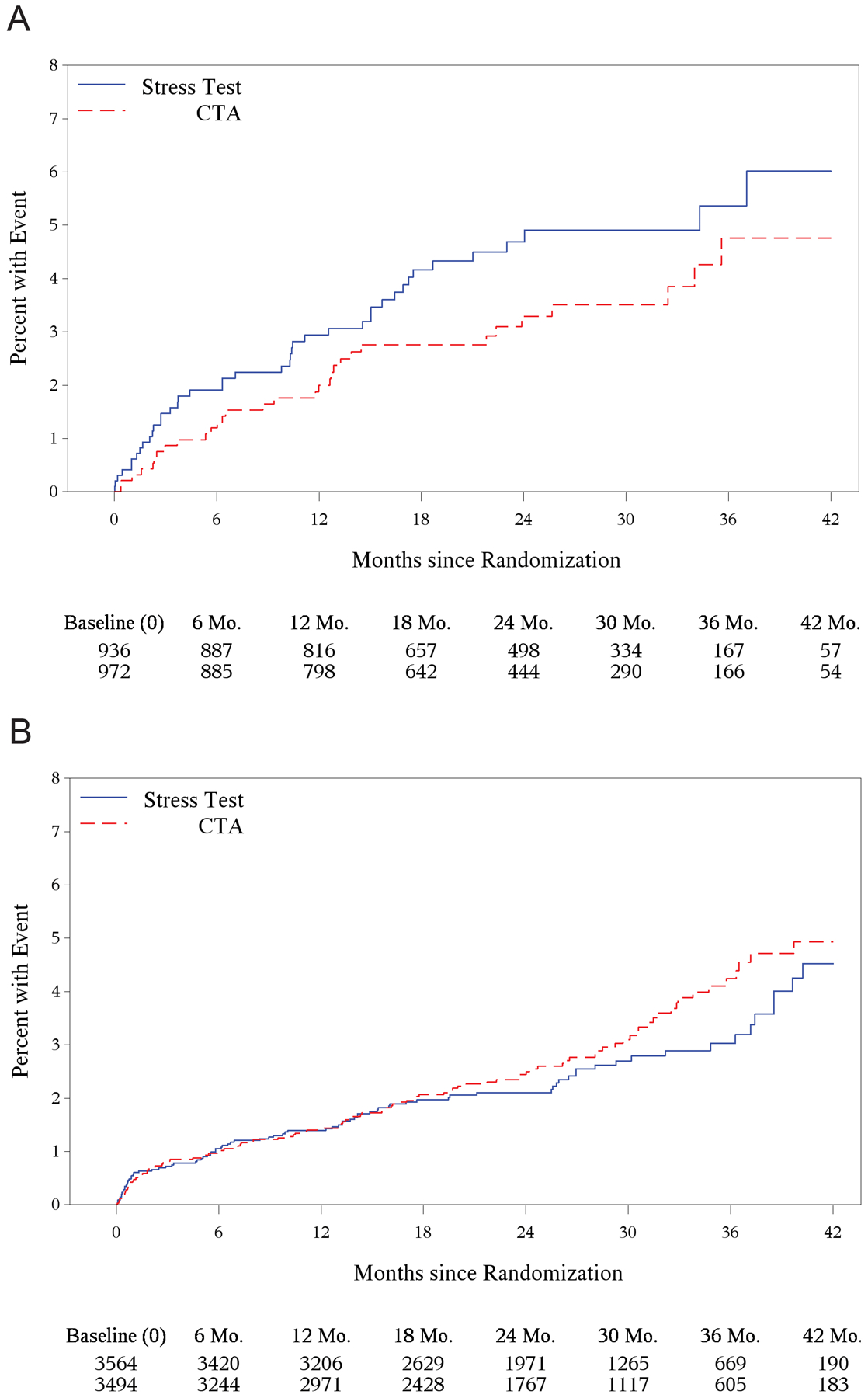
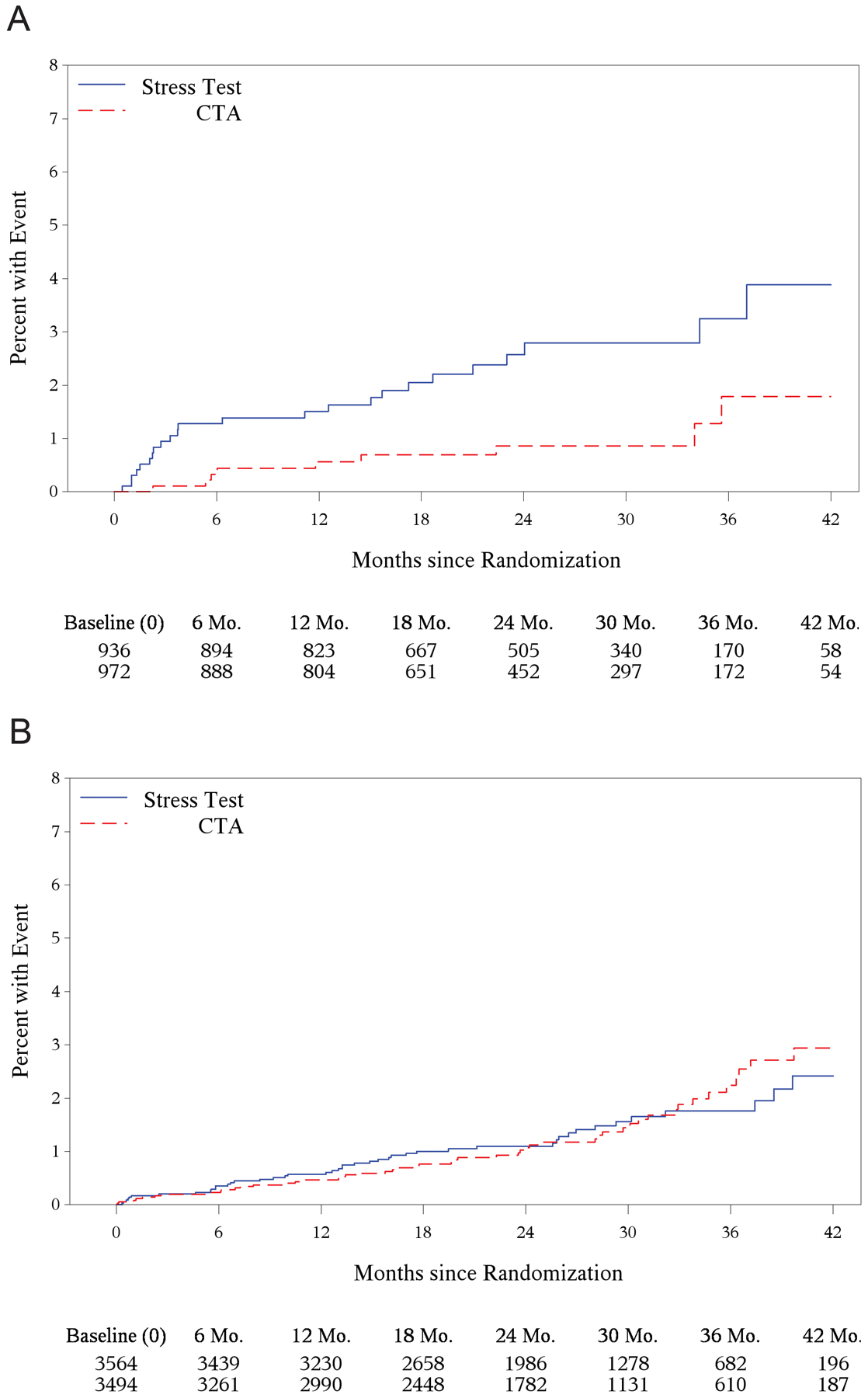
PROMISE (Prospective Multicenter Imaging Study for Evaluation of Chest Pain) was a randomized trial evaluating an initial strategy of CTA versus functional testing in stable outpatients with symptoms suggestive of CAD. The study compared CV outcomes in patients with diabetes (n = 1,908 [21%]) and without diabetes (n = 7,058 [79%]) based on their randomization to CTA or functional testing.
Patients with diabetes (vs. without) were similar in age (median 61 years vs. 60 years) and sex (female 54% vs. 52%) but had a greater burden of CV comorbidities. Patients with diabetes who underwent CTA had a lower risk of CV death/MI compared with functional stress testing (CTA: 1.1% [10 of 936] vs. stress testing: 2.6% [25 of 972]; adjusted hazard ratio: 0.38; 95% confidence interval: 0.18 to 0.79; p = 0.01). There was no significant difference in nondiabetic patients (CTA: 1.4% [50 of 3,564] vs. stress testing: 1.3% [45 of 3,494]; adjusted hazard ratio: 1.03; 95% confidence interval: 0.69 to 1.54; p = 0.887; interaction term for diabetes p value = 0.02).
In diabetic patients presenting with stable chest pain, a CTA strategy resulted in fewer adverse CV outcomes than a functional testing strategy. CTA may be considered as the initial diagnostic strategy in this subgroup. (PROspective Multicenter Imaging Study for Evaluation of Chest Pain [PROMISE]; NCT01174550).
患有糖尿病且稳定型冠状动脉疾病(CAD)症状的患者,最佳的非侵入性检测(NIT)方法仍不清楚。
本研究旨在评估基于冠状动脉计算机断层扫描血管造影(CTA)的诊断策略是否优于功能压力测试,以降低有症状的糖尿病患者不良心血管(CV)结局(CV 死亡或心肌梗死[MI])。
PROMISE(多中心前瞻性影像学胸痛评估研究)是一项随机试验,评估了在稳定的门诊 CAD 疑似患者中,CTA 与功能测试的初始策略。该研究比较了糖尿病患者(n=1908[21%])和非糖尿病患者(n=7058[79%])根据随机接受 CTA 或功能测试的 CV 结局。
糖尿病患者(vs. 非糖尿病患者)在年龄(中位数 61 岁 vs. 60 岁)和性别(女性 54% vs. 52%)方面相似,但 CV 合并症负担更大。接受 CTA 的糖尿病患者与接受功能压力测试的患者相比,CV 死亡/MI 的风险较低(CTA:1.1%[936 例中的 10 例] vs. 压力测试:2.6%[972 例中的 25 例];调整后的危险比:0.38;95%置信区间:0.18 至 0.79;p=0.01)。非糖尿病患者中没有显著差异(CTA:1.4%[3564 例中的 50 例] vs. 压力测试:1.3%[3494 例中的 45 例];调整后的危险比:1.03;95%置信区间:0.69 至 1.54;p=0.887;糖尿病交互项 p 值=0.02)。
在稳定型胸痛的糖尿病患者中,CTA 策略的不良 CV 结局少于功能测试策略。CTA 可考虑作为该亚组的初始诊断策略。(多中心前瞻性影像学胸痛评估研究[PROMISE];NCT01174550)。