Population Health Research Group, South Australian Health and Medical Research Institute, Adelaide, South Australia, Australia.
School of Psychology, The University of Adelaide, Adelaide, South Australia, Australia.
BMJ Open. 2019 Feb 27;9(2):e023630. doi: 10.1136/bmjopen-2018-023630.
Sugar-sweetened beverage (SSB) consumption in Australian Aboriginal and Torres Strait Islander people is reported to be disproportionally high compared with the general Australian population. This review aimed to scope the literature documenting SSB consumption and interventions to reduce SSB consumption among Australian Aboriginal and Torres Strait Islander people. Findings will inform strategies to address SSB consumption in Aboriginal and Torres Strait Islander communities.
PubMed, SCOPUS, CINAHL, Informit, Joanna Briggs Institute EBP, Mura databases and grey literature were searched for articles published between January 1980 and June 2018. Studies were included if providing data specific to an Australian Aboriginal and/or Torres Strait Islander population's SSB consumption or an intervention that focused on reducing SSB consumption in this population.
Systematic scoping review.
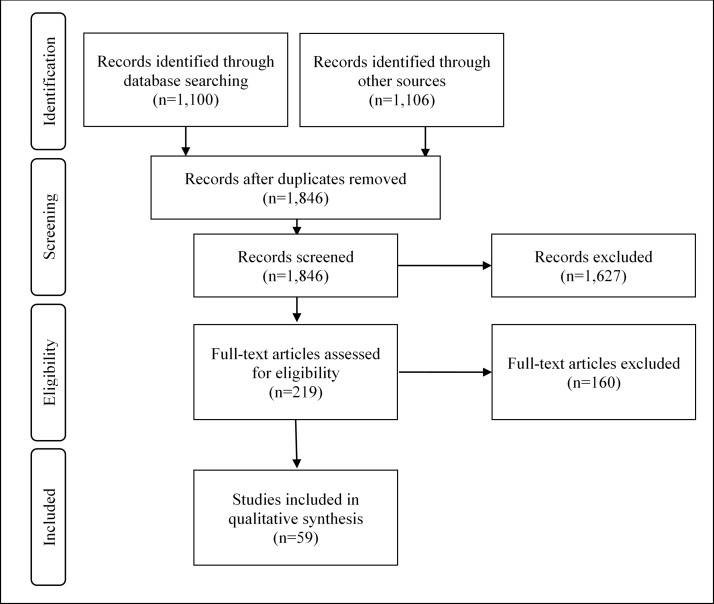
59 articles were included (1846 screened). While reported SSB consumption was high, there were age-related and community-related differences observed in some studies. Most studies were conducted in remote or rural settings. Implementation of nutrition interventions that included an SSB component has built progressively in remote communities since the 1980s with a growing focus on community-driven, culturally sensitive approaches. More recent studies have focused exclusively on SSB consumption. Key SSB-related intervention elements included incentivising healthier options; reducing availability of less-healthy options; nutrition education; multifaceted or policy implementation (store nutrition or government policy).
There was a relatively large number of studies reporting data on SSB consumption and/or sales, predominantly from remote and rural settings. During analysis it was subjectively clear that the more impactful studies were those which were community driven or involved extensive community consultation and collaboration. Extracting additional SSB-specific consumption data from an existing nationally representative survey of Aboriginal and Torres Strait Islander people could provide detailed information for demographic subgroups and benchmarks for future interventions. It is recommended that a consistent, culturally appropriate, set of consumption measures be developed.
据报道,与澳大利亚普通人群相比,澳大利亚原住民和托雷斯海峡岛民的含糖饮料(SSB)消费不成比例地高。本综述旨在概述记录 SSB 消费和减少澳大利亚原住民和托雷斯海峡岛民 SSB 消费的干预措施的文献。研究结果将为解决原住民和托雷斯海峡岛民社区的 SSB 消费问题提供策略。
在 1980 年 1 月至 2018 年 6 月期间,检索了 PubMed、SCOPUS、CINAHL、Informit、 Joanna Briggs Institute EBP、Mura 数据库和灰色文献,以获取针对澳大利亚原住民和/或托雷斯海峡岛民 SSB 消费或专注于减少该人群 SSB 消费的干预措施的文章。
系统范围审查。
纳入 59 篇文章(筛选出 1846 篇)。虽然报告的 SSB 消费很高,但在一些研究中观察到了与年龄和社区相关的差异。大多数研究在偏远或农村地区进行。自 20 世纪 80 年代以来,在偏远社区中逐步实施了包括 SSB 成分的营养干预措施,越来越注重社区驱动、文化敏感的方法。最近的研究则专门关注 SSB 消费。关键的 SSB 相关干预要素包括激励更健康的选择;减少较不健康选择的供应;营养教育;多方面或政策实施(商店营养或政府政策)。
有相当数量的研究报告了 SSB 消费和/或销售数据,主要来自偏远和农村地区。在分析过程中,从主观上可以清楚地看出,更有影响力的研究是那些由社区驱动或涉及广泛社区咨询和合作的研究。从现有的澳大利亚原住民和托雷斯海峡岛民全国代表性调查中提取额外的 SSB 特定消费数据,可以为人口统计子组提供详细信息,并为未来的干预措施提供基准。建议制定一套一致的、文化适宜的消费措施。