Department of Cell Biology & Anatomy, Arnie Charbonneau Cancer Institute, University of Calgary, Calgary, AB, Canada.
Department of Marine Biotechnology, Gangneung-Wonju National University, Gangneung, South Korea; and.
Blood. 2019 May 16;133(20):2222-2232. doi: 10.1182/blood-2018-12-890236. Epub 2019 Feb 28.
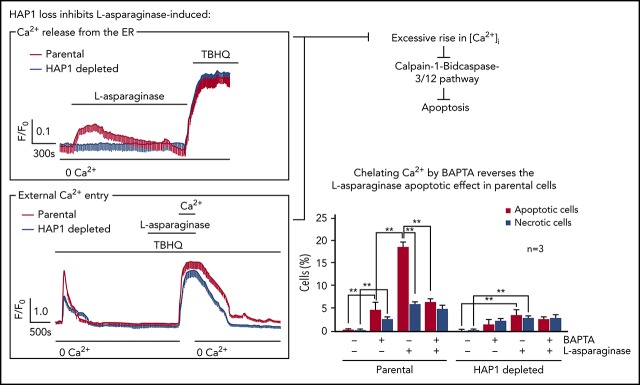
l-Asparaginase (l-ASNase) is a strategic component of treatment protocols for acute lymphoblastic leukemia (ALL). It causes asparagine deficit, resulting in protein synthesis inhibition and subsequent leukemic cell death and ALL remission. However, patients often relapse because of the development of resistance, but the underlying mechanism of ALL cell resistance to l-asparaginase remains unknown. Through unbiased genome-wide RNA interference screening, we identified huntingtin associated protein 1 () as an ALL biomarker for l-asparaginase resistance. Knocking down HAP1 induces l-asparaginase resistance. HAP1 interacts with huntingtin and the intracellular Ca channel, inositol 1,4,5-triphosphate receptor to form a ternary complex that mediates endoplasmic reticulum (ER) Ca release upon stimulation with inositol 1,4,5-triphosphate Loss of HAP1 prevents the formation of the ternary complex and thus l-asparaginase-mediated ER Ca release. HAP1 loss also inhibits external Ca entry, blocking an excessive rise in [Ca], and reduces activation of the Ca-dependent calpain-1, Bid, and caspase-3 and caspase-12, leading to reduced number of apoptotic cells. These findings indicate that HAP1 loss prevents l-asparaginase-induced apoptosis through downregulation of the Ca-mediated calpain-1-Bid-caspase-3/12 apoptotic pathway. Treatment with BAPTA-AM [1,2-bis(2-aminophenoxy)ethane-','-tetraacetic acid tetrakis(acetoxymethyl ester)] reverses the l-asparaginase apoptotic effect in control cells, supporting a link between l-asparaginase-induced [Ca] increase and apoptotic cell death. Consistent with these findings, ALL patient leukemic cells with lower HAP1 levels showed resistance to l-asparaginase, indicating the clinical relevance of HAP1 loss in the development of l-asparaginase resistance, and pointing to as a functional l-asparaginase resistance biomarker that may be used for the design of effective treatment of l-asparaginase-resistant ALL.
L-天冬酰胺酶(l-ASNase)是急性淋巴细胞白血病(ALL)治疗方案的重要组成部分。它导致天冬酰胺缺乏,从而抑制蛋白质合成,导致白血病细胞死亡和 ALL 缓解。然而,患者经常会因耐药性的发展而复发,但 ALL 细胞对 l-天冬酰胺酶耐药的潜在机制尚不清楚。通过无偏见的全基因组 RNA 干扰筛选,我们发现亨廷顿蛋白结合蛋白 1()是 l-天冬酰胺酶耐药的 ALL 生物标志物。敲低 HAP1 可诱导 l-天冬酰胺酶耐药。HAP1 与亨廷顿蛋白和细胞内 Ca 通道相互作用,形成三元复合物,在受到肌醇 1,4,5-三磷酸刺激时介导内质网(ER)Ca 释放。HAP1 的缺失阻止了三元复合物的形成,从而阻止了 l-天冬酰胺酶介导的 ER Ca 释放。HAP1 的缺失还抑制了外源性 Ca 内流,阻止了[Ca]的过度升高,并减少了 Ca 依赖性钙蛋白酶-1、Bid 和 caspase-3 和 caspase-12 的激活,从而减少了凋亡细胞的数量。这些发现表明,HAP1 的缺失通过下调 Ca 介导的钙蛋白酶-1-Bid-caspase-3/12 凋亡途径来阻止 l-天冬酰胺酶诱导的细胞凋亡。用 BAPTA-AM [1,2-双(2-氨基苯氧基)乙烷-N,N,N',N'-四乙酸四(乙酰氧甲酯)]处理可逆转对照细胞中 l-天冬酰胺酶的凋亡作用,支持 l-天冬酰胺酶诱导的[Ca]增加与凋亡细胞死亡之间的联系。与这些发现一致的是,HAP1 水平较低的 ALL 患者白血病细胞对 l-天冬酰胺酶耐药,表明 HAP1 缺失在 l-天冬酰胺酶耐药发展中的临床相关性,并指出作为一种功能性 l-天冬酰胺酶耐药生物标志物,可用于设计有效的 l-天冬酰胺酶耐药 ALL 治疗。