Choi Jung-In, Kim Jun, Choung Se-Young
College of Pharmacy, Kyung Hee University, Kyung Hee University, Dongdaemun-gu, Seoul, Korea.
Department of Life and Nanopharmaceutical Sciences, Graduate School, Kyung Hee University, Dongdaemun-gu, Seoul, Korea '.
Mol Vis. 2019 Feb 8;25:118-128. eCollection 2019.
As the aging population is increasing, the incidence of age-related cataract is expected to increase globally. The surgical intervention, a treatment for cataract, still has complications and is limited to developed countries. In this study, we investigated whether the polyphenol-enriched fraction of (FH) prevents cataract formation in Sprague-Dawley (SD) rat pups.
Sixty rat pups were randomly divided into six groups: CTL, Se, FH40, FH80, FH120, and Cur80. The cataract was induced with subcutaneous injection of sodium selenite (18 μmol/kg bodyweight) on postnatal (P) day 10. All groups, except CTL, were injected with sodium selenite, and the FH40, FH80, and FH120 groups were given gastric intubation with FH40 mg/kg, 80 mg/kg, and 120 mg/kg on P9, P10, and P11. The Cur80 group was also given gastric intubation with curcumin 80 mg/kg on P9, P10, and P11. All rat pups were euthanized on P30.
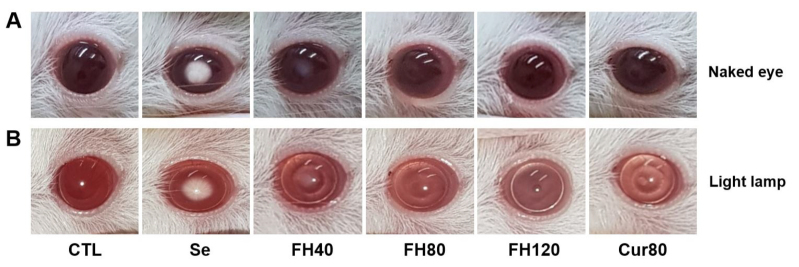
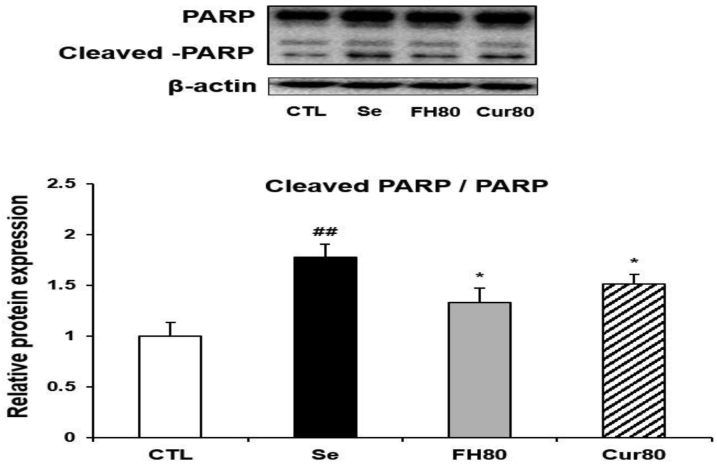
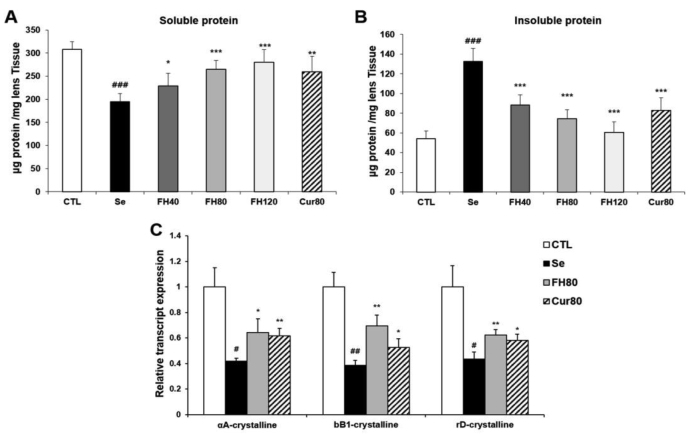
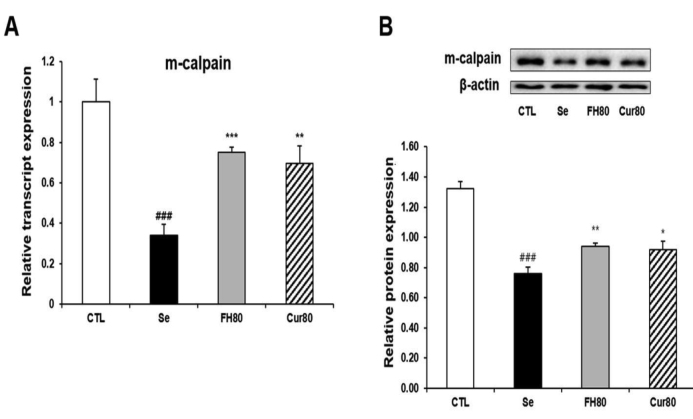
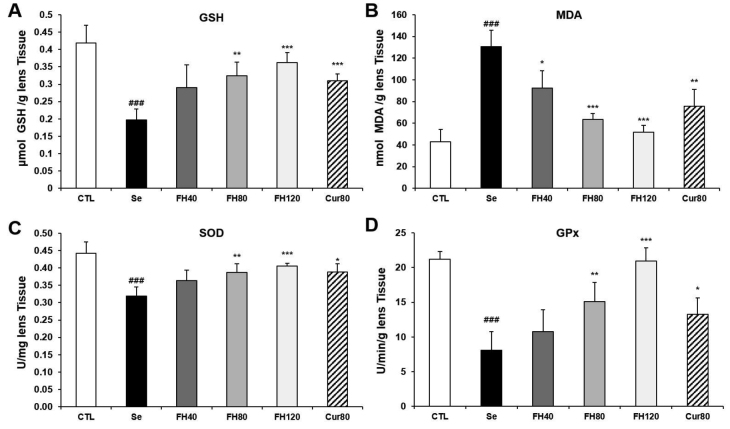
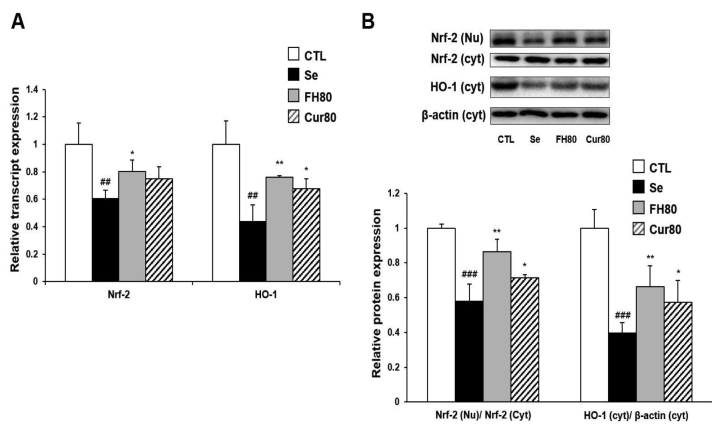
Lens morphological analysis showed that FH dose-dependently inhibited cataract formation. In the Se group, soluble proteins were insolubilized, and the gene expression of the α-, β-, and γ-crystallins was downregulated. However, FH treatment statistically significantly inhibited insolubilization of soluble proteins and downregulation of the gene expression of the α-, β-, and γ-crystallins. In the Se group, the gene and protein levels of m-calpain were downregulated, which were attenuated with FH treatment. In addition, sodium selenite injection caused reduced antioxidant enzymes (superoxide dismutase (SOD) and glutathione peroxidase (GPx)), glutathione (GSH) depletion, and malondialdehyde (MDA) production in the lens. The administration of FH inhibited sodium selenite-induced oxidative stress in a dose-dependent manner. The mechanism of protection against oxidative stress by FH involves NF-E2-related factor (Nrf-2) and hemoxygenase-1 (HO-1). FH treatment inhibited decrease of Nrf-2 in the nucleus fraction and HO-1 in the cytosol fraction. Finally, the FH treatment protected poly (ADP)-ribose polymerase (PARP) from cleavage, determined with western blotting.
FH showed a preventive effect against cataract formation by inhibiting m-calpain-mediated proteolysis and oxidative stress in the lens. These results suggest that FH could be a potential anticataract agent in age-related cataract.
随着老龄化人口的增加,全球年龄相关性白内障的发病率预计将会上升。白内障的外科干预治疗仍存在并发症,且仅限于发达国家。在本研究中,我们调查了富含多酚的[具体物质未提及]提取物(FH)是否能预防Sprague-Dawley(SD)大鼠幼崽的白内障形成。
60只大鼠幼崽随机分为六组:CTL组、硒组、FH40组、FH80组、FH120组和Cur80组。在出生后(P)第10天通过皮下注射亚硒酸钠(18 μmol/kg体重)诱导白内障形成。除CTL组外,所有组均注射亚硒酸钠,FH40组、FH80组和FH120组在P9、P10和P11分别给予40 mg/kg、80 mg/kg和120 mg/kg的FH灌胃。Cur80组在P9、P10和P11也给予80 mg/kg姜黄素灌胃。所有大鼠幼崽在P30处死。
晶状体形态分析表明,FH剂量依赖性地抑制白内障形成。在硒组中,可溶性蛋白发生不溶性化,α-、β-和γ-晶状体蛋白的基因表达下调。然而,FH处理在统计学上显著抑制了可溶性蛋白的不溶性化以及α-、β-和γ-晶状体蛋白基因表达的下调。在硒组中,m-钙蛋白酶的基因和蛋白水平下调,而FH处理使其减弱。此外,注射亚硒酸钠导致晶状体中抗氧化酶(超氧化物歧化酶(SOD)和谷胱甘肽过氧化物酶(GPx))减少、谷胱甘肽(GSH)耗竭以及丙二醛(MDA)生成。FH给药以剂量依赖性方式抑制亚硒酸钠诱导的氧化应激。FH对抗氧化应激的保护机制涉及NF-E2相关因子(Nrf-2)和血红素加氧酶-1(HO-1)。FH处理抑制了细胞核部分中Nrf-2和细胞质部分中HO-1的减少。最后,通过蛋白质印迹法测定,FH处理保护了聚(ADP)-核糖聚合酶(PARP)不被切割。
FH通过抑制晶状体中m-钙蛋白酶介导的蛋白水解和氧化应激,对白内障形成具有预防作用。这些结果表明,FH可能是年龄相关性白内障的一种潜在抗白内障药物。