Department for Neonatology and Pediatric Intensive Care, University Hospital Carl Gustav Carus, Technische Universität Dresden, Fetscherstr. 74, 01307, Dresden, Germany.
Center for Evidence-based Healthcare, University Hospital and Medical Faculty Carl Gustav Carus, Technische Universität Dresden, Fetscherstr. 74, 01307, Dresden, Germany.
BMC Pediatr. 2019 Mar 1;19(1):69. doi: 10.1186/s12887-019-1424-8.
Comprehensive data are needed to evaluate the burden of low birthweight. Analysis of routine data on health-care utilization during early childhood were used to test the hypothesis that infants with low birthweight have (i) increased inpatient health-care utilization, (ii) higher hospital costs and (iii) different morbidity pattern in early childhood when compared with normal birthweight infants.
Children born between 2007 and 2013 that were insured at birth with the statutory health insurance AOK PLUS were included (N = 118,166, equaling 49% of the Saxon newborns) and classified into very low (< 1500 g, VLBW), low (1500-2499 g, LBW) birthweight and reference group (> 2500 g). Outcomes were: inpatient health-care utilization quantified by number and length of hospital stays; costs of hospitalizations including medication; reasons of hospitalizations for each year of life (YOL).
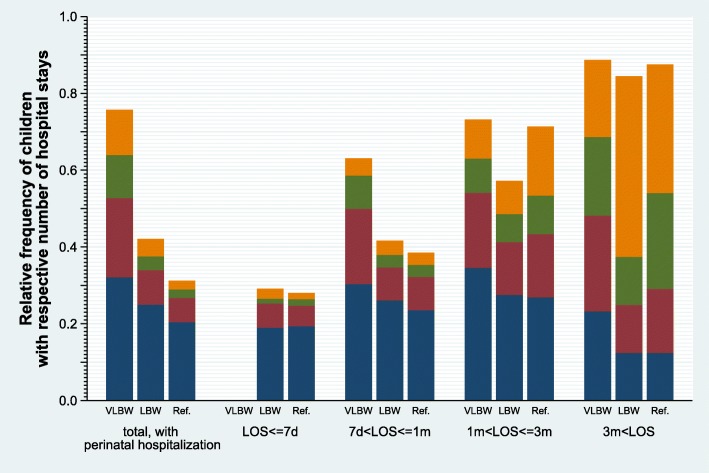
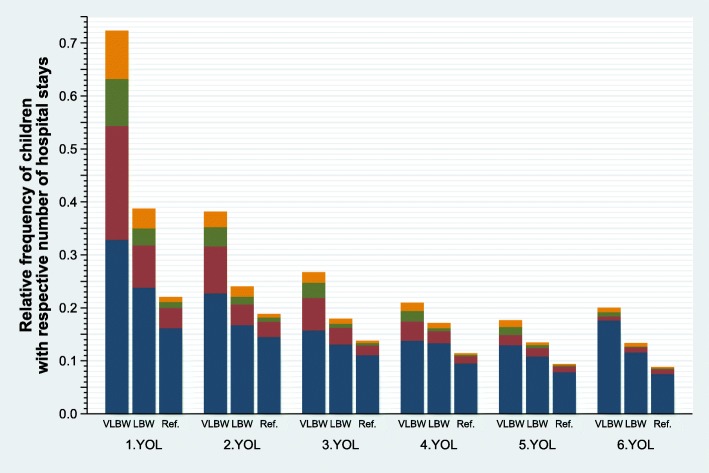
72, 38 and 22% of VLBW-, LBW- and reference group were hospitalized after perinatal period within the first YOL with a more than 5-fold increased risk in VLBW to be hospitalized for hemangioma, convulsions, hydrocephalus, hernia and respiratory problems. Median (IQR) cumulative cost of inpatient care during the first four YOLs was 2953 (1213-7885), 1331 (0-3451) and 0 (0-2062) Euro for respective groups. Inpatient early childhood health-care utilization (after first YOL) was higher in VLBW compared to healthy, normal birth weight infants (RR 3.92 [95%-CI 3.63, 4.23]), residents of rural areas (RR 1.37 [95%-CI 1.35, 1.40]) and in boys (RR 1.31 [95%-CI 1.29, 1.33]).
This large population-based birth-cohort study indicates a high clinical and economic burden of low birthweight which is not restricted to the first year of life.
需要全面的数据来评估低出生体重的负担。本研究利用儿童早期常规医疗保健利用数据分析,旨在验证以下假设:与正常出生体重儿相比,低出生体重儿(i)住院医疗利用增加,(ii)住院费用更高,(iii)在儿童早期具有不同的发病模式。
本研究纳入了在 2007 年至 2013 年间出生且在出生时通过法定健康保险 AOK PLUS 投保的儿童(N=118166,占萨克森新生儿的 49%),并将其分为极低出生体重儿(<1500g,VLBW)、低出生体重儿(1500-2499g,LBW)和参考组(>2500g)。结局包括:通过住院次数和住院时间量化的住院医疗利用;包括药物在内的住院费用;每一年龄段(YOL)的住院原因。
在第一个 YOL 内,VLBW-、LBW-和参考组中分别有 72%、38%和 22%的儿童在围生期后住院,VLBW 组中患有血管瘤、惊厥、脑积水、疝和呼吸系统问题的儿童住院风险增加了 5 倍以上。在第一个 YOL 后四年的住院期间,累积住院费用的中位数(IQR)分别为 2953(1213-7885)、1331(0-3451)和 0(0-2062)欧元。与健康、正常出生体重儿相比,VLBW 患儿在儿童早期(第一个 YOL 后)的住院医疗利用率更高(RR 3.92[95%-CI 3.63, 4.23]),农村地区(RR 1.37[95%-CI 1.35, 1.40])和男孩(RR 1.31[95%-CI 1.29, 1.33])的住院医疗利用率更高。
本大规模基于人群的出生队列研究表明,低出生体重儿具有较高的临床和经济负担,且不限于生命的第一年。