Epidemiology, Biostatistics and Prevention Institute (EBPI), University of Zurich, Hirschengraben 84, 8001, Zurich, Switzerland.
BMC Pulm Med. 2019 Mar 1;19(1):57. doi: 10.1186/s12890-019-0817-7.
Exercise training is an important component of pulmonary rehabilitation (PR) programmes in chronic obstructive pulmonary disease (COPD), but the great majority of COPD patients who would benefit from PR never follow such programmes or fail to maintain exercise training after PR completion. Against this background, we developed an exercise training programme that requires minimal equipment and can be implemented long-term in the patient's home-setting. The aims of the HOMEX-1 and HOMEX-2 trials are to assess the effectiveness of this home-based exercise training programme in two groups of COPD patients over the course of one year: patients who have completed PR (HOMEX-1 trial) and patients who did not enrol in existing PR programmes within the last two years (HOMEX-2 trial).
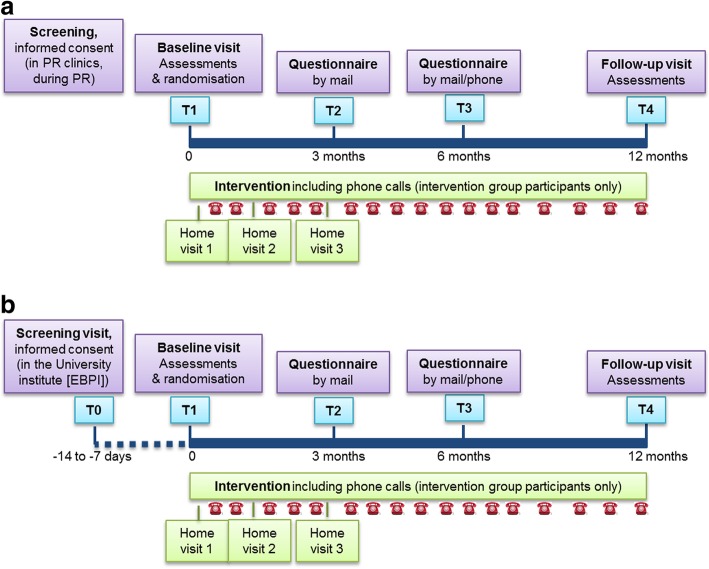
HOMEX-1 and HOMEX-2 are multicentre, parallel group, randomised controlled trials. For both trials each, it is planned to include 120 study participants with a diagnosis of COPD. Participants will be randomised with a 1:1 ratio into the intervention group or the control group (usual care/no intervention). The intervention consists of minimal-equipment exercise training elements with progressive level of intensity, conducted by the participant during six days per week and instructed and coached by a trained health care professional during three home visits and regular telephone calls during one year. Primary outcome is change in dyspnoea (domain of Chronic Respiratory Questionnaire) from baseline to 12-months follow-up. Secondary outcomes are change in dyspnoea over the course of the year (assessed at 3, 6 and 12 month) and change in functional exercise capacity, physical activity, health-related quality of life, health status, exacerbations and symptoms from baseline to 12 months follow-up. In addition, explanatory, safety and cost-effectiveness outcomes will be assessed. We will conduct intention-to-treat analyses separately per trial and per protocol analyses as sensitivity analyses.
The HOMEX-1 and HOMEX-2 trials assess a novel intervention that provides an innovative way of making exercise training as accessible as possible for COPD patients. If the intervention proves to be effective long-term, it will fill the gap of providing an easily accessible and feasible intervention so that more COPD patients can follow an exercise programme.
ClinicalTrials.gov Identifier: HOMEX-1 NCT03461887 (registration date: March 12, 2018; retrospectively registered); HOMEX-2 NCT03654092 (registration date: August 31, 2018).
运动训练是慢性阻塞性肺疾病(COPD)肺康复(PR)计划的重要组成部分,但绝大多数受益于 PR 的 COPD 患者从未参加过此类计划,或在 PR 完成后无法维持运动训练。有鉴于此,我们开发了一种运动训练计划,该计划需要最少的设备,并且可以在患者的家庭环境中长期实施。HOMEX-1 和 HOMEX-2 试验的目的是评估该基于家庭的运动训练计划在两组 COPD 患者中的有效性,为期一年:一组是已完成 PR 的患者(HOMEX-1 试验),另一组是在过去两年内未参加现有 PR 计划的患者(HOMEX-2 试验)。
HOMEX-1 和 HOMEX-2 是多中心、平行组、随机对照试验。每个试验计划纳入 120 名 COPD 诊断患者。参与者将以 1:1 的比例随机分为干预组或对照组(常规护理/无干预)。干预措施包括最低限度的运动训练要素,强度逐渐增加,由参与者在一周六天进行,并由经过培训的医疗保健专业人员在三次家访和一年期间的定期电话访问中进行指导和辅导。主要结局是从基线到 12 个月随访时呼吸困难(慢性呼吸道问卷的一个领域)的变化。次要结局是一年内呼吸困难的变化(分别在 3、6 和 12 个月评估)以及功能运动能力、身体活动、健康相关生活质量、健康状况、加重和症状的变化,从基线到 12 个月随访。此外,还将评估解释性、安全性和成本效益结果。我们将分别对每个试验进行意向治疗分析和按方案分析作为敏感性分析。
HOMEX-1 和 HOMEX-2 试验评估了一种新的干预措施,为 COPD 患者提供了一种使运动训练尽可能容易获得的创新方法。如果该干预措施被证明长期有效,它将填补提供一种易于获得和可行的干预措施的空白,以便更多的 COPD 患者能够遵循运动计划。
ClinicalTrials.gov 标识符:HOMEX-1 NCT03461887(注册日期:2018 年 3 月 12 日;回顾性注册);HOMEX-2 NCT03654092(注册日期:2018 年 8 月 31 日)。