Wu Jie, Li Xiwen, Huang Linfang, Meng Xiangxiao, Hu Haoyu, Luo Lu, Chen Shilin
1Institute of Chinese Materia Medica, China Academy of Chinese Medical Sciences, Beijing, 100700 China.
2Institute of Medicinal Plant Development, Chinese Academy of Medical Sciences and Peking Union Medical College, Beijing, 100193 China.
Chin Med. 2019 Feb 20;14:4. doi: 10.1186/s13020-019-0226-0. eCollection 2019.
The endangered rate of medicinal plant exceeds that of endangered plant species. However, blindly introducing medicinal plants in regions without comprehensively considering the involved environmental factors results in diseases and insect pests and the consequent overproof pesticide residue as well as reduces the quality of herbal medicine produced.
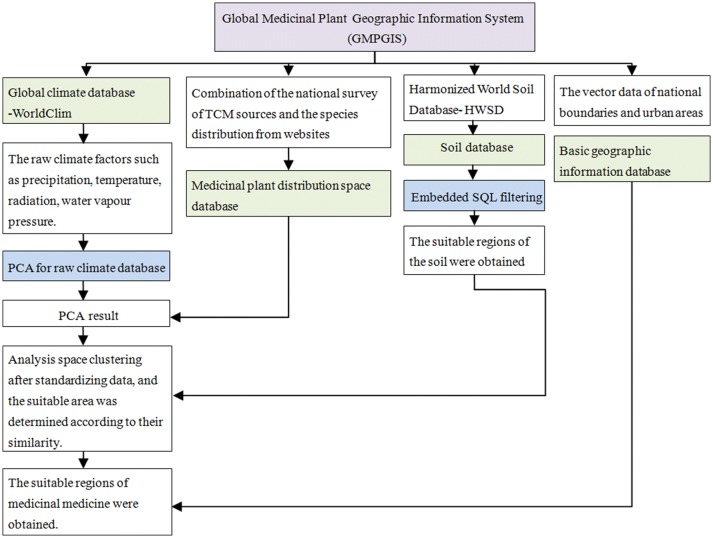
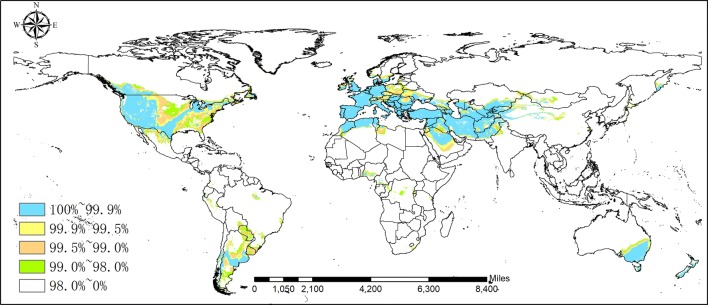
Global Medicinal Plant Geographic Information System (GMPGIS) was developed to analyze environmental information of ecologically suitable regions, thus guiding the conservation and introduction of medicinal plants. This system is based on theories and methods from multiple disciplines, including computer science, geoinformatics, ecology, and traditional herbal medicine. Using a range-based method, the previously established ecologically suitable regions were evaluated. This new method effectively resolved the problem of outlier points, and its functions were implemented in Python. The system automatically calculates the Euclidean distance of climatic factors and intersection of soil factors, thus identifying regions with high ecological similarity and those are climatically and edaphically suitable for the cultivation of medicinal plants.
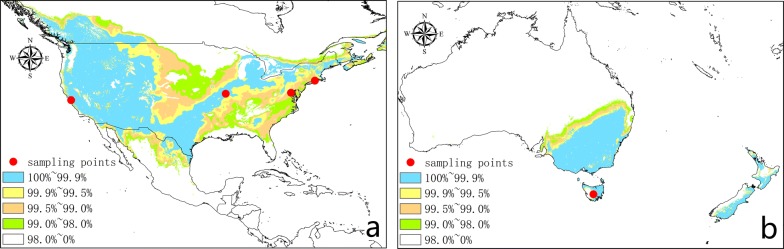
These results, validated using real-world regions, revealed that GMPGIS is highly accurate in screening ecologically suitable regions for the cultivation of medicinal plants worldwide.
Overall, because of these features, the GMPGIS is considered as a suitable distribution analysis system for global medicinal plant cultivation.
药用植物的濒危率超过了濒危植物物种。然而,在未全面考虑相关环境因素的地区盲目引种药用植物会导致病虫害以及随之而来的农药残留超标,还会降低所产草药的质量。
开发了全球药用植物地理信息系统(GMPGIS)来分析生态适宜区域的环境信息,从而指导药用植物的保护和引种。该系统基于包括计算机科学、地理信息学、生态学和传统草药学在内的多学科理论和方法。采用基于范围的方法对先前确定的生态适宜区域进行评估。这种新方法有效解决了异常点问题,其功能在Python中实现。该系统自动计算气候因子的欧几里得距离和土壤因子的交集,从而识别出生态相似度高以及气候和土壤条件适合药用植物种植的区域。
使用实际区域进行验证的这些结果表明,GMPGIS在筛选全球药用植物种植的生态适宜区域方面具有很高的准确性。
总体而言,由于这些特性,GMPGIS被认为是一个适用于全球药用植物种植的分布分析系统。