Gruntman Alisha M, Gernoux Gwladys, Tang Qiushi, Ye Guo-Jie, Knop Dave R, Wang Gensheng, Benson Janet, Coleman Kristen E, Keeler Allison M, Mueller Christian, Chicoine Louis G, Chulay Jeffrey D, Flotte Terence R
University of Massachusetts Medical School, Worcester, MA 01655, USA.
Tufts University Cummings School of Veterinary Medicine, North Grafton, MA 01536, USA.
Mol Ther Methods Clin Dev. 2019 Feb 2;13:233-242. doi: 10.1016/j.omtm.2019.01.013. eCollection 2019 Jun 14.
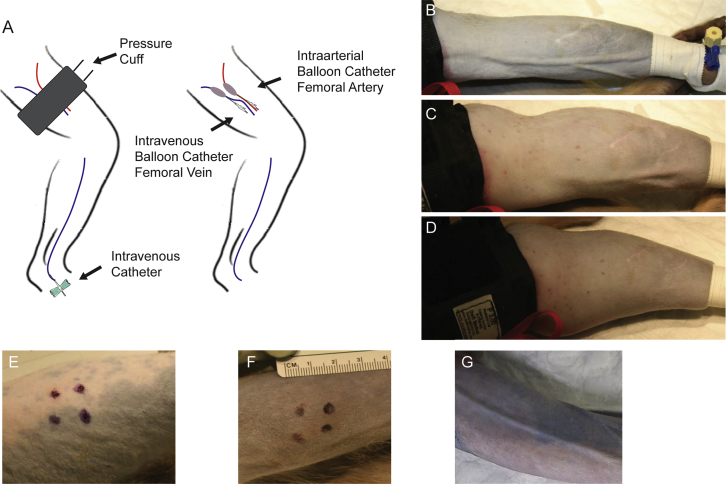
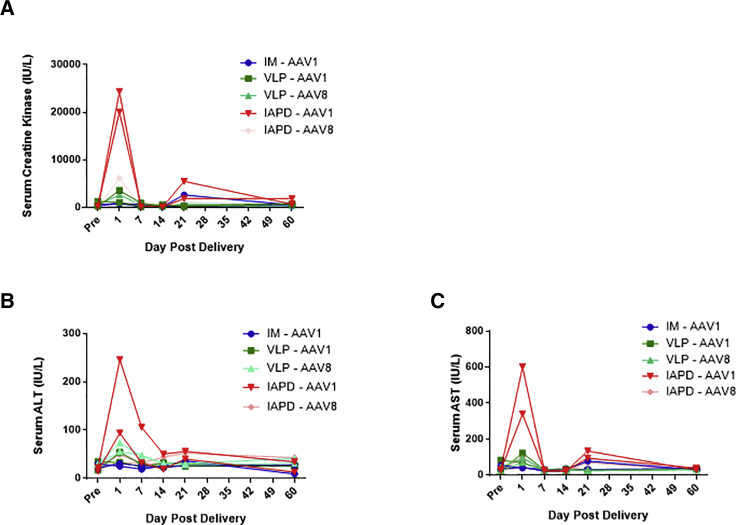
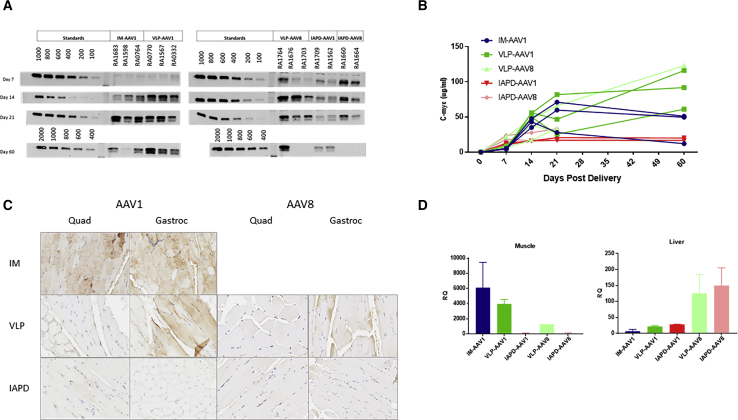
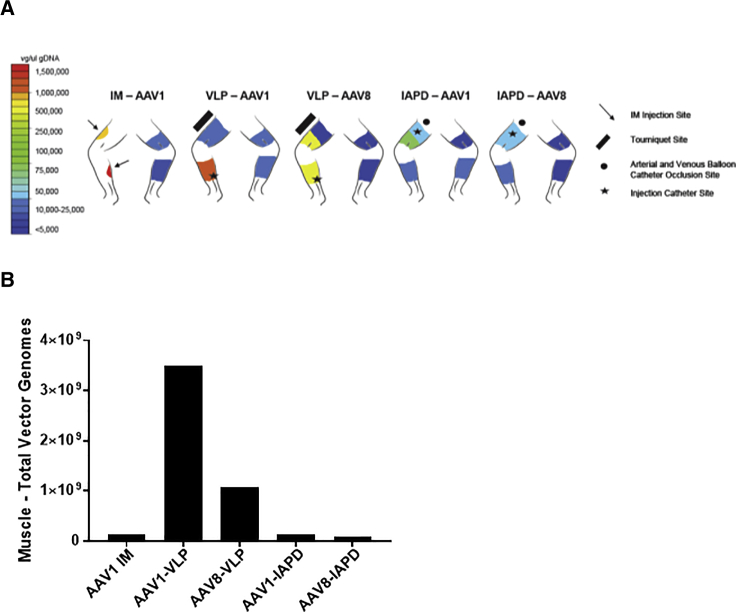
Phase 1 and phase 2 gene therapy trials using intramuscular (IM) administration of a recombinant adeno-associated virus serotype 1 (rAAV1) for replacement of serum alpha-1 antitrypsin (AAT) deficiency have shown long-term (5-year) stable transgene expression at approximately 2% to 3% of therapeutic levels, arguing for the long-term viability of this approach to gene replacement of secreted serum protein deficiencies. However, achieving these levels required 100 IM injections to deliver 135 mL of vector, and further dose escalation is limited by the scalability of direct IM injection. To further advance the dose escalation, we sought to bridge the rAAV-AAT clinical development program to regional limb perfusion, comparing two methods previously established for gene therapy, peripheral venous limb perfusion (VLP) and an intra-arterial push and dwell (IAPD) using rAAV1 and rAAV8 in a non-human primate (rhesus macaque) study. The rhesus AAT transgene was used with a c-myc tag to enable quantification of transgene expression. 5 cohorts of animals were treated with rAAV1-IM, rAAV1-VLP, rAAV1-IAPD, rAAV8-VLP, and rAAV8-IAPD (n = 2-3), with a dose of 6 × 10 vg/kg. All methods were well tolerated clinically. Potency, as determined by serum levels of AAT, of rAAV1 by the VLP method was twice that observed with direct IM injection; 90 μg/mL with VLP versus 38 μg/mL with direct IM injection. There was an approximately 25-fold advantage in estimated vector genomes retained within the muscle tissue with VLP and a 5-fold improvement in the ratio of total vector genomes retained within muscle as compared with liver. The other methods were intermediate in the potency and retention of vector genomes. Examination of muscle enzyme (CK) levels indicated rAAV1-VLP to be equally safe as compared with IM injection, while the IAPD method showed significant CK elevation. Overall, rAAV1-VLP demonstrates higher potency per vector genome injected and a greater total vector retention within the muscle, as compared to IM injection, while enabling a much greater total dose to be delivered, with equivalent safety. These data provide the basis for continuation of the dose escalation of the rAAV1-AAT program in patients and bode well for rAAV-VLP as a platform for replacement of secreted proteins.
使用重组腺相关病毒1型(rAAV1)肌肉注射(IM)来替代血清α-1抗胰蛋白酶(AAT)缺乏的1期和2期基因治疗试验显示,在约2%至3%的治疗水平上有长期(5年)稳定的转基因表达,这表明这种用于替代分泌型血清蛋白缺乏的基因替代方法具有长期可行性。然而,要达到这些水平需要进行100次肌肉注射以递送135毫升载体,并且进一步的剂量递增受到直接肌肉注射可扩展性的限制。为了进一步推进剂量递增,我们试图将rAAV-AAT临床开发项目与区域肢体灌注相衔接,在一项非人类灵长类动物(恒河猴)研究中比较两种先前确立的基因治疗方法,即外周静脉肢体灌注(VLP)和动脉内推注并滞留(IAPD),使用rAAV1和rAAV8。恒河猴AAT转基因与c-myc标签一起使用,以实现转基因表达的定量。5组动物分别接受rAAV1-IM、rAAV1-VLP、rAAV1-IAPD、rAAV8-VLP和rAAV8-IAPD治疗(n = 2 - 3),剂量为6×10 vg/kg。所有方法在临床上耐受性良好。通过VLP方法,rAAV1的效力(由血清AAT水平确定)是直接肌肉注射观察到的效力的两倍;VLP为90μg/mL,而直接肌肉注射为38μg/mL。与直接肌肉注射相比,VLP在肌肉组织中保留的估计载体基因组有大约25倍的优势,并且肌肉中保留的总载体基因组与肝脏中的比例提高了5倍。其他方法在载体基因组的效力和保留方面处于中间水平。对肌肉酶(CK)水平的检测表明,与肌肉注射相比,rAAV1-VLP同样安全,而IAPD方法显示CK显著升高。总体而言,与肌肉注射相比,rAAV1-VLP每注射的载体基因组显示出更高的效力,并且在肌肉中有更大的总载体保留量,同时能够递送更大的总剂量,且安全性相当。这些数据为在患者中继续推进rAAV1-AAT项目的剂量递增提供了基础,并且预示着rAAV-VLP作为替代分泌蛋白的平台前景良好。