Cell Biology, Genetics Department, Shantou University Medical College, Shantou 515041, China; Department of Biochemistry, Medical College of Jiaying University, Meizhou 514031, China.
First Affiliated Hospital of Shantou University Medical College, Shantou 515041, China.
Clin Chim Acta. 2019 Jul;494:22-30. doi: 10.1016/j.cca.2019.02.034. Epub 2019 Mar 1.
To explore the clinical, microbiological and immunological features of patients with fever and thrombocytopenia.
Patients with unexplained fever and thrombocytopenia were enrolled. Viruses were detected using real-time PCR, and bacteria were measured by culturing methods. Serum cytokines, platelet antibody IgG (PA-IgG) and Helicobacter pylori (HP) were detected using ELISA.
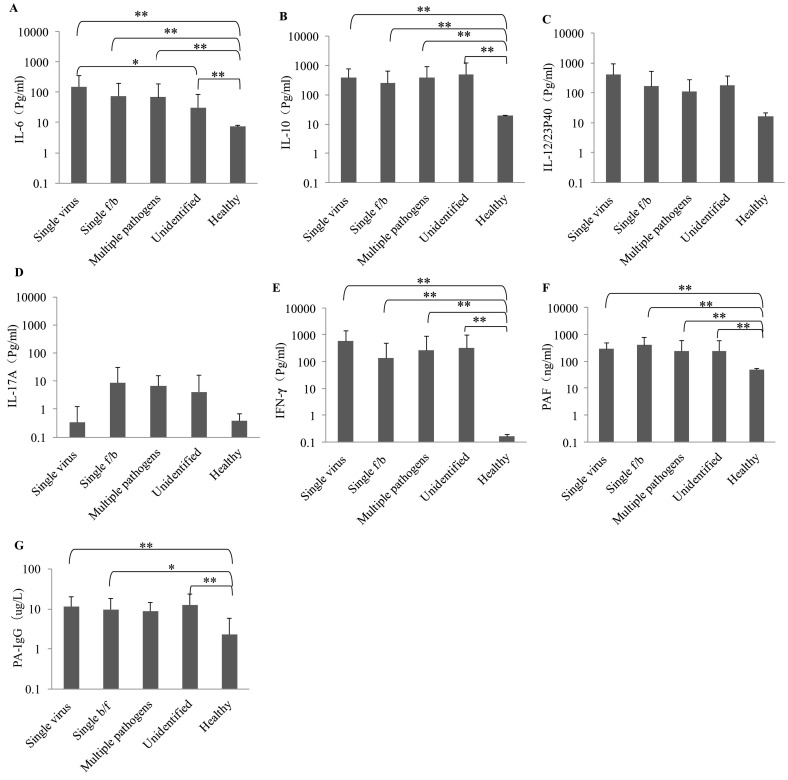
Pathogens were detected in 74.68% of patients, which included single fungal/viral/bacterial infection and multiple infection. The pathogens could not be unidentified in 25.32% of cases. Cytokines including Interleukin (IL)-6, IL-10, interferon-γ(IFN-γ), platelet activating factor (PAF) and PA-IgG were significantly higher in patients as compared to healthy controls (P < .01 or P < .05). Principal component analyses extracted four groups of parameters that have a strong positive predicting value, revealing that disease status evaluation would be more accurate if we combined the platelet parameters and inflammatory biomarkers. While event-free survival (EFS) that indicates the time of platelet elevated after therapy was the highest in patients with single bacterial or fungal infection, EFS was affected by the levels of cytokines and PA-IgG.
Differences in immune function may be the main factors affecting the prognosis of patients with fever and thrombocytopenia, while treatment based on precise etiological diagnosis is important for therapeutic efficacy.
探讨发热伴血小板减少患者的临床、微生物学和免疫学特征。
纳入不明原因发热伴血小板减少的患者。采用实时 PCR 检测病毒,培养方法检测细菌。采用 ELISA 法检测血清细胞因子、血小板抗体 IgG(PA-IgG)和幽门螺杆菌(HP)。
74.68%的患者检测到病原体,包括单一真菌感染/病毒感染/细菌感染和多重感染。25.32%的病例无法确定病原体。与健康对照组相比,患者的细胞因子如白细胞介素(IL)-6、IL-10、干扰素-γ(IFN-γ)、血小板激活因子(PAF)和 PA-IgG 明显升高(P<0.01 或 P<0.05)。主成分分析提取了四组具有强阳性预测值的参数,表明如果将血小板参数和炎症生物标志物结合起来,对疾病状态的评估将更加准确。而表明治疗后血小板升高时间的无事件生存(EFS)在单一细菌或真菌感染患者中最高,EFS 受细胞因子和 PA-IgG 水平的影响。
免疫功能的差异可能是影响发热伴血小板减少患者预后的主要因素,而基于精确病因诊断的治疗对治疗效果很重要。