Awaji Mohammad, Singh Rakesh K
Department of Pathology and Microbiology, University of Nebraska Medical Center, 985845 UNMC, Omaha, NE 68198-5845, USA.
Department of Pathology and Laboratory Medicine, King Fahad Specialist Hospital-Dammam, Dammam 31444, Saudi Arabia.
Cancers (Basel). 2019 Mar 1;11(3):290. doi: 10.3390/cancers11030290.
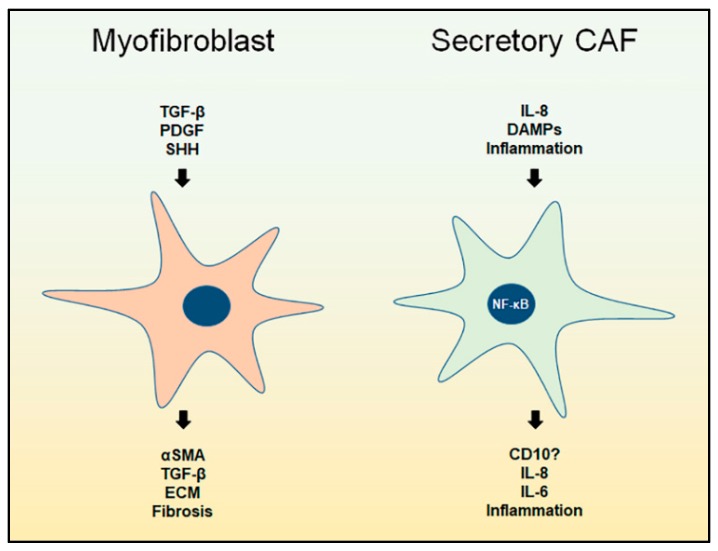
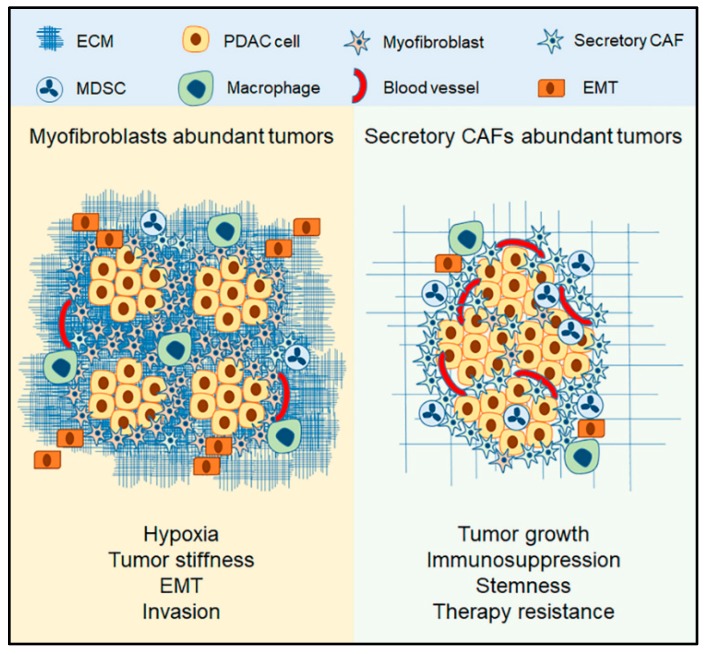
Pancreatic ductal adenocarcinoma (PDAC) is a leading cause of cancer-related deaths in the USA. Desmoplasia and inflammation are two major hallmarks of PDAC. Desmoplasia, composed of extracellular matrix (ECM), cancer-associated fibroblasts (CAFs), and infiltrating immune and endothelial cells, acts as a biophysical barrier to hinder chemotherapy and actively contributes to tumor progression and metastasis. CAFs represent a multifunctional subset of PDAC microenvironment and contribute to tumor initiation and progression through ECM deposition and remodeling, as well as the secretion of paracrine factors. Attempts to resolve desmoplasia by targeting CAFs can render an adverse outcome, which is likely due to CAFs heterogeneity. Recent reports describe subsets of CAFs that assume more secretory functions, in addition to the typical myofibroblast phenotype. Here, we review the literature and describe the relationship between CAFs and inflammation and the role of the secretory-CAFs in PDAC.
胰腺导管腺癌(PDAC)是美国癌症相关死亡的主要原因。促结缔组织增生和炎症是PDAC的两个主要特征。促结缔组织增生由细胞外基质(ECM)、癌症相关成纤维细胞(CAFs)以及浸润的免疫和内皮细胞组成,作为一种生物物理屏障阻碍化疗,并积极促进肿瘤进展和转移。CAFs是PDAC微环境的一个多功能亚群,通过ECM沉积和重塑以及旁分泌因子的分泌促进肿瘤起始和进展。通过靶向CAFs来解决促结缔组织增生的尝试可能会产生不良后果,这可能是由于CAFs的异质性。最近的报告描述了除典型的肌成纤维细胞表型外,具有更多分泌功能的CAFs亚群。在这里,我们回顾文献并描述CAFs与炎症之间的关系以及分泌型CAFs在PDAC中的作用。