School of Electronics and Information Engineering, Tongji University, Shanghai 201804, China.
Dynamics and Control, University of Duisburg-Essen, Duisburg 47057, Germany.
Sensors (Basel). 2019 Mar 3;19(5):1088. doi: 10.3390/s19051088.
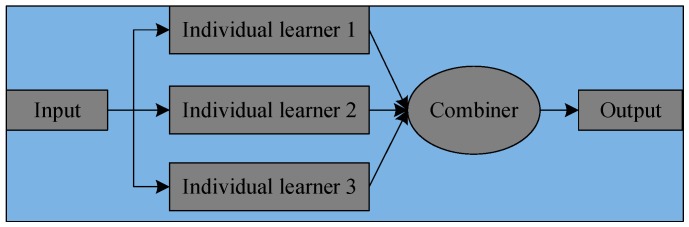
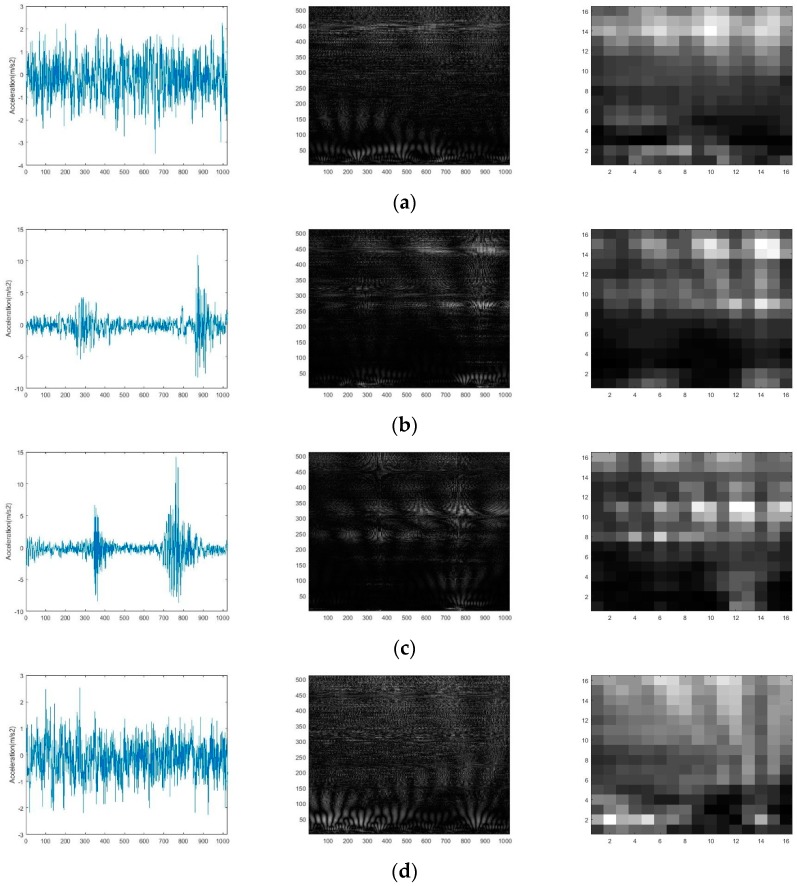
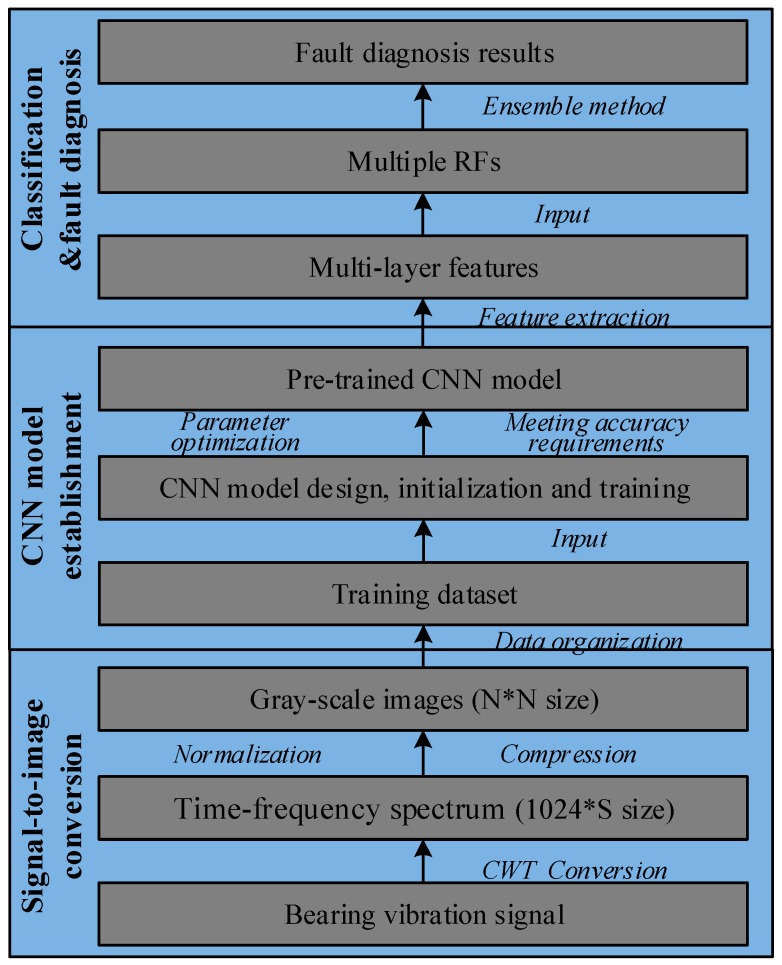
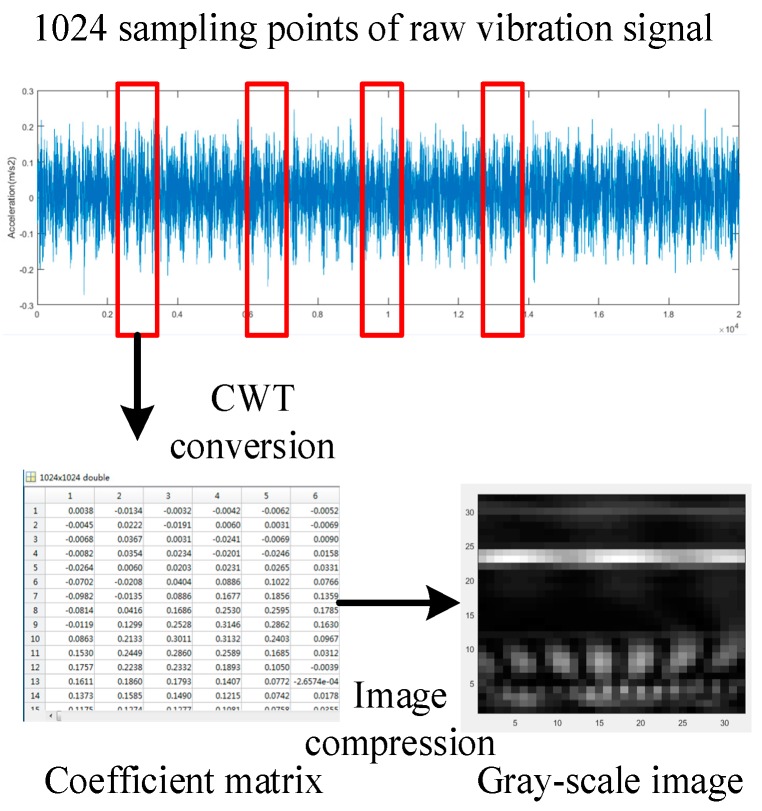
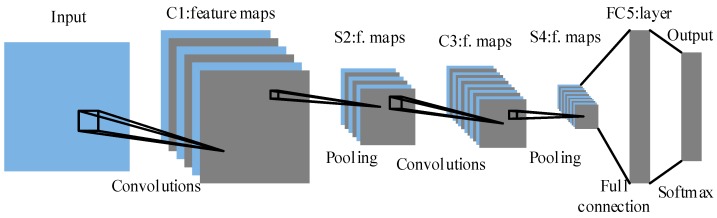
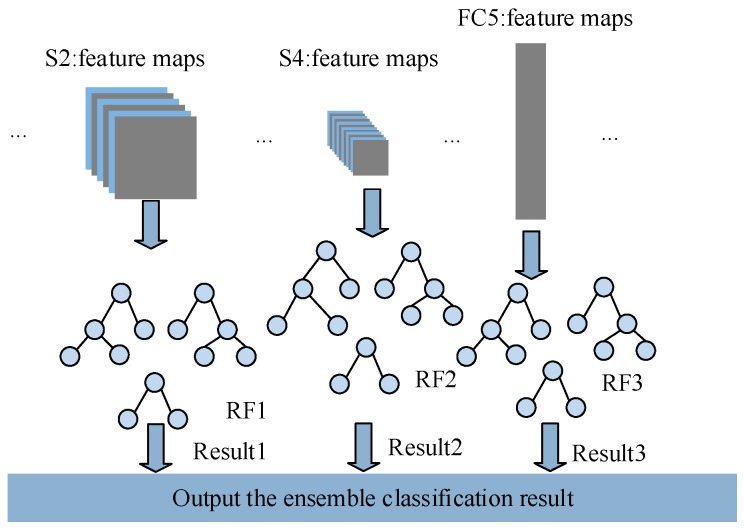
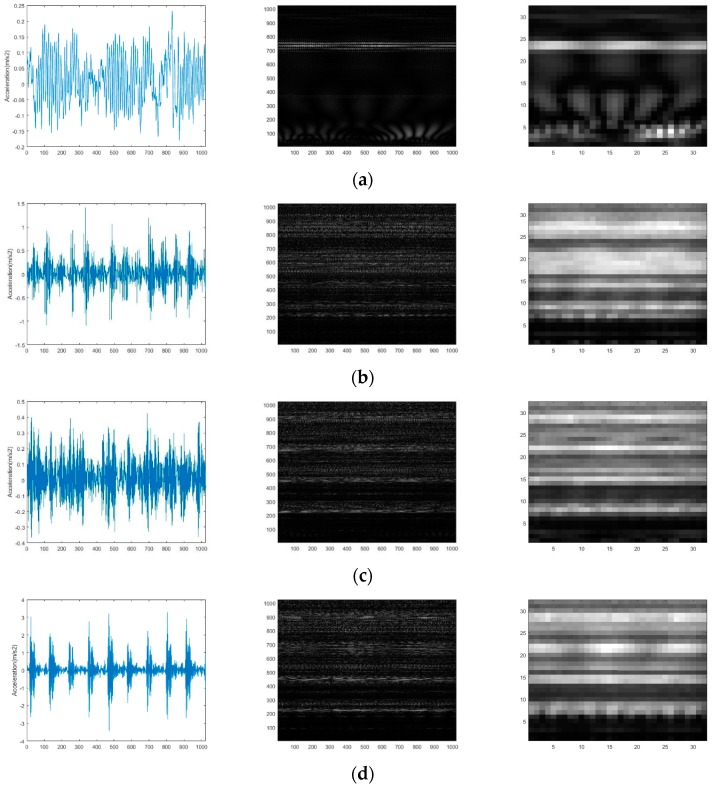
Recently, research on data-driven bearing fault diagnosis methods has attracted increasing attention due to the availability of massive condition monitoring data. However, most existing methods still have difficulties in learning representative features from the raw data. In addition, they assume that the feature distribution of training data in source domain is the same as that of testing data in target domain, which is invalid in many real-world bearing fault diagnosis problems. Since deep learning has the automatic feature extraction ability and ensemble learning can improve the accuracy and generalization performance of classifiers, this paper proposes a novel bearing fault diagnosis method based on deep convolutional neural network (CNN) and random forest (RF) ensemble learning. Firstly, time domain vibration signals are converted into two dimensional (2D) gray-scale images containing abundant fault information by continuous wavelet transform (CWT). Secondly, a CNN model based on LeNet-5 is built to automatically extract multi-level features that are sensitive to the detection of faults from the images. Finally, the multi-level features containing both local and global information are utilized to diagnose bearing faults by the ensemble of multiple RF classifiers. In particular, low-level features containing local characteristics and accurate details in the hidden layers are combined to improve the diagnostic performance. The effectiveness of the proposed method is validated by two sets of bearing data collected from reliance electric motor and rolling mill, respectively. The experimental results indicate that the proposed method achieves high accuracy in bearing fault diagnosis under complex operational conditions and is superior to traditional methods and standard deep learning methods.
最近,由于大量状态监测数据的可用性,基于数据驱动的轴承故障诊断方法的研究引起了越来越多的关注。然而,大多数现有的方法仍然难以从原始数据中学习有代表性的特征。此外,它们假设源域训练数据的特征分布与目标域测试数据的特征分布相同,但在许多实际的轴承故障诊断问题中这是无效的。由于深度学习具有自动特征提取能力,而集成学习可以提高分类器的准确性和泛化性能,因此本文提出了一种基于深度卷积神经网络(CNN)和随机森林(RF)集成学习的新型轴承故障诊断方法。首先,通过连续小波变换(CWT)将时域振动信号转换为包含丰富故障信息的二维(2D)灰度图像。其次,构建基于 LeNet-5 的 CNN 模型,自动从图像中提取对故障检测敏感的多级特征。最后,利用包含局部和全局信息的多级特征,通过多个 RF 分类器的集成来诊断轴承故障。特别是,结合隐藏层中包含局部特征和准确细节的低层特征,以提高诊断性能。通过来自reliance 电机和轧机的两组轴承数据验证了所提出方法的有效性。实验结果表明,该方法在复杂工况下的轴承故障诊断中具有很高的准确性,优于传统方法和标准深度学习方法。