Delamater Paul L, Shortridge Ashton M, Kilcoyne Rachel C
Department of Geography and the Carolina Population Center, University of North Carolina at Chapel Hill, Chapel Hill, NC, 27599, USA.
Department of Geography, Environment, and Spatial Sciences, Michigan State University, East Lansing, MI, 48824, USA.
BMC Health Serv Res. 2019 Mar 4;19(1):144. doi: 10.1186/s12913-019-3969-5.
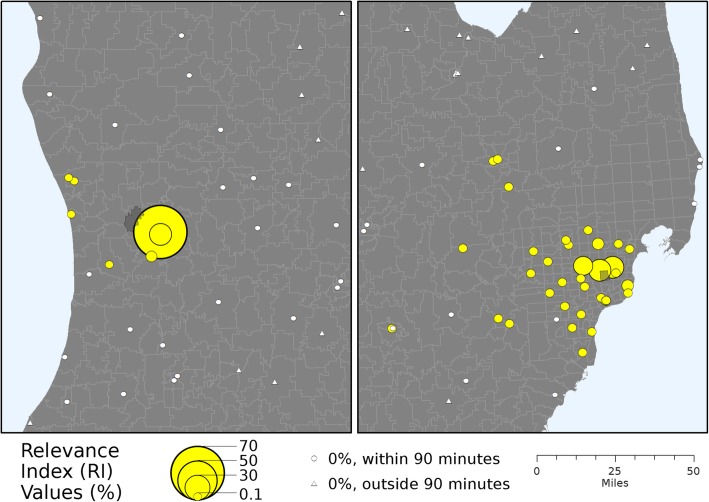
Floating Catchment Area (FCA) metrics provide a comprehensive measure of potential spatial accessibility to health care services and are often used to identify geographic disparities in health care access. An unexplored aspect of FCA metrics is whether they can be useful in predicting where people actually seek care. This research addresses this question by examining the utility of FCA metrics for predicting patient utilization patterns, the flows of patients from their residences to facilities.
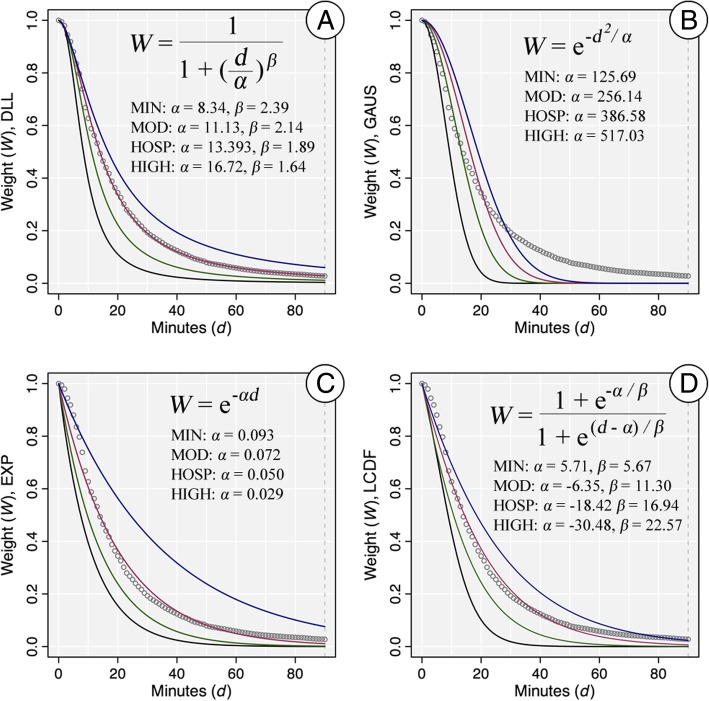
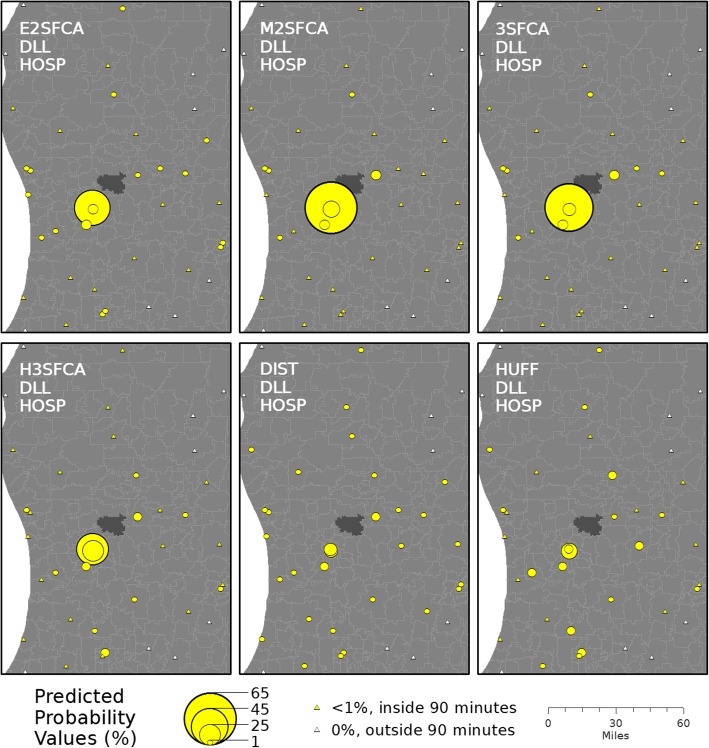
Using more than one million inpatient hospital visits in Michigan, we calculated expected utilization patterns from Zip Codes to hospitals using four FCA metrics and two traditional metrics (simple distance and a Huff model) and compared them to observed utilization patterns. Because all of the accessibility metrics rely on the specification of a distance decay function and its associated parameters, we conducted a sensitivity analysis to evaluate their effects on prediction accuracy.
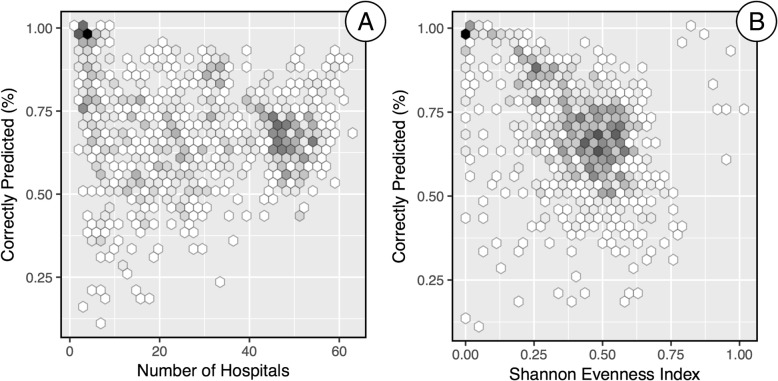
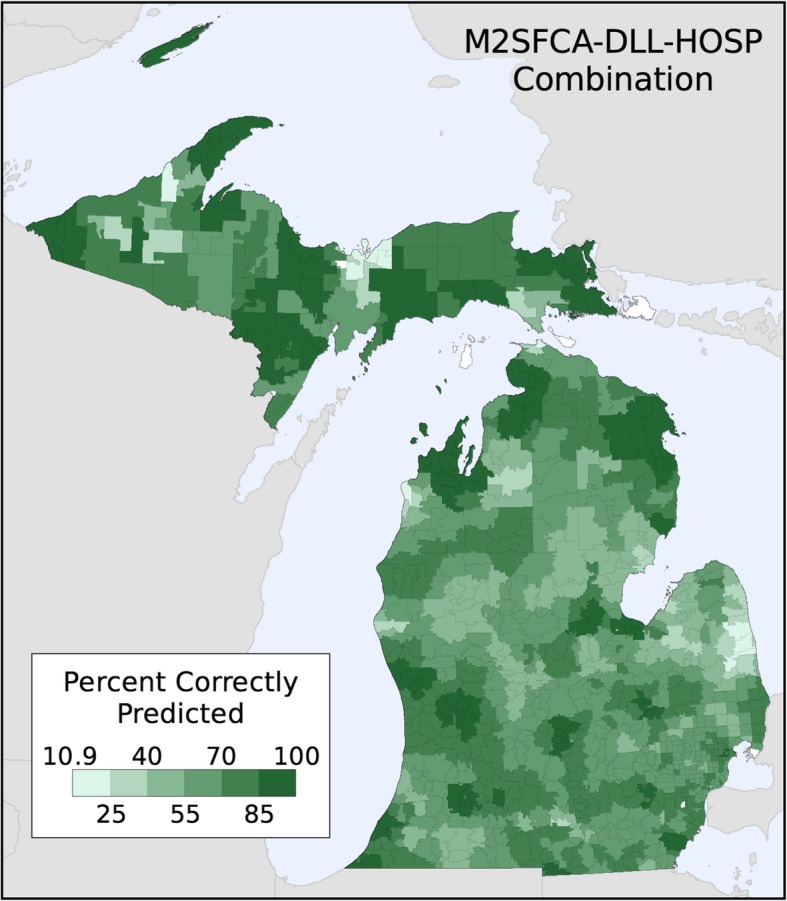
We found that the Three Step FCA (3SFCA) and Modified Two Step FCA (M2SFCA) were the most effective metrics for predicting utilization patterns, correctly predicting the destination hospital for nearly 74% of hospital visits in Michigan. These two metrics were also the least sensitive to changes to the distance decay functions and parameter settings.
Overall, this research demonstrates that FCA metrics can provide reasonable predictions of patient utilization patterns and FCA utilization models could be considered as a substitute when utilization pattern data are unavailable.
浮动集水区(FCA)指标提供了对医疗服务潜在空间可达性的全面衡量,常用于识别医疗服务可及性方面的地理差异。FCA指标一个未被探索的方面是它们是否有助于预测人们实际寻求医疗服务的地点。本研究通过检验FCA指标在预测患者利用模式(即患者从住所到医疗机构的流动情况)方面的效用,来解决这个问题。
利用密歇根州超过100万次住院就诊数据,我们使用四种FCA指标和两种传统指标(简单距离和哈夫模型)计算了从邮政编码区域到医院的预期利用模式,并将其与观察到的利用模式进行比较。由于所有可达性指标都依赖于距离衰减函数及其相关参数的设定,我们进行了敏感性分析,以评估它们对预测准确性的影响。
我们发现三步FCA(3SFCA)和改良两步FCA(M2SFCA)是预测利用模式最有效的指标,能正确预测密歇根州近74%住院就诊的目的地医院。这两个指标对距离衰减函数和参数设置的变化也最不敏感。
总体而言,本研究表明FCA指标能够对患者利用模式做出合理预测,并且在无法获取利用模式数据时,FCA利用模型可被视为一种替代方法。