Department of Anaesthesiology, Institute of Anaesthesiology and Critical Care Medicine, Union Hospital, Tongji Medical College, Huazhong University of Science and Technology, Wuhan, 430022, Hubei, China.
Anaesthetics, Pain Medicine and Intensive Care, Department of Surgery and Cancer, Faculty of Medicine, Imperial College London, Chelsea & Westminster Hospital, London, SW10 9NH, UK.
BMC Anesthesiol. 2019 Mar 4;19(1):30. doi: 10.1186/s12871-019-0698-6.
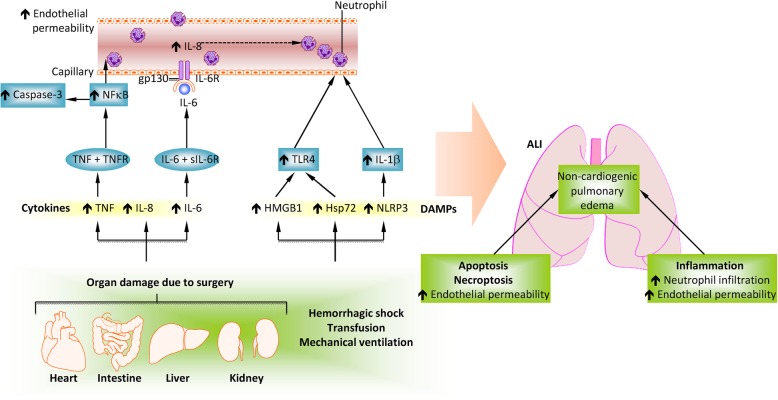
Postoperative remote lung injury is a complication following various surgeries and is associated with short and long-term mortality and morbidity. The release of proinflammatory cytokines, damage-associated molecular patterns such as high-mobility group box-1, nucleotide-biding oligomerization domain (NOD)-like receptor protein 3 and heat shock protein, and cell death signalling activation, trigger a systemic inflammatory response, which ultimately results in organ injury including lung injury. Except high financial burden, the outcome of patients developing postoperative remote lung injury is often not optimistic. Several risk factors had been classified to predict the occurrence of postoperative remote lung injury, while lung protective ventilation and other strategies may confer protective effect against it. Understanding the pathophysiology of this process will facilitate the design of novel therapeutic strategies and promote better outcomes of surgical patients. This review discusses the cause and pathology underlying postoperative remote lung injury. Risk factors, surgical outcomes and potential preventative/treatment strategies against postoperative remote lung injury are also addressed.
术后远隔性肺损伤是多种手术后的一种并发症,与短期和长期死亡率和发病率有关。促炎细胞因子、损伤相关分子模式(如高迁移率族蛋白 B1、核苷酸结合寡聚化结构域样受体蛋白 3 和热休克蛋白)和细胞死亡信号转导的释放会引发全身性炎症反应,最终导致包括肺损伤在内的器官损伤。除了高昂的经济负担外,发生术后远隔性肺损伤的患者的预后通常不容乐观。已经有一些风险因素被分类来预测术后远隔性肺损伤的发生,而肺保护性通气和其他策略可能对其有保护作用。了解这一过程的病理生理学将有助于设计新的治疗策略,并促进手术患者的更好结局。本文综述了术后远隔性肺损伤的病因和病理学。还讨论了术后远隔性肺损伤的风险因素、手术结果以及潜在的预防/治疗策略。