Department of Pathology, Shanghai Tenth People's Hospital, Tongji University School of Medicine, 301 Yanchang Road, Shanghai 200072, China; Shanghai Institute of Immunology, Department of Immunology and Microbiology, Shanghai Jiaotong University School of Medicine, 227 South Chongqing Road, Shanghai 200025, China.
Division of Gastroenterology and Hepatology, Renji Hospital, School of Medicine, Shanghai Jiao Tong University, Shanghai Institute of Digestive Disease, 145 Middle Shandong Road, Shanghai 200001, China.
EBioMedicine. 2019 Mar;41:156-166. doi: 10.1016/j.ebiom.2019.02.051. Epub 2019 Mar 1.
Activation of autocrine VEGF-VEGFR2 signalling in tumour cells activates cell proliferation, survival, and angiogenesis, all of which are crucial for tumour progression. Ovarian cancer-associated antigen 66 (OVA66) is now known to be overexpressed in multiple tumours and plays a role in tumour development, but the underlying mechanisms has not been fully investigated.
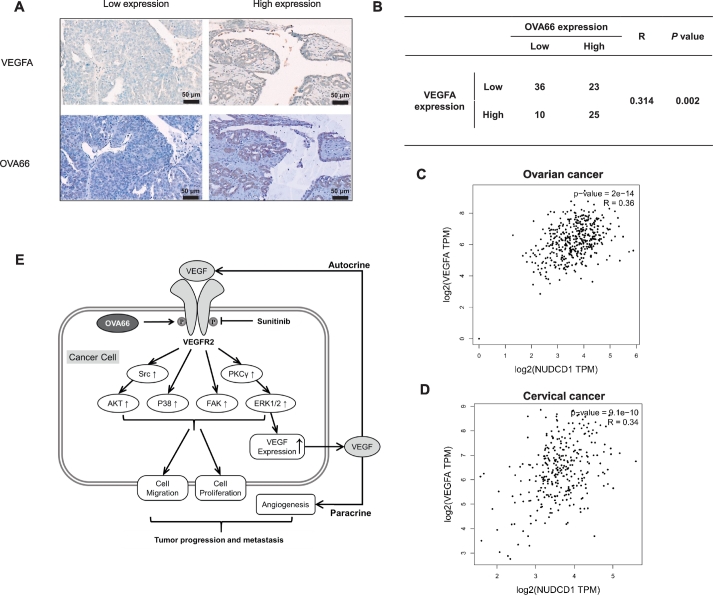
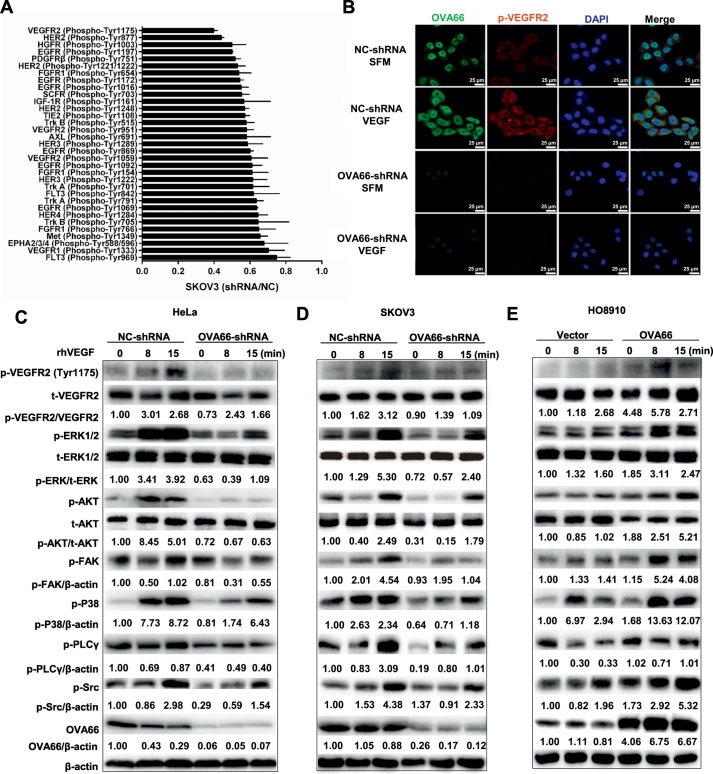
We employed ovarian and cervical cancer cells and mouse models to detect the role of OVA66 in angiogenesis, growth, and metastasis of cancer cells. Immunofluorescence and western blot were used to determine the function of OVA66 in regulating autocrine VEGF-VEGFR2 signalling. Immunohistochemistry and bioinformatics analysis were used to detect the correlation of OVA66 and VEGF expression.
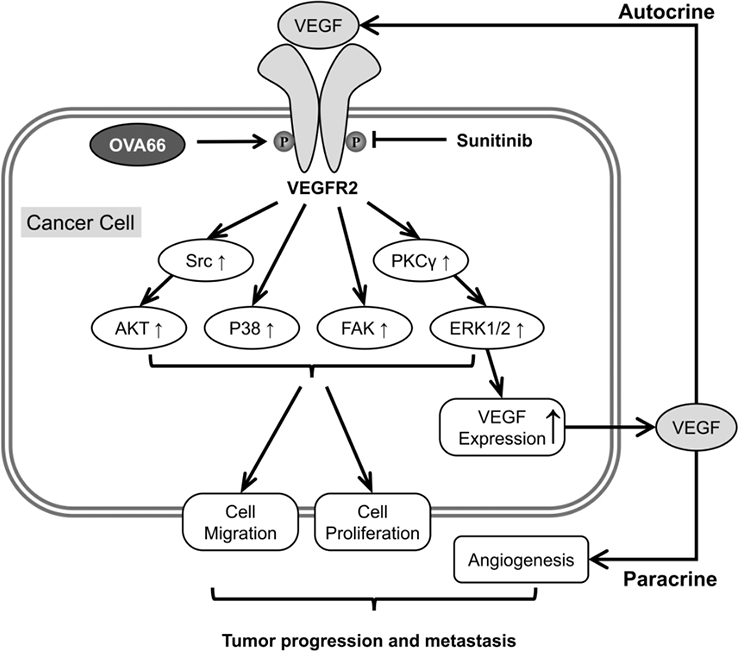
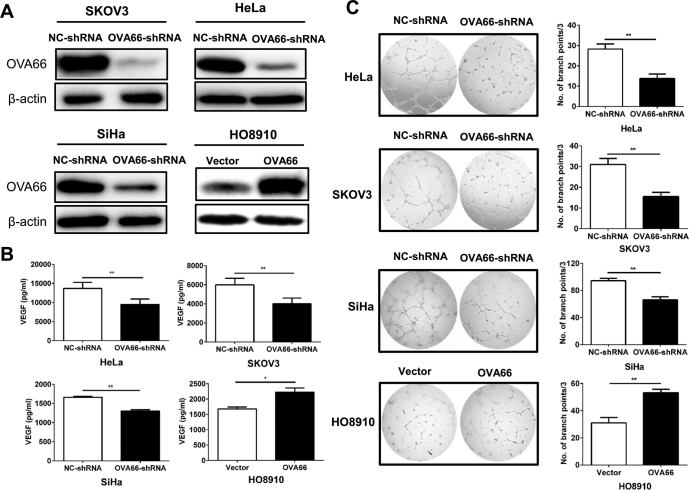
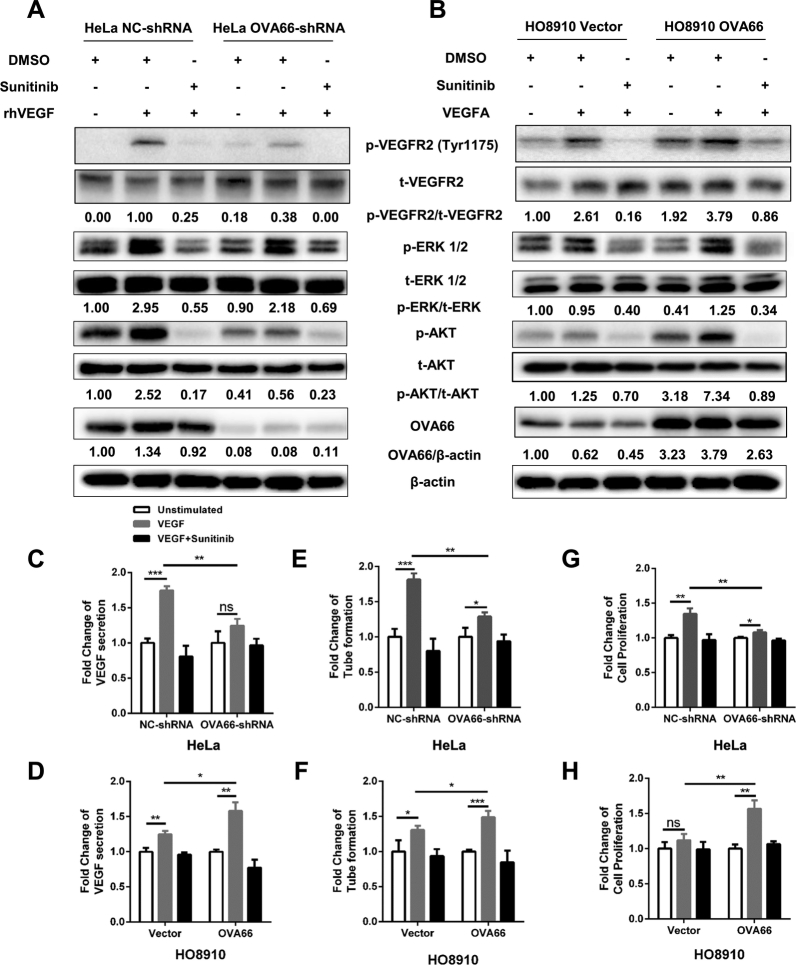
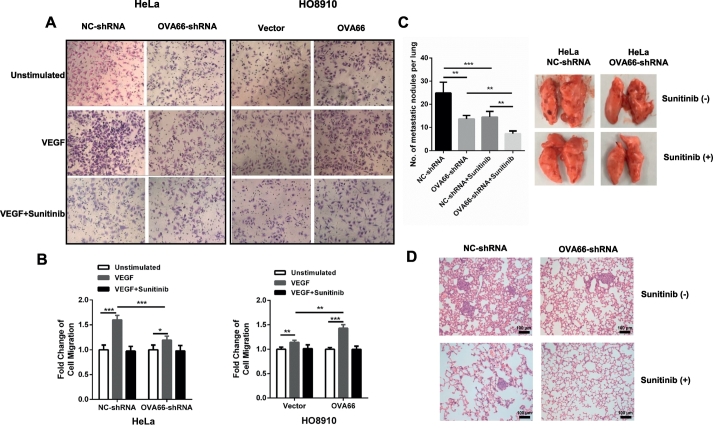
OVA66 overexpression in the cancer cell lines promoted VEGF secretion, tumour growth and angiogenesis in vitro and in vivo. Conversely, shRNA-mediated OVA66 knockdown had the opposite effects. Mechanistically, OVA66 overexpression was found to boost an autocrine VEGF-VEGFR2 positive-feedback signalling loop in the tumour cells, leading to amplified effect of VEGF on tumour angiogenesis and proliferation and increased migration in vitro and in vivo, respectively. Finally, we identified a significant positive correlation between the expression levels of OVA66 and VEGF in ovarian and cervical cancer specimens, and found that OVA66 was significantly associated with advanced ovarian cancer.
We identify a novel function for OVA66 in regulating an autocrine VEGF-VEGFR2 feed-forward signalling loop that promotes tumour progression and angiogenesis. FUND: This work was supported by the National Natural Science Foundation of China (81602262); and Excellent Youth Scholar Program of Tongji University (2015KJ062).
肿瘤细胞中自分泌 VEGF-VEGFR2 信号的激活可激活细胞增殖、存活和血管生成,所有这些都是肿瘤进展的关键。卵巢癌相关抗原 66(OVA66)现已在多种肿瘤中过度表达,并在肿瘤发展中发挥作用,但潜在机制尚未得到充分研究。
我们使用卵巢癌和宫颈癌细胞及小鼠模型来检测 OVA66 在癌细胞血管生成、生长和转移中的作用。免疫荧光和 Western blot 用于确定 OVA66 在调节自分泌 VEGF-VEGFR2 信号中的作用。免疫组织化学和生物信息学分析用于检测 OVA66 与 VEGF 表达的相关性。
在癌细胞系中过表达 OVA66 可促进 VEGF 的分泌、肿瘤的生长和体内外血管生成。相反,shRNA 介导的 OVA66 敲低则产生相反的效果。机制上,发现 OVA66 过表达可增强肿瘤细胞中的自分泌 VEGF-VEGFR2 正反馈信号环,从而放大 VEGF 对肿瘤血管生成和增殖的作用,并分别增加体外和体内的迁移。最后,我们在卵巢癌和宫颈癌标本中鉴定出 OVA66 和 VEGF 表达水平之间存在显著的正相关,并且发现 OVA66 与晚期卵巢癌显著相关。
我们发现 OVA66 在调节自分泌 VEGF-VEGFR2 正反馈信号环中具有新的功能,该信号环可促进肿瘤进展和血管生成。
本工作得到了国家自然科学基金(81602262)和同济大学优秀青年学者计划(2015KJ062)的支持。