Department of Biochemistry, Groningen Biomolecular Sciences and Biotechnology Institute, University of Groningen, Groningen, The Netherlands.
Jilin Provincial Key Laboratory of Nutrition and Functional Food, Jilin University, Changchun, People's Republic of China.
J Bacteriol. 2019 Apr 24;201(10). doi: 10.1128/JB.00708-18. Print 2019 May 15.
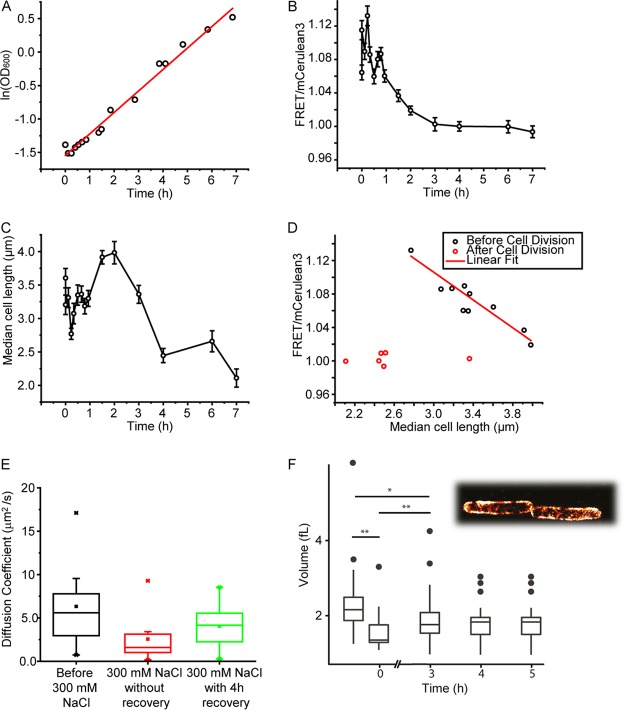
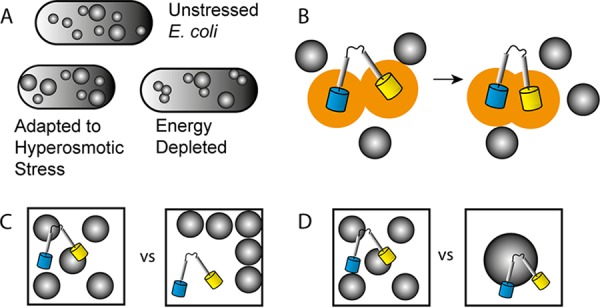
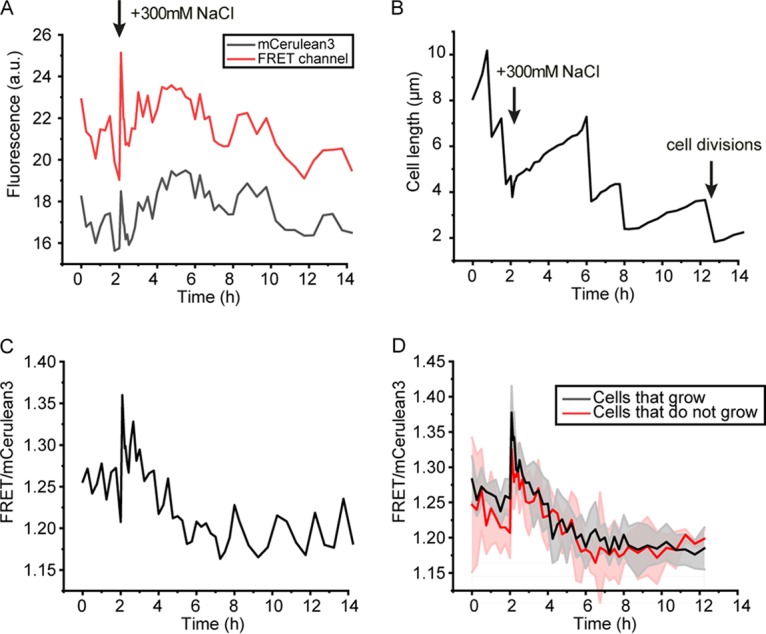
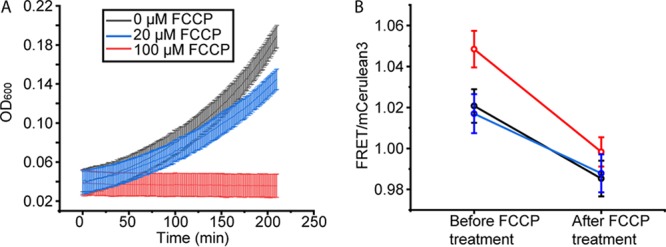
adapts to changing environmental osmolality to survive and maintain growth. It has been shown that the diffusion of green fluorescent protein (GFP) in cells adapted to osmotic upshifts is higher than expected from the increase in biopolymer volume fraction. To better understand the physicochemical state of the cytoplasm in adapted cells, we now follow the macromolecular crowding during adaptation with fluorescence resonance energy transfer (FRET)-based sensors. We apply an osmotic upshift and find that after an initial increase, the apparent crowding decreases over the course of hours to arrive at a value lower than that before the osmotic upshift. Crowding relates to cell volume until cell division ensues, after which a transition in the biochemical organization occurs. Analysis of single cells by microfluidics shows that changes in cell volume, elongation, and division are most likely not the cause for the transition in organization. We further show that the decrease in apparent crowding upon adaptation is similar to the apparent crowding in energy-depleted cells. Based on our findings in combination with literature data, we suggest that adapted cells have indeed an altered biochemical organization of the cytoplasm, possibly due to different effective particle size distributions and concomitant nanoscale heterogeneity. This could potentially be a general response to accommodate higher biopolymer fractions yet retaining crowding homeostasis, and it could apply to other species or conditions as well. Bacteria adapt to ever-changing environmental conditions such as osmotic stress and energy limitation. It is not well understood how biomolecules reorganize themselves inside under these conditions. An altered biochemical organization would affect macromolecular crowding, which could influence reaction rates and diffusion of macromolecules. In cells adapted to osmotic upshift, protein diffusion is indeed faster than expected on the basis of the biopolymer volume fraction. We now probe the effects of macromolecular crowding in cells adapted to osmotic stress or depleted in metabolic energy with a genetically encoded fluorescence-based probe. We find that the effective macromolecular crowding in adapted and energy-depleted cells is lower than in unstressed cells, indicating major alterations in the biochemical organization of the cytoplasm.
适应不断变化的环境渗透压以存活和维持生长。已经表明,适应渗透压升高的细胞中绿色荧光蛋白 (GFP) 的扩散速度高于生物聚合物体积分数增加所预期的速度。为了更好地了解适应细胞中细胞质的物理化学状态,我们现在使用荧光共振能量转移 (FRET) 基于传感器来跟踪适应过程中的大分子拥挤。我们施加渗透压升高,并发现在初始增加后,在数小时内,表观拥挤度降低,达到渗透压升高前的值以下。拥挤度与细胞体积相关,直到细胞分裂发生,之后生化组织发生转变。通过微流控技术对单细胞进行分析表明,细胞体积、伸长和分裂的变化不太可能是组织转变的原因。我们进一步表明,适应过程中表观拥挤度的降低与能量耗竭细胞中的表观拥挤度相似。基于我们的发现并结合文献数据,我们认为适应细胞的细胞质生化组织确实发生了改变,可能是由于有效粒子尺寸分布不同和伴随的纳米级异质性所致。这可能是一种适应更高生物聚合物分数的普遍反应,同时保持拥挤度的平衡,并且可能适用于其他物种或条件。细菌适应不断变化的环境条件,如渗透压应激和能量限制。生物分子在这些条件下如何重新组织自己尚不清楚。改变的生化组织会影响大分子拥挤度,从而影响大分子的反应速率和扩散。在适应渗透压升高的细胞中,蛋白质扩散速度确实比基于生物聚合物体积分数所预期的速度快。现在,我们使用遗传编码的荧光基于探针来探测适应渗透压应激或代谢能量耗竭的细胞中大分子拥挤的影响。我们发现适应和能量耗竭细胞中的有效大分子拥挤度低于未受应激的细胞,表明细胞质的生化组织发生了重大改变。