Weininger Joshua, Roman Elena, Tierney Paul, Barry Denis, Gallagher Hugh, Murphy Paul, Levins Kirk J, O'Keane Veronica, O'Hanlon Erik, Roddy Darren W
REDEEM Group, Department of Psychiatry, Trinity College Dublin, Dublin, Ireland.
Department of Anatomy, Trinity College Dublin, Dublin, Ireland.
Front Neuroanat. 2019 Feb 18;13:14. doi: 10.3389/fnana.2019.00014. eCollection 2019.
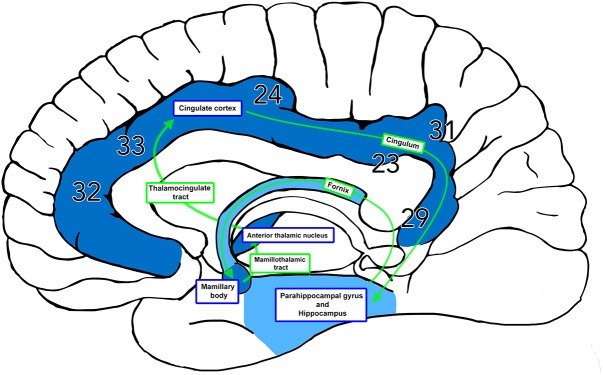
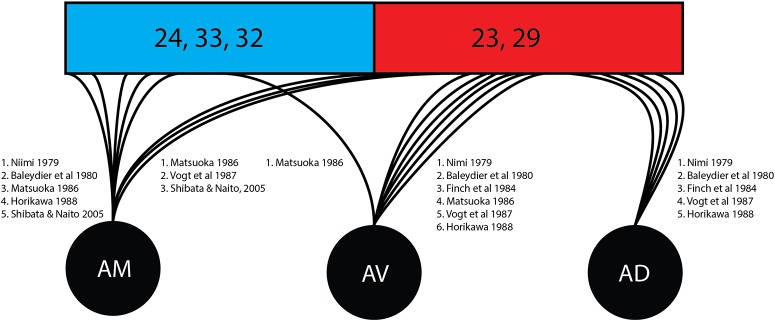
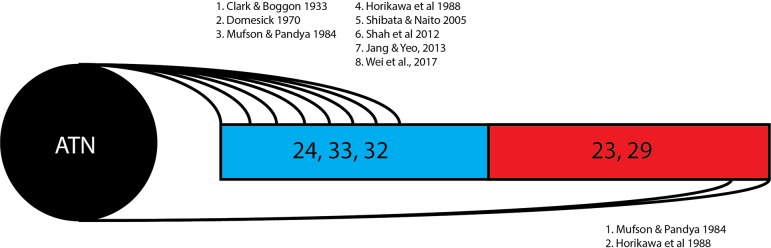
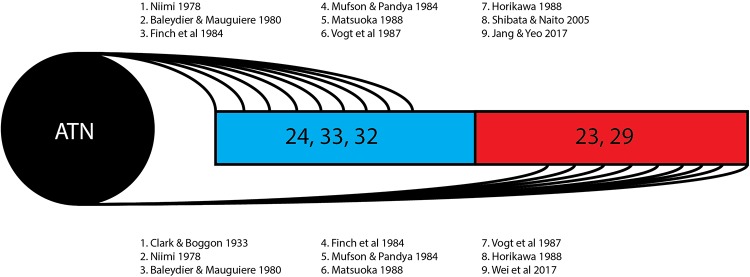
The thalamocingulate tract is a key component of the Papez circuit that connects the anterior thalamic nucleus (ATN) to the cingulum bundle. While the other white matter connections, consisting of the fornix, cingulum bundle and mammillothalamic tract, were well defined in Papez's original 1937 paper, the anatomy of the thalamocingulate pathway was mentioned only in passing. Subsequent research has been unable to clarify the precise anatomical trajectory of this tract. In particular, the site of thalamocingulate tract interactions with the cingulum bundle have been inconsistently reported. This review aims to synthesize research on this least studied component of the Papez circuit. A systemic approach to reviewing historical anatomical dissection and neuronal tracing studies as well as contemporary diffusion magnetic resonance imaging studies of the thalamocingulate tract was undertaken across species. We found that although inconsistent, prior research broadly encompasses two differing descriptions of how the ATN interfaces with the cingulum after passing laterally through the anterior limb of the internal capsule. The first group of studies show that the pathway turns medially and rostrally and passes to the anterior cingulate region (Brodmann areas 24, 33, and 32) only. A second group suggests that the thalamocingulate tract interfaces with both the anterior and posterior cingulate (Brodmann areas 23 and 31) and retrosplenial region (Brodmann area 29). We discuss potential reasons for these discrepancies such as altering methodologies and species differences. We also discuss how these inconsistencies may be resolved in further research with refinements of terminology for the cingulate cortex and the thalamocingulate tract. Understanding the precise anatomical course of the last remaining unresolved final white matter tract in the Papez circuit may facilitate accurate investigation of the role of the complete Papez circuit in emotion and memory.
丘脑扣带回束是Papez环路的关键组成部分,它将丘脑前核(ATN)与扣带束相连。虽然其他白质连接,包括穹窿、扣带束和乳头丘脑束,在Papez 1937年的原始论文中已有明确界定,但丘脑扣带回通路的解剖结构仅被顺带提及。后续研究未能阐明该束的确切解剖轨迹。特别是,关于丘脑扣带回束与扣带束相互作用的部位,报道并不一致。本综述旨在综合对Papez环路中这一研究最少的组成部分的研究。我们采用系统的方法,全面回顾了跨物种的历史解剖学 dissections和神经元追踪研究,以及当代对丘脑扣带回束的扩散磁共振成像研究。我们发现,尽管存在不一致之处,但先前的研究大致涵盖了两种不同的描述,即ATN在横向穿过内囊前肢后如何与扣带束连接。第一组研究表明,该通路向内侧和 Rostrally 转弯,仅通向扣带回前部区域(Brodmann 区 24、33 和 32)。第二组研究表明,丘脑扣带回束与扣带回前部和后部(Brodmann 区 23 和 31)以及压后皮质区域(Brodmann 区 29)均有连接。我们讨论了这些差异的潜在原因,如方法的改变和物种差异。我们还讨论了如何通过完善扣带回皮质和丘脑扣带回束的术语,在进一步的研究中解决这些不一致之处。了解Papez环路中最后一个尚未解决的最终白质束的确切解剖过程,可能有助于准确研究完整的Papez环路在情感和记忆中的作用。