Hosokawa Yuri, Nagata Takashi, Hasegawa Manabu
College of Sport and Health Science, Ritsumeikan University, Kusatsu, Japan.
Faculty of Medical Sciences, Kyushu University, Fukuoka, Japan.
Front Physiol. 2019 Feb 18;10:108. doi: 10.3389/fphys.2019.00108. eCollection 2019.
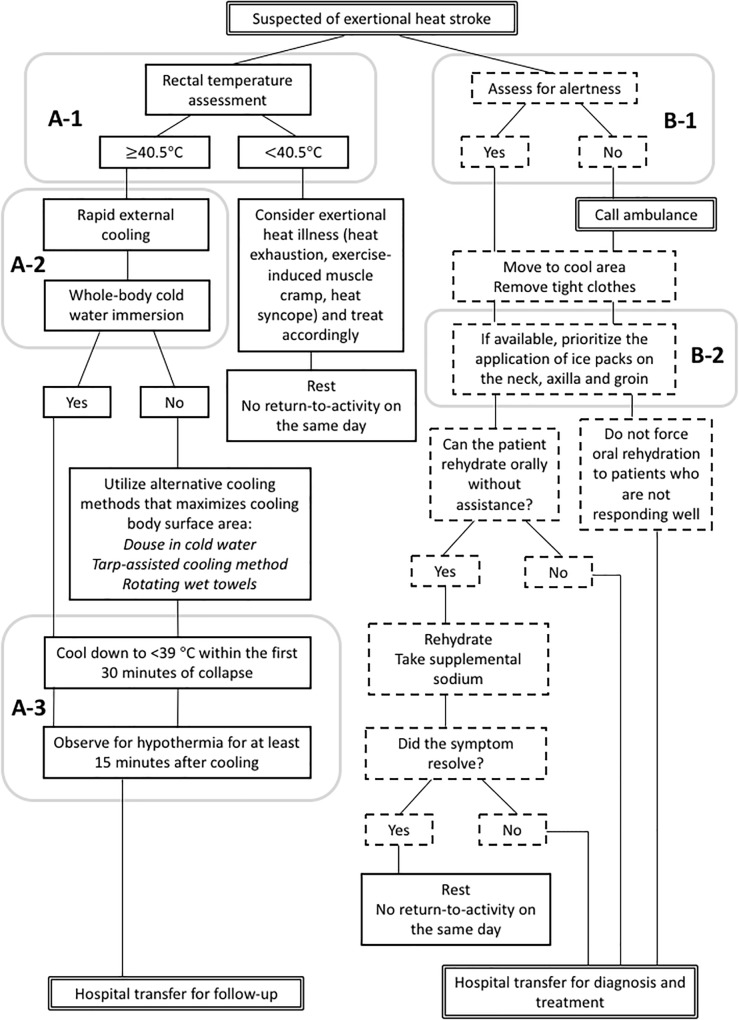
Tokyo 2020 Summer Olympics are projected to experience environmental heat stress that surpasses the environmental conditions observed in the Atlanta (1996), Athens (2004), Beijing (2008), and Rio (2016) Summer Olympics. This raises particular concerns for athletes who will likely to be exposed to extreme heat during the competitions. Therefore, in mass-participation event during warm season, it is vital for the hosting organization to build preparedness and resilience against heat, including appropriate treatment, and management strategies for exertional heat stroke (EHS). However, despite the existing literature regarding the evidence-based management of EHS, rectal thermometry and whole-body cold-water immersion are not readily accepted by medical professionals outside of the sports, and military medicine professionals. Current Japanese medical standard is no exception in falling behind on evidence-based management of EHS. Therefore, the first aim of this paper is to elucidate the inconsistency between the standard of care provided in Japan for EHS and what has been accepted as the gold standard by the scientific literature. The second aim of this paper is to provide optimal EHS management strategies that should be implemented at the Tokyo 2020 Summer Olympics from organizational level to maximize the safety of athletes and to improve organizational resilience to heat. The risk of extreme heat is often neglected until a catastrophic incidence occurs. It is vital for the Japanese medical leadership and athletic communities to re-examine the current EHS management strategies and implement evidence-based countermeasure for EHS to expand the application of scientific knowledge.
预计2020年东京夏季奥运会将面临超过亚特兰大(1996年)、雅典(2004年)、北京(2008年)和里约(2016年)夏季奥运会所观测到的环境热应激。这引发了对运动员的特别关注,他们在比赛期间可能会暴露在极端高温环境中。因此,在温暖季节的大众参与赛事中,主办机构做好应对高温的准备并具备应对能力至关重要,包括对劳力性热射病(EHS)的适当治疗和管理策略。然而,尽管现有关于EHS循证管理的文献,但直肠测温法和全身冷水浸泡并未被体育界和军事医学领域之外的医学专业人员广泛接受。当前日本的医学标准在EHS循证管理方面也不例外,同样滞后。因此,本文的首要目的是阐明日本提供的EHS护理标准与科学文献中公认的金标准之间的不一致性。本文的第二个目的是提供在2020年东京夏季奥运会从组织层面应实施的最佳EHS管理策略,以最大限度地保障运动员安全并提高组织对高温的应对能力。极端高温风险往往在灾难性事件发生之前被忽视。日本医学领导层和体育界重新审视当前的EHS管理策略并实施基于证据的EHS应对措施以扩大科学知识的应用至关重要。