Cai Lixiong, Huo Zhiqian, Yang Haiyun, He Fengchun, Cao Zhenglin, Wu Feng, Liu Lianjun, Sun Bingyin
Department of Traumatology and Orthopedics, Foshan Hospital of TCM, Foshan 528000, China.
Department of Spine Osteopathy, Nanhai Hospital of Southen Medical University, Foshan 528000, China.
Iran J Basic Med Sci. 2019 Feb;22(2):173-178. doi: 10.22038/IJBMS.2018.29498.7123.
The prognosis of osteoporosis is very poor, and it is very important to identify a biomarker for prevention of osteoporosis. In this study, we aimed to identify candidate markers in osteoporosis and to investigate the role of candidate markers in osteogenic differentiation.
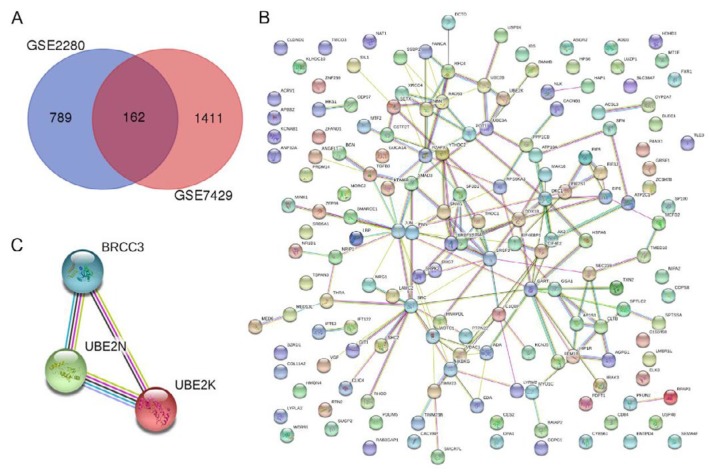
Using Weighted Gene Co-Expression Network analysis, we identified three hub genes might associate with osteoporosis. The mRNA expression of hub genes in osteoblasts from osteoporosis patients or healthy donor was detected by qRT-PCR. Using siRNA and overexpression, we investigated the role of hub gene BRCC3 in osteogenic differentiation by alkaline phosphatase staining and Alizarin red staining. Moreover, the role of β-catenin signaling in the osteogenic differentiation was detected by using β-catenin signaling inhibitor XAV939.
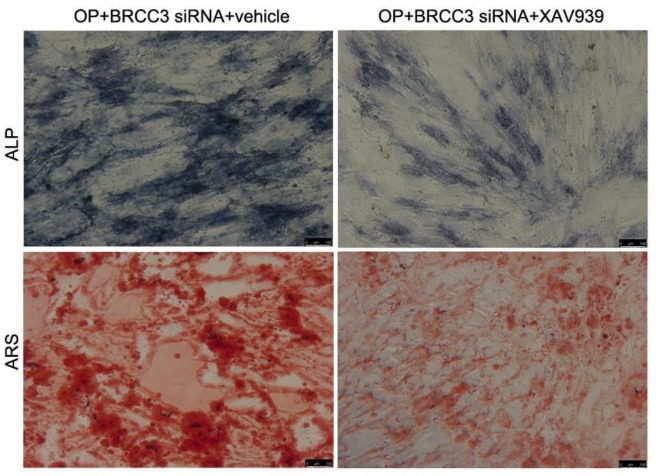
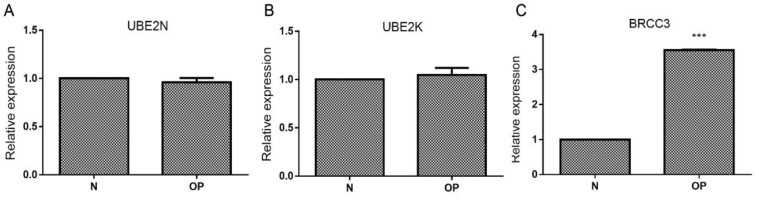
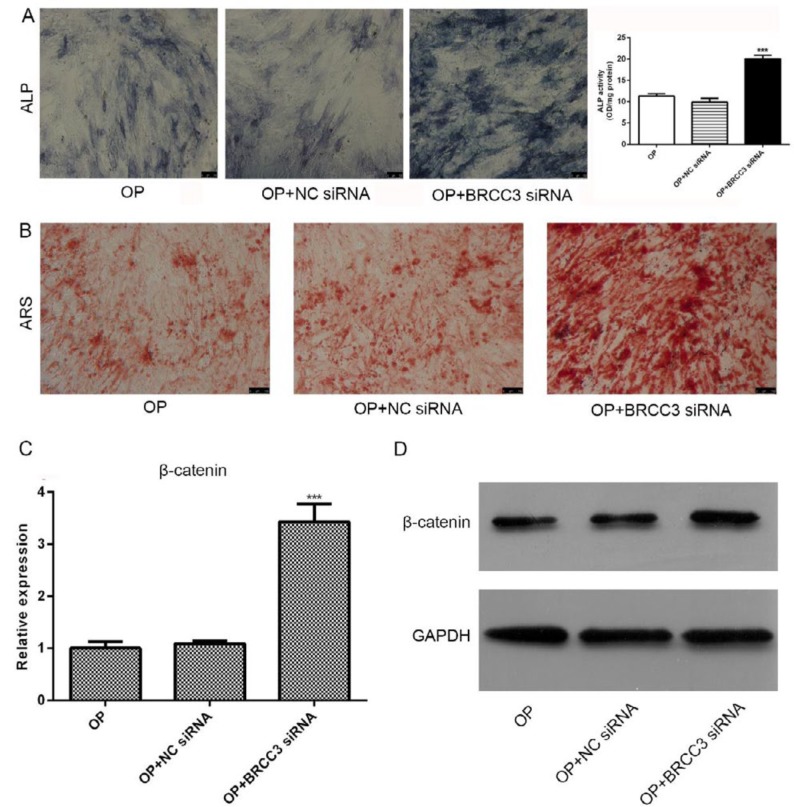
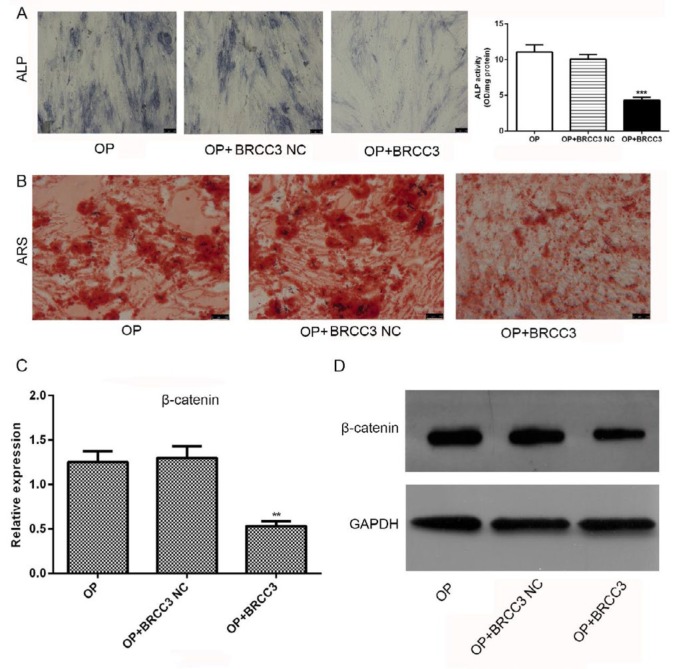
We identified three hub genes that might associate with osteoporosis including BRCC3, UBE2N, and UBE2K. UBE2N mRNA and UBE2K mRNA were not changed in osteoblasts isolated from osteoporosis patients, compared with healthy donors, whereas BRCC3 mRNA was significantly increased. Depletion of BRCC3 promoted the activation of alkaline phosphatase and formation of calcified nodules in osteoblasts isolated from osteoporosis patients and up-regulated β-catenin expression. XAV939 reversed the BRCC3 siRNA-induced osteogenic differentiation. Additionally, inhibited osteogenic differentiation was also observed after BACC3 overexpression, and this was accompanied by decreased β-catenin expression.
BRCC3 is an important regulator for osteogenic differentiation of osteoblasts through β-catenin signaling, and it might be a promising target for osteoporosis treatment.
骨质疏松症的预后很差,识别一种预防骨质疏松症的生物标志物非常重要。在本研究中,我们旨在识别骨质疏松症的候选标志物,并研究候选标志物在成骨分化中的作用。
使用加权基因共表达网络分析,我们识别出三个可能与骨质疏松症相关的枢纽基因。通过qRT-PCR检测骨质疏松症患者或健康供体来源的成骨细胞中枢纽基因的mRNA表达。使用小干扰RNA(siRNA)和过表达技术,通过碱性磷酸酶染色和茜素红染色研究枢纽基因BRCC3在成骨分化中的作用。此外,使用β-连环蛋白信号抑制剂XAV939检测β-连环蛋白信号在成骨分化中的作用。
我们识别出三个可能与骨质疏松症相关的枢纽基因,包括BRCC3、UBE2N和UBE2K。与健康供体相比,从骨质疏松症患者分离的成骨细胞中UBE2N mRNA和UBE2K mRNA没有变化,而BRCC3 mRNA显著增加。敲低BRCC3可促进从骨质疏松症患者分离的成骨细胞中碱性磷酸酶的激活和钙化结节的形成,并上调β-连环蛋白的表达。XAV939逆转了BRCC3 siRNA诱导的成骨分化。此外,BRCC3过表达后也观察到成骨分化受到抑制,同时伴有β-连环蛋白表达降低。
BRCC3是通过β-连环蛋白信号通路调节成骨细胞成骨分化的重要调节因子,可能是骨质疏松症治疗的一个有前景的靶点。