Kouam Marc K, Tchouankui Honorine N, Ngapagna Arouna Njayou
Department of Animal Production, Faculty of Agronomy and Agricultural Sciences, P.O. Box 188, Dschang, Cameroon.
Center for Research on Filariasis and Other Tropical Diseases (CRFilMT), P.O. Box 5797, Yaoundé, Cameroon.
Vet Med Int. 2019 Jan 27;2019:3796369. doi: 10.1155/2019/3796369. eCollection 2019.
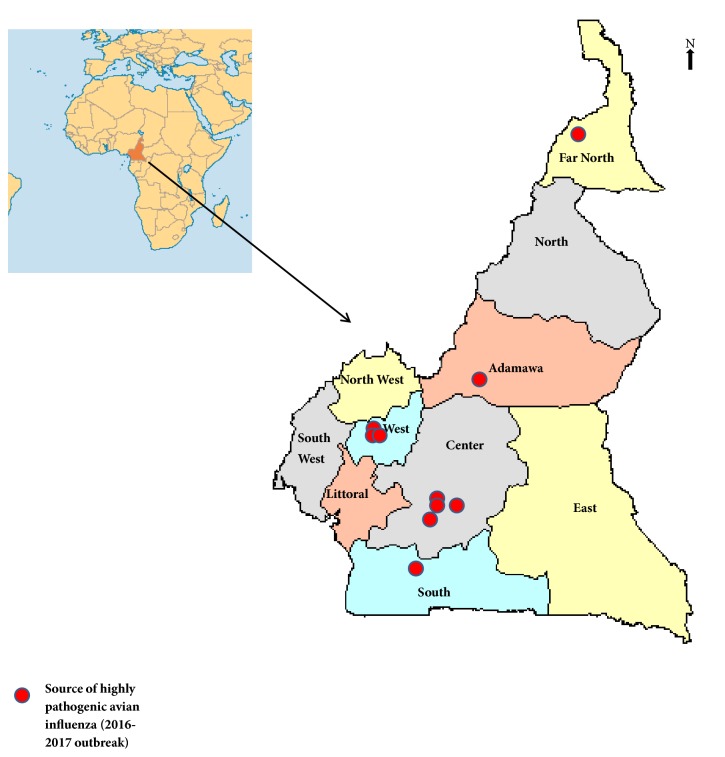
The epidemiology of avian influenza is unknown in Cameroon despite the two outbreaks that occurred in 2006 and 2016-2017, respectively. In order to fill the gap, an attempt was made to provide some basic information on the epidemiology of highly pathogenic avian influenza in Cameroon. Thus, data were collected from follow-up reports of the second HPAI outbreaks prepared by the veterinary health officials of Cameroon and sent to the World Organisation for Animal Health (OIE). Two HPAI virus strains (H5N1 and H5N8) turned out to occur, with H5N1 virus involved in the Center, South, West, and Adamawa regions outbreaks and H5N8 involved in the Far North outbreak only. The affected hosts were the laying hens, backyard chickens, turkeys, guinea fowls, ducks, broiler and layer breeders, and geese for the H5N1 virus and the Indian peafowl (), pigeon, ducks, backyard chickens, and guinea fowls for the H5N8 virus. The first outbreak took place in Mvog-Betsi poultry complex in the Center region on the 20 May 2016 and spread to other regions. The mortality rate varied from 8% to 72% for H5N1 virus and was 96.26% for the H5N8 strain in Indian peafowl. No human case was recorded. The potential supporting factors for disease dissemination identified on the field were the following: poultry and eggs dealers moving from one farm, market, or town to another without any preventive care; poor biosecurity measures on farms and live poultry markets. After the first HPAI H5N1 virus outbreak in 2006, the second HPAI outbreak ten years later (2016-2017) involving two virus strains is a cause of concern for the poultry industry. The Cameroon Epidemio-Surveillance Network needs to be more watchful.
尽管喀麦隆分别在2006年和2016 - 2017年发生了两次禽流感疫情,但其禽流感流行病学情况仍不为人知。为了填补这一空白,人们试图提供一些关于喀麦隆高致病性禽流感流行病学的基本信息。因此,数据收集自喀麦隆兽医卫生官员编写并提交给世界动物卫生组织(OIE)的第二次高致病性禽流感疫情的后续报告。结果发现有两种高致病性禽流感病毒株(H5N1和H5N8)出现,其中H5N1病毒株涉及中部、南部、西部和阿达马瓦地区的疫情,而H5N8仅涉及远北地区的疫情。受影响的宿主方面,H5N1病毒影响蛋鸡、后院鸡、火鸡、珍珠鸡、鸭、肉鸡和蛋种鸡以及鹅,H5N8病毒影响印度孔雀、鸽子、鸭、后院鸡和珍珠鸡。首次疫情于2016年5月20日在中部地区的姆沃格 - 贝齐家禽养殖场爆发,并蔓延至其他地区。H5N1病毒的死亡率在8%至72%之间,H5N8毒株在印度孔雀中的死亡率为96.26%。未记录到人类病例。在实地确定的疾病传播潜在支持因素如下:家禽和鸡蛋经销商在没有任何预防措施的情况下从一个农场、市场或城镇转移到另一个地方;农场和活禽市场的生物安全措施不力。2006年首次爆发高致病性禽流感H5N1病毒疫情后,十年后的第二次高致病性禽流感疫情(2016 - 2017年)涉及两种病毒株,这引起了家禽业的关注。喀麦隆流行病监测网络需要更加警惕。