1 University of Miami Miller School of Medicine Miami FL.
2 University of Miami School of Architecture Coral Gables FL.
J Am Heart Assoc. 2019 Mar 19;8(6):e010258. doi: 10.1161/JAHA.118.010258.
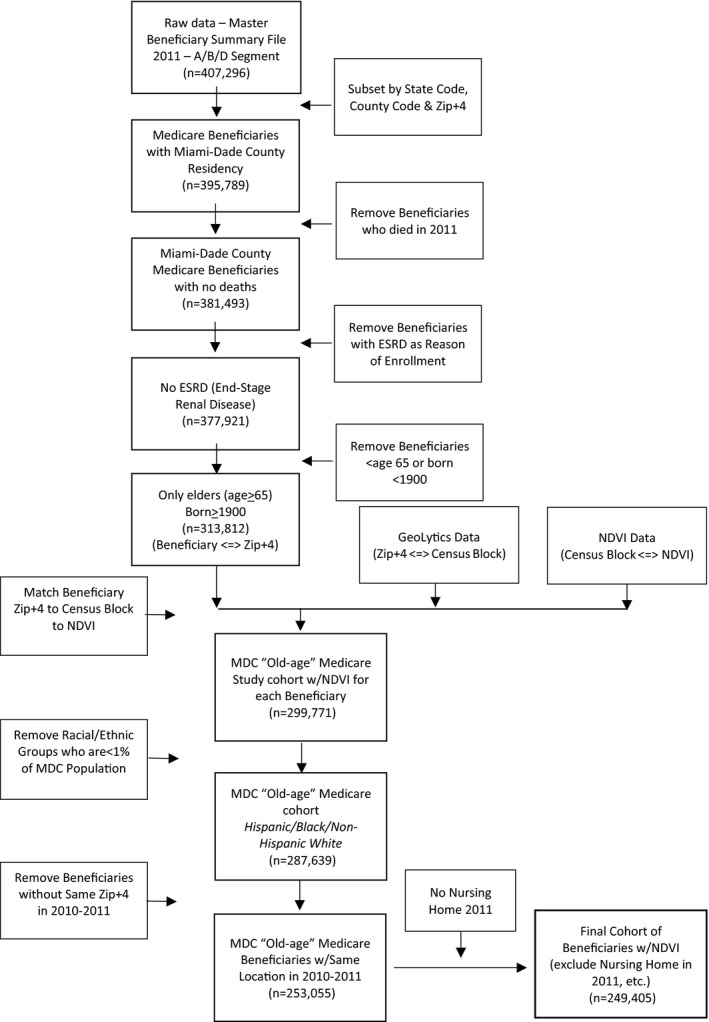
Background Nature exposures may be associated with reduced risk of heart disease. The present study examines the relationship between objective measures of neighborhood greenness (vegetative presence) and 4 heart disease diagnoses (acute myocardial infarction, ischemic heart disease, heart failure, and atrial fibrillation) in a population-based sample of Medicare beneficiaries. Methods and Results The sample included 249 405 Medicare beneficiaries aged 65 years and older whose location ( ZIP +4) in Miami-Dade County, Florida, did not change from 2010 to 2011. Analyses examined relationships between greenness, measured by mean block-level normalized difference vegetation index from satellite imagery, and 4 heart disease diagnoses. Hierarchical regression analyses, in a multilevel framework, assessed the relationship of greenness to each heart disease diagnosis, adjusting successively for individual sociodemographics, neighborhood income, and biological risk factors (diabetes mellitus, hypertension, and hyperlipidemia). Higher greenness was associated with reduced heart disease risk, adjusting for individual sociodemographics and neighborhood income. Compared with the lowest tertile of greenness, the highest tertile of greenness was associated with reduced odds of acute myocardial infarction by 25% (odds ratio, 0.75; 95% CI , 0.63-0.90), ischemic heart disease by 20% (odds ratio, 0.80; 95% CI , 0.77-0.83), heart failure by 16% (odds ratio, 0.84; 95% CI , 0.80-0.88), and atrial fibrillation by 6% (odds ratio, 0.94; 95% CI , 0.87-1.00). Associations were attenuated after adjusting for biological risk factors, suggesting that cardiometabolic risk factors may partly mediate the greenness to heart disease relationships. Conclusions Neighborhood greenness may be associated with reduced heart disease risk. Strategies to increase area greenness may be a future means of reducing heart disease at the population level.
自然暴露可能与降低心脏病风险有关。本研究在迈阿密-戴德县的 Medicare 受益人群中,使用客观的社区绿化指标(植被覆盖率),调查了与 4 种心脏病诊断(急性心肌梗死、缺血性心脏病、心力衰竭和心房颤动)的关系。
研究样本包括 249405 名年龄在 65 岁及以上的 Medicare 受益人,其在佛罗里达州迈阿密-戴德县的位置(ZIP+4)在 2010 年至 2011 年期间没有变化。分析了通过卫星图像获得的平均街区归一化差异植被指数(NDVI)衡量的绿化与 4 种心脏病诊断之间的关系。多层次框架中的分层回归分析评估了绿化与每种心脏病诊断的关系,依次调整个人社会人口统计学、邻里收入和生物危险因素(糖尿病、高血压和高脂血症)。
在调整了个人社会人口统计学和邻里收入后,较高的绿化与较低的心脏病风险相关。与绿化最低 tertile 相比,绿化最高 tertile 与急性心肌梗死的风险降低 25%(比值比,0.75;95%可信区间,0.63-0.90)、缺血性心脏病降低 20%(比值比,0.80;95%可信区间,0.77-0.83)、心力衰竭降低 16%(比值比,0.84;95%可信区间,0.80-0.88)和心房颤动降低 6%(比值比,0.94;95%可信区间,0.87-1.00)相关。在调整生物危险因素后,相关性减弱,表明心血管代谢危险因素可能部分介导绿化与心脏病之间的关系。
社区绿化可能与降低心脏病风险有关。增加区域绿化的策略可能是未来降低人群心脏病的一种手段。