Cancer Biology Program, University of Hawaii Cancer Center, Honolulu, Hawaii.
Department of Hepatobiliary Surgery, The Affiliated Drum Tower Hospital of Nanjing University Medical School, Nanjing, Jiangsu, China.
Gastroenterology. 2019 Jun;156(8):2297-2312. doi: 10.1053/j.gastro.2019.02.040. Epub 2019 Mar 2.
BACKGROUND & AIMS: Interleukin 6 (IL6) and tumor necrosis factor contribute to the development of colitis-associated cancer (CAC). We investigated these signaling pathways and the involvement of G protein subunit alpha i1 (GNAI1), GNAI2, and GNAI3 in the development of CAC in mice and humans.
B6;129 wild-type (control) or mice with disruption of Gnai1, Gnai2, and/or Gnai3 or conditional disruption of Gnai2 in CD11c or epithelial cells were given dextran sulfate sodium (DSS) to induce colitis followed by azoxymethane (AOM) to induce carcinogenesis; some mice were given an antibody against IL6. Feces were collected from mice, and the compositions of microbiomes were analyzed by polymerase chain reactions. Dendritic cells (DCs) and myeloid-derived suppressor cells (MDSCs) isolated from spleen and colon tissues were analyzed by flow cytometry. We performed immunoprecipitation and immunoblot analyses of colon tumor tissues, MDSCs, and mouse embryonic fibroblasts to study the expression levels of GNAI1, GNAI2, and GNAI3 and the interactions of GNAI1 and GNAI3 with proteins in the IL6 signaling pathway. We analyzed the expression of Gnai2 messenger RNA by CD11c cells in the colonic lamina propria by PrimeFlow, expression of IL6 in DCs by flow cytometry, and secretion of cytokines in sera and colon tissues by enzyme-linked immunosorbent assay. We obtained colon tumor and matched nontumor tissues from 83 patients with colorectal cancer having surgery in China and 35 patients with CAC in the United States. Mouse and human colon tissues were analyzed by histology, immunoblot, immunohistochemistry, and/or RNA-sequencing analyses.
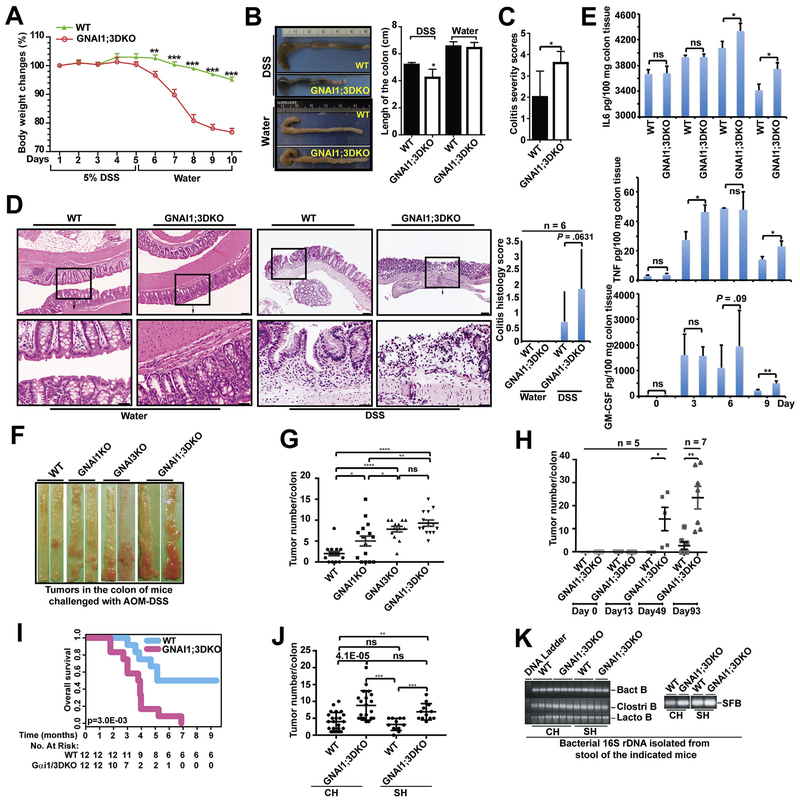
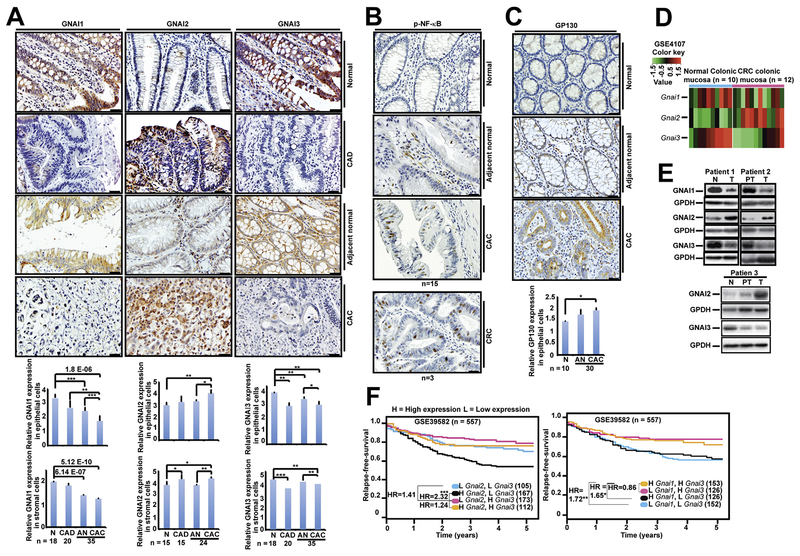
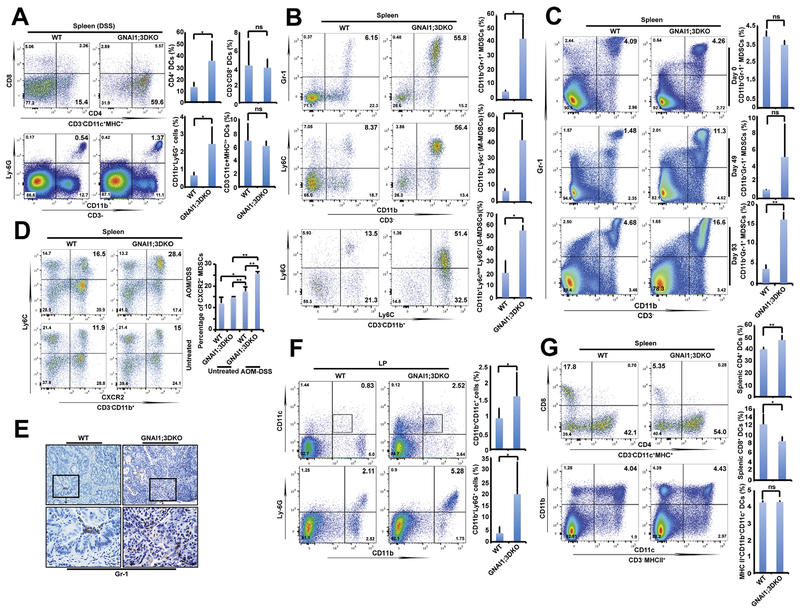
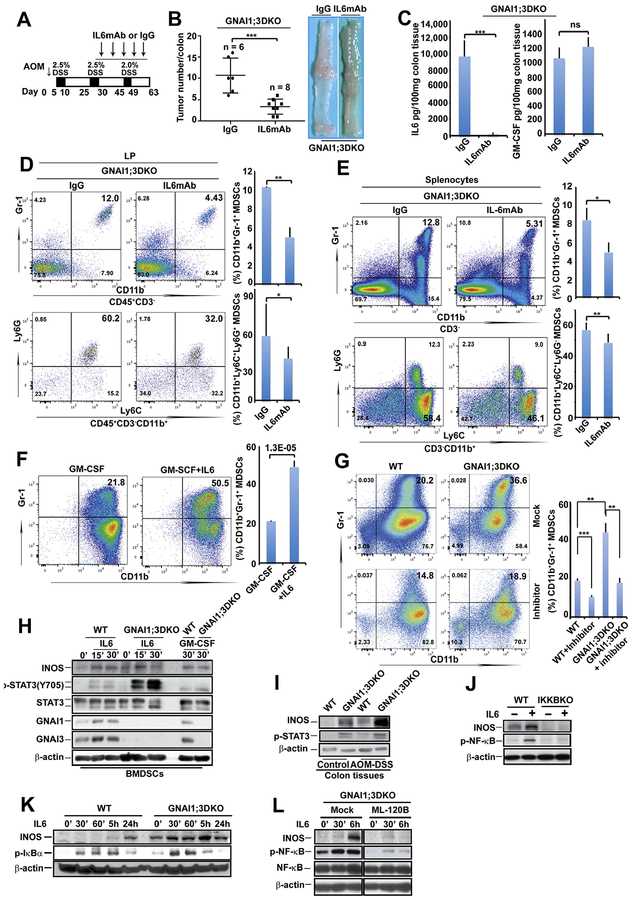
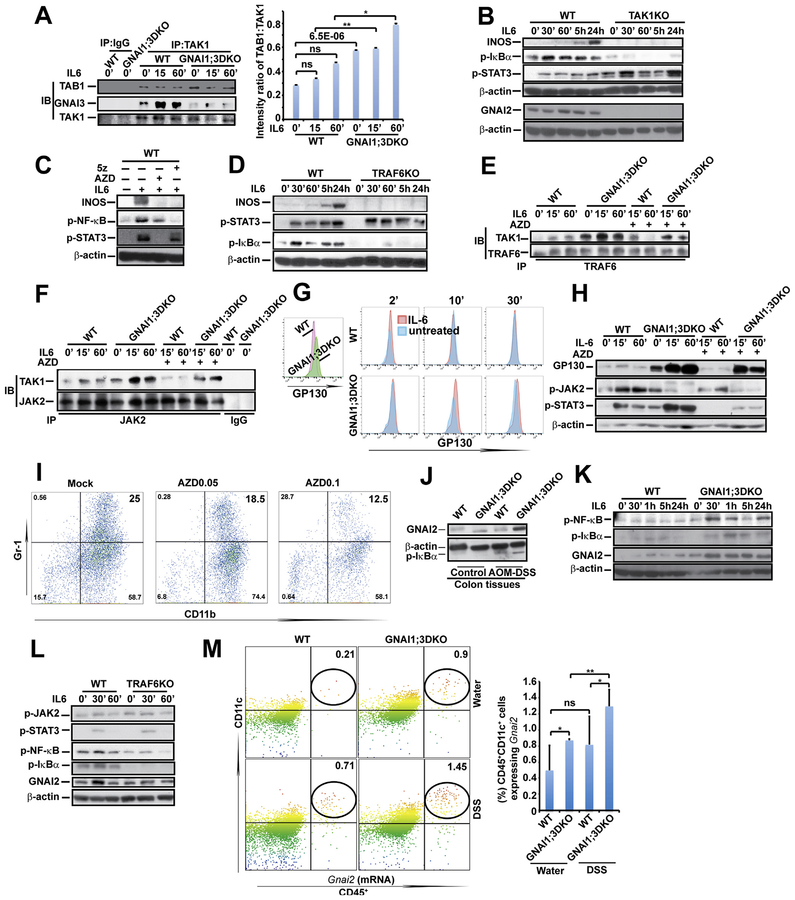
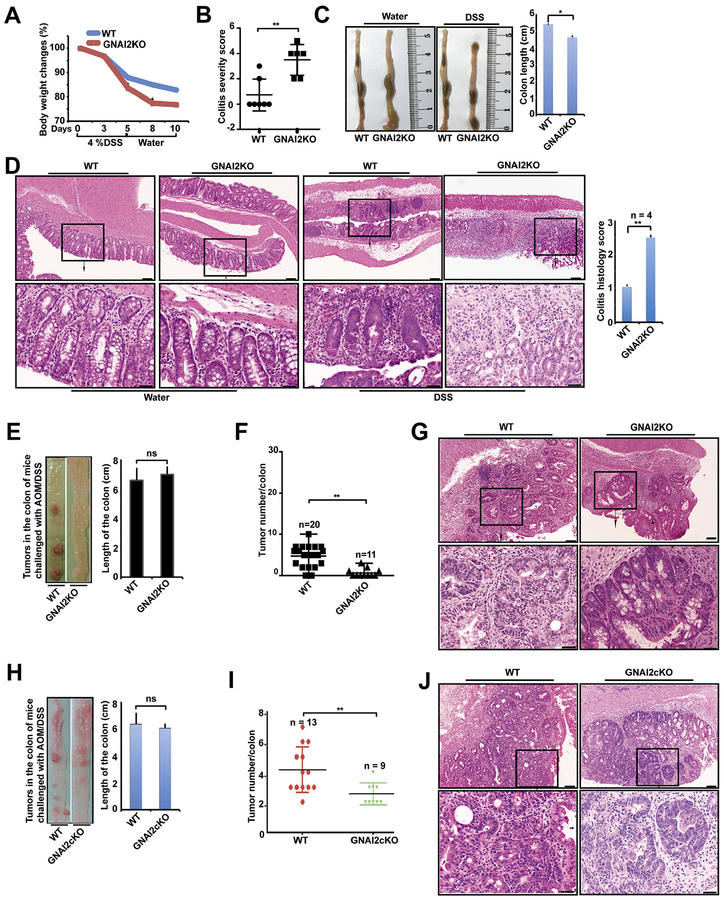
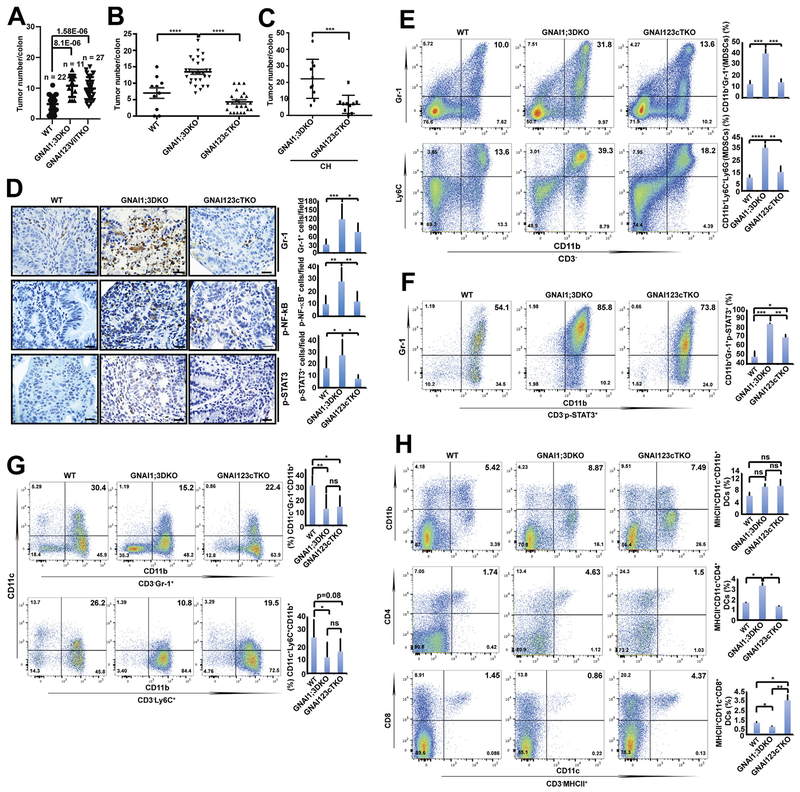
GNAI1 and GNAI3 (GNAI1;3) double-knockout (DKO) mice developed more severe colitis after administration of DSS and significantly more colonic tumors than control mice after administration of AOM plus DSS. Development of increased tumors in DKO mice was not associated with changes in fecal microbiomes but was associated with activation of nuclear factor (NF) κB and signal transducer and activator of transcription (STAT) 3; increased levels of GNAI2, nitric oxide synthase 2, and IL6; increased numbers of CD4 DCs and MDSCs; and decreased numbers of CD8 DCs. IL6 was mainly produced by CD4/CD11b, but not CD8, DCs in DKO mice. Injection of DKO mice with a blocking antibody against IL6 reduced the expansion of MDSCs and the number of tumors that developed after CAC induction. Incubation of MDSCs or mouse embryonic fibroblasts with IL6 induced activation of either NF-κB by a JAK2-TRAF6-TAK1-CHUK/IKKB signaling pathway or STAT3 by JAK2. This activation resulted in expression of GNAI2, IL6 signal transducer (IL6ST, also called GP130) and nitric oxide synthase 2, and expansion of MDSCs; the expression levels of these proteins and expansion of MDSCs were further increased by the absence of GNAI1;3 in cells and mice. Conditional disruption of Gnai2 in CD11c cells of DKO mice prevented activation of NF-κB and STAT3 and changes in numbers of DCs and MDSCs. Colon tumor tissues from patients with CAC had reduced levels of GNAI1 and GNAI3 and increased levels of GNAI2 compared with normal tissues. Further analysis of a public human colorectal tumor DNA microarray database (GSE39582) showed that low Gani1 and Gnai3 messenger RNA expression and high Gnai2 messenger RNA expression were significantly associated with decreased relapse-free survival.
GNAI1;3 suppresses DSS-plus-AOM-induced colon tumor development in mice, whereas expression of GNAI2 in CD11c cells and IL6 in CD4/CD11b DCs appears to promote these effects. Strategies to induce GNAI1;3, or block GNAI2 and IL6, might be developed for the prevention or therapy of CAC in patients.
白细胞介素 6(IL6)和肿瘤坏死因子有助于结肠炎相关癌症(CAC)的发展。我们研究了这些信号通路以及 G 蛋白亚基α i1(GNAI1)、GNAI2 和 GNAI3 在小鼠和人类 CAC 发展中的作用。
给予 B6;129 野生型(对照)或 Gnai1、Gnai2 和/或 Gnai3 缺失或 CD11c 或上皮细胞中 Gnai2 条件性缺失的小鼠葡聚糖硫酸钠(DSS)诱导结肠炎,然后给予氧化偶氮甲烷(AOM)诱导癌变;一些小鼠给予抗 IL6 抗体。从小鼠中收集粪便,并通过聚合酶链反应分析微生物组的组成。通过流式细胞术分析来自脾和结肠组织的树突状细胞(DCs)和髓样来源的抑制细胞(MDSCs)。我们进行免疫沉淀和免疫印迹分析结肠肿瘤组织、MDSCs 和小鼠胚胎成纤维细胞,以研究 GNAI1、GNAI2 和 GNAI3 的表达水平以及 GNAI1 和 GNAI3 与 IL6 信号通路中蛋白的相互作用。我们通过 PrimeFlow 分析结肠固有层中 CD11c 细胞的 Gnai2 信使 RNA 表达、流式细胞术分析 DC 中的 IL6 表达以及酶联免疫吸附试验分析血清和结肠组织中的细胞因子分泌。我们从中国接受手术的 83 名结直肠癌患者和美国的 35 名 CAC 患者中获得了结肠肿瘤和匹配的非肿瘤组织。通过组织学、免疫印迹、免疫组织化学和/或 RNA 测序分析分析了小鼠和人类结肠组织。
GNAI1 和 GNAI3(GNAI1;3)双敲除(DKO)小鼠在给予 DSS 后发生更严重的结肠炎,在给予 AOM 加 DSS 后发生明显更多的结肠肿瘤。DKO 小鼠肿瘤增加的发展与粪便微生物组的变化无关,但与核因子(NF)κB 和信号转导和转录激活因子(STAT)3 的激活、GNAI2、一氧化氮合酶 2 和 IL6 水平的增加、CD4 DCs 和 MDSCs 数量的增加以及 CD8 DCs 数量的减少有关。在 DKO 小鼠中,IL6 主要由 CD4/CD11b,但不是 CD8,DC 产生。用抗 IL6 抗体阻断 DKO 小鼠的注射减少了 MDSC 的扩张和 CAC 诱导后肿瘤的发生。用 IL6 孵育 MDSC 或小鼠胚胎成纤维细胞可通过 JAK2-TRAF6-TAK1-CHUK/IKKB 信号通路诱导 NF-κB 的激活或通过 JAK2 诱导 STAT3 的激活。这种激活导致 GNAI2、IL6 信号转导物(IL6 信号转导物,也称为 GP130)和一氧化氮合酶 2 的表达以及 MDSC 的扩张;在细胞和小鼠中缺乏 GNAI1;3 时,这些蛋白质的表达水平和 MDSC 的扩张进一步增加。在 DKO 小鼠的 CD11c 细胞中条件性敲除 Gnai2 可防止 NF-κB 和 STAT3 的激活以及 DC 和 MDSC 数量的变化。CAC 患者的结肠肿瘤组织与正常组织相比,GNAI1 和 GNAI3 的水平降低,GNAI2 的水平升高。对公共人类结直肠肿瘤 DNA 微阵列数据库(GSE39582)的进一步分析表明,低 Gani1 和 Gnai3 信使 RNA 表达和高 Gnai2 信使 RNA 表达与无复发生存率降低显著相关。
GNAI1;3 抑制小鼠 DSS 加 AOM 诱导的结肠肿瘤发展,而 CD11c 细胞中 GNAI2 的表达和 CD4/CD11b DC 中的 IL6 表达似乎促进了这些作用。诱导 GNAI1;3 或阻断 GNAI2 和 IL6 的策略可能会为患者的 CAC 预防或治疗提供依据。