Department of Civil Engineering, The University of Tokyo, Tokyo, Japan.
Department of Atmospheric and Oceanic Sciences, University of California, Los Angeles, Los Angeles, CA, USA.
Sci Rep. 2019 Mar 5;9(1):3483. doi: 10.1038/s41598-019-39936-2.
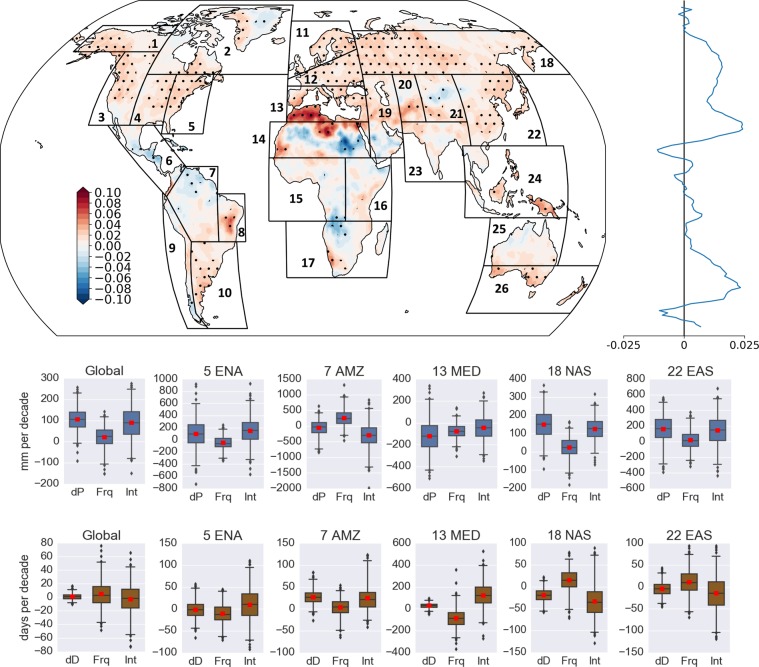
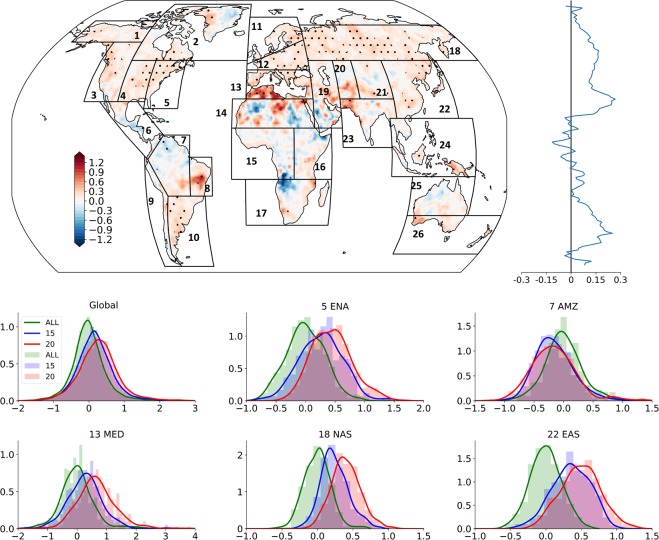
The Paris agreement was adopted to hold the global average temperature increase to well below 2 °C and pursue efforts to limit it to 1.5 °C. Here, we investigate the event-to-event hydroclimatic intensity, where an event is a pair of adjacent wet and dry spells, under future warming scenarios. According to a set of targeted multi-model large ensemble experiments, event-wise intensification will significantly increase globally for an additional 0.5 °C warming beyond 1.5 °C. In high latitudinal regions of the North American continent and Eurasia, this intensification is likely to involve overwhelming increases in wet spell intensity. Western and Eastern North America will likely experience more intense wet spells with negligible changes of dry spells. For the Mediterranean region, enhancement of dry spells seems to be dominating compared to the decrease in wet spell strength, and this will lead to an overall event-wise intensification. Furthermore, the extreme intensification could be 10 times stronger than the mean intensification. The high damage potential of such drastic changes between flood and drought conditions poses a major challenge to adaptation, and the findings suggest that risks could be substantially reduced by achieving a 1.5 °C target.
《巴黎协定》的通过旨在将全球平均气温升幅控制在远低于 2°C 以下,并努力将气温升幅限制在 1.5°C 以内。在这里,我们研究了未来变暖情景下,由相邻湿润期和干燥期组成的事件的逐次水文气候强度。根据一组有针对性的多模式大型集合试验,在 1.5°C 以上额外升温 0.5°C的情况下,全球的事件强度将显著增加。在北美大陆和欧亚大陆的高纬度地区,这种强度的增加很可能涉及到湿润期强度的压倒性增加。北美西部和东部可能会经历更强烈的湿润期,而干燥期的变化可以忽略不计。对于地中海地区,与湿润期强度下降相比,干旱期的增强似乎占据主导地位,这将导致整体事件强度的增加。此外,极端强度可能比平均强度强 10 倍。这种洪水和干旱条件之间剧烈变化的高破坏潜力对适应构成了重大挑战,研究结果表明,通过实现 1.5°C 的目标,可以大大降低风险。