1 Department of Endocrinology, The Second Affiliated Hospital of Soochow University, Suzhou, P. R. China.
2 Center for Translational Pain Medicine, Institute of Neuroscience, Soochow University, Suzhou, P. R. China.
Mol Pain. 2019 Jan-Dec;15:1744806919838659. doi: 10.1177/1744806919838659.
Diabetic neuropathic pain is a refractory and disabling complication of diabetes mellitus. The pathogenesis of the diabetic neuropathic pain is still unclear, and treatment is insufficient. The aim of this study is to investigate the roles of glucose-6-phosphate dehydrogenase (G6PD) and toll-like receptor 4 (TLR4) in neuropathic pain in rats with diabetes.
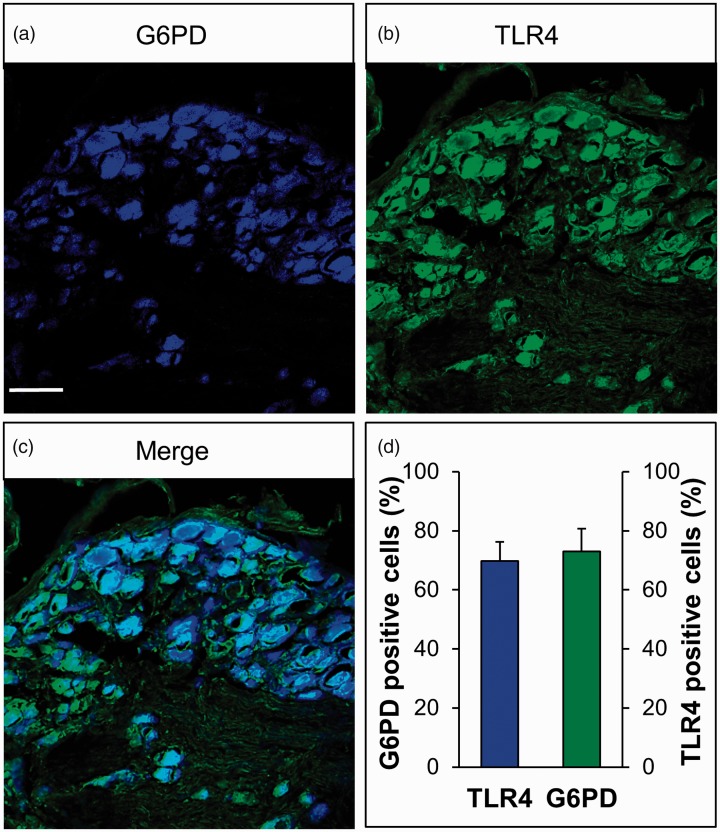
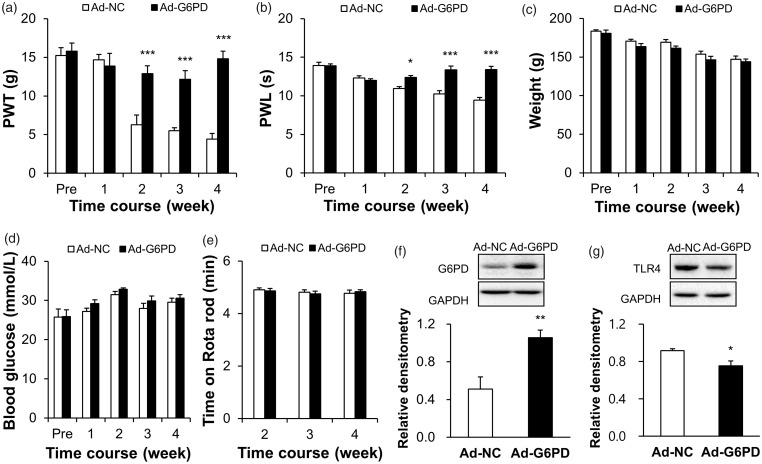
Type 1 diabetes model was induced by intraperitoneal injection of streptozotocin (STZ, 75 mg/kg) in adult female Sprague-Dawley rats. Paw withdrawal threshold and paw withdrawal latency of rats were measured by von Frey filaments and thermal radiation, respectively. The expressions of G6PD and TLR4 in L4-L6 dorsal root ganglions (DRGs) were measured by western blotting and quantitative real-time polymerase chain reaction analysis. Fluorescent immunohistochemistry was employed to detect expressions of G6PD and TLR4 and co-location of G6PD with TLR4.
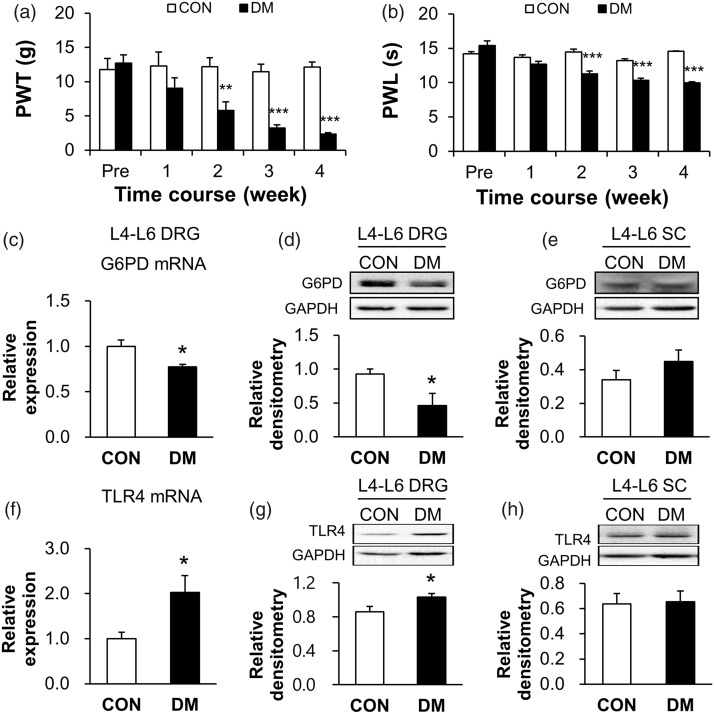
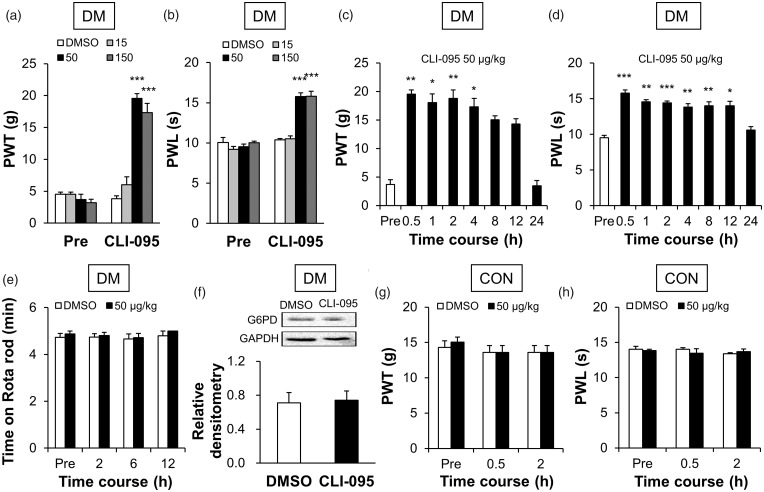
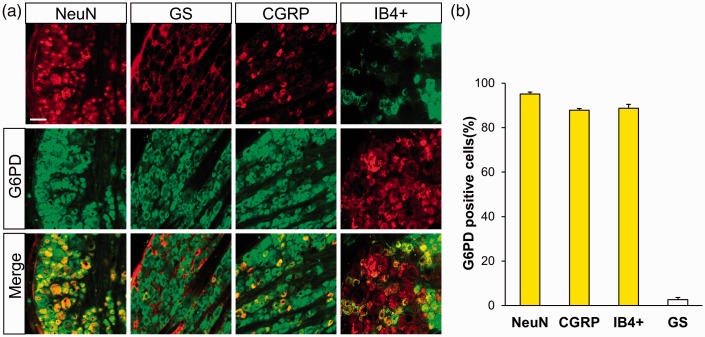
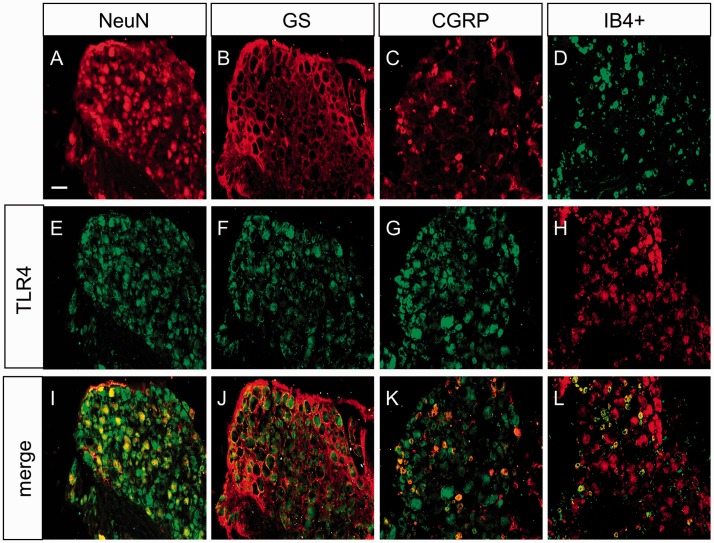
The mRNA and protein expression levels of G6PD in DRGs were significantly decreased in diabetic rats when compared with age-matched control rats. Upregulation of G6PD by intrathecal injection of G6PD overexpression adenovirus markedly attenuated hindpaw pain hypersensitivity of diabetic rats. The mRNA and protein expression levels of TLR4 in DRGs of diabetic rats were significantly increased when compared with control rats. Intrathecal injection of TLR4-selective inhibitor CLI-095 attenuated diabetic pain in dose- and time-dependent manners. Furthermore, G6PD and TLR4 were co-localized in DRG neurons. Intrathecal injection of G6PD overexpression adenovirus greatly reduced TLR4 expression, while intrathecal injection of CLI-095 had no significant effect on G6PD expression in diabetic rats.
Our results suggest that decrease in G6PD expression was involved in diabetic peripheral neuropathic pain, which was most likely through upregulation of TLR4 expression in the DRGs of rats.
糖尿病性神经病理性疼痛是糖尿病的一种难治性致残性并发症。糖尿病性神经病理性疼痛的发病机制尚不清楚,治疗也不足。本研究旨在探讨葡萄糖-6-磷酸脱氢酶(G6PD)和 Toll 样受体 4(TLR4)在糖尿病大鼠神经病理性疼痛中的作用。
成年雌性 Sprague-Dawley 大鼠腹腔注射链脲佐菌素(STZ,75mg/kg)诱导 1 型糖尿病模型。采用 von Frey 细丝和热辐射分别测量大鼠的足底退缩阈值和足底退缩潜伏期。采用 Western blot 和实时定量聚合酶链反应分析测定 L4-L6 背根神经节(DRG)中 G6PD 和 TLR4 的表达。荧光免疫组织化学法检测 G6PD 和 TLR4 的表达及 G6PD 与 TLR4 的共定位。
与同龄对照组大鼠相比,糖尿病大鼠 DRG 中 G6PD 的 mRNA 和蛋白表达水平显著降低。鞘内注射 G6PD 过表达腺病毒上调 G6PD 显著减轻糖尿病大鼠后爪痛觉过敏。与对照组大鼠相比,糖尿病大鼠 DRG 中 TLR4 的 mRNA 和蛋白表达水平显著升高。鞘内注射 TLR4 选择性抑制剂 CLI-095 呈剂量和时间依赖性减轻糖尿病疼痛。此外,G6PD 和 TLR4 共定位于 DRG 神经元。鞘内注射 G6PD 过表达腺病毒可显著降低 TLR4 表达,而鞘内注射 CLI-095 对糖尿病大鼠 G6PD 表达无显著影响。
我们的研究结果表明,G6PD 表达的降低参与了糖尿病周围神经病理性疼痛,这很可能是通过大鼠 DRG 中 TLR4 表达的上调。