Enkhbat Erdenetungalag, Korenromp Eline L, Badrakh Jugderjav, Zayasaikhan Setsen, Baya Purevsuren, Orgiokhuu Enkhjargal, Jadambaa Narantuya, Munkhbaatar Sergelen, Khishigjargal Delgermaa, Khad Narantuya, Mahiané Guy, Ishikawa Naoko, Jagdagsuren Davaalkham, Taylor Melanie M
Mongolia National Centre for Communicable Disease, AIDS/STI Surveillance and Research Department, Ulaanbaatar, 210648, Bayanzurkh District, Nam-Yan-Ju Street, Mongolia.
Avenir Health, Geneva, Switzerland, 1 route de Morillons / 150 Route de Ferney (WCC, Office 164), PO Box 2100, CH-1211 Geneva 2, Switzerland.
Infect Dis Model. 2018 Mar 9;3:13-22. doi: 10.1016/j.idm.2018.03.003. eCollection 2018.
Mongolia's health ministry prioritizes control of Sexually Transmitted Infections, including syphilis screening and treatment in antenatal care (ANC).
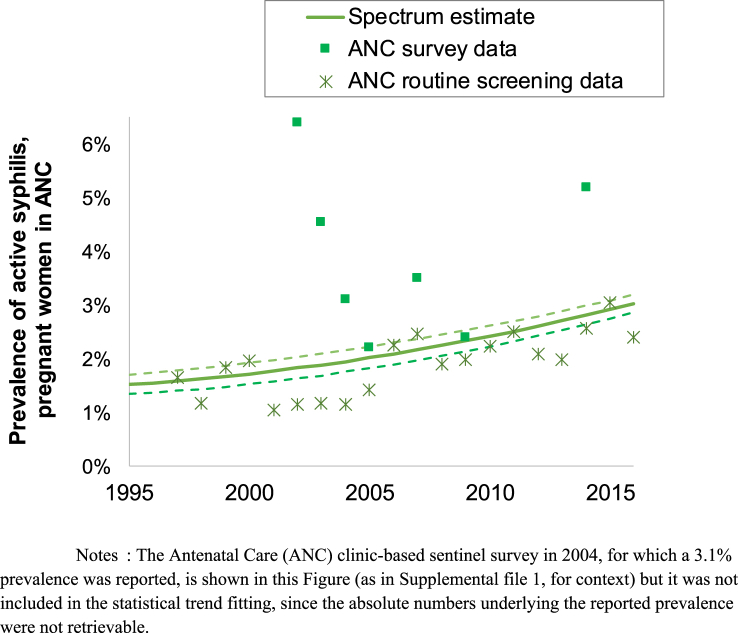
Adult syphilis prevalence trends were fitted using the Spectrum-STI estimation tool, using data from ANC surveys and routine screening over 1997-2016. Estimates were combined with programmatic data to estimate numbers of treated and untreated pregnant women with syphilis and associated incidence congenital syphilis (CS) and CS-attributable adverse birth outcomes (ABO), which we compared with CS case reports.
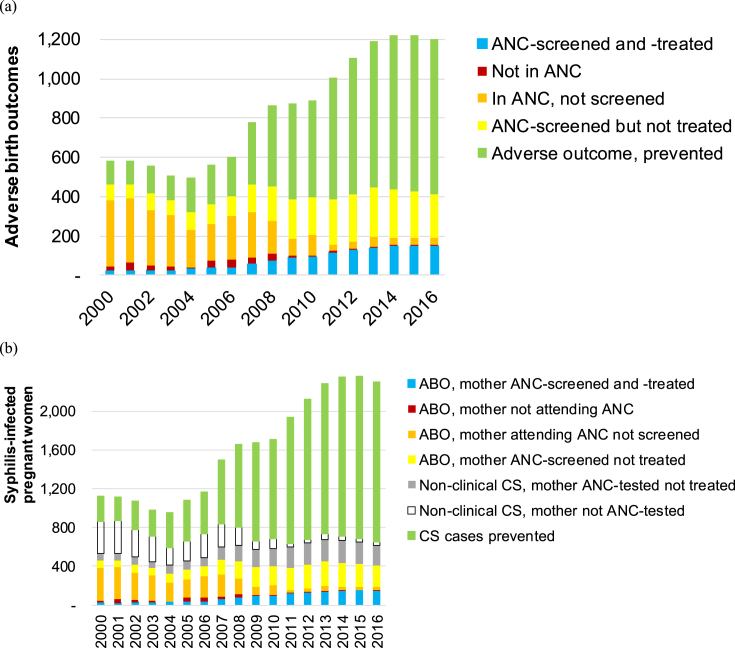
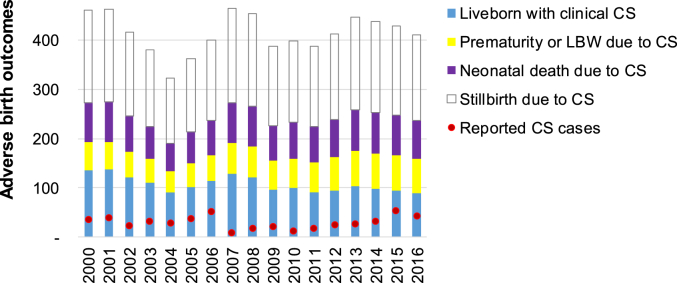
Syphilis prevalence in pregnant women was estimated at 1.7% in 2000 and 3.0% in 2016. We estimated 652 CS cases, of which 410 ABO, in 2016. Far larger, annually increasing numbers of CS cases and ABO were estimated to have been prevented: 1654 cases, of which 789 ABO in 2016 - thanks to increasing coverages of ANC (99% in 2016), ANC-based screening (97% in 2016) and treatment of women diagnosed (81% in 2016). The 42 CS cases reported nationally over 2016 (liveborn infants only) represented 27% of liveborn infants with clinical CS, but only 7% of estimated CS cases among women found syphilis-infected in ANC, and 6% of all estimated CS cases including those born to women with undiagnosed syphilis.
DISCUSSION/CONCLUSION: Mongolia's ANC-based syphilis screening program is reducing CS, but maternal prevalence remains high. To eliminate CS (target: <50 cases per 100,000 live births), Mongolia should strengthen ANC services, limiting losses during referral for treatment, and under-diagnosis of CS including still-births and neonatal deaths, and expand syphilis screening and prevention programs.
蒙古卫生部将性传播感染的控制列为优先事项,包括在产前保健(ANC)中进行梅毒筛查和治疗。
使用Spectrum-STI估计工具,根据1997 - 2016年期间产前保健调查和常规筛查的数据,拟合成人梅毒流行趋势。将估计值与项目数据相结合,以估计梅毒感染孕妇的治疗和未治疗人数,以及先天性梅毒(CS)的相关发病率和CS导致的不良出生结局(ABO),并与CS病例报告进行比较。
2000年孕妇梅毒患病率估计为1.7%,2016年为3.0%。2016年,我们估计有652例先天性梅毒病例,其中410例出现不良出生结局。估计每年预防的先天性梅毒病例和不良出生结局数量要大得多且呈上升趋势:2016年有1654例先天性梅毒病例,其中789例出现不良出生结局,这得益于产前保健覆盖率(2016年为99%)、基于产前保健的筛查(2016年为97%)以及对诊断出的女性的治疗(2016年为81%)的提高。2016年全国报告的42例先天性梅毒病例(仅活产婴儿)占临床诊断先天性梅毒活产婴儿的27%,但仅占产前保健中梅毒检测呈阳性女性估计先天性梅毒病例的7%,占所有估计先天性梅毒病例(包括未诊断出梅毒的女性所生婴儿)的6%。
讨论/结论:蒙古基于产前保健的梅毒筛查项目正在减少先天性梅毒的发生,但孕产妇患病率仍然很高。为消除先天性梅毒(目标:每10万活产儿<50例),蒙古应加强产前保健服务,减少转诊治疗期间的损失以及先天性梅毒(包括死产和新生儿死亡)的漏诊,并扩大梅毒筛查和预防项目。