Department of Obstetrics, Gynecology & Reproductive Sciences, University of California, San Francisco, San Francisco, CA, United States of America.
Kenya Medical Research Institute (KEMRI), Centre for Microbiology Research, Nairobi, Kenya.
PLoS One. 2019 Mar 6;14(3):e0212656. doi: 10.1371/journal.pone.0212656. eCollection 2019.
Female positive/male negative HIV-serodiscordant couples express a desire for children and may engage in condomless sex to become pregnant. Current guidelines recommend antiretroviral treatment in HIV-serodiscordant couples, yet HIV RNA viral suppression may not be routinely assessed or guaranteed and pre-exposure prophylaxis may not be readily available. Therefore, options for becoming pregnant while limiting HIV transmission should be offered and accessible to HIV-affected couples desiring children.
A prospective pilot study of female positive/male negative HIV-serodiscordant couples desiring children was conducted to evaluate the acceptability, feasibility, and effectiveness of timed vaginal insemination. Eligible women were 18-34 years with regular menses. Prior to timed vaginal insemination, couples were observed for two months, and tested and treated for sexually transmitted infections. Timed vaginal insemination was performed for up to six menstrual cycles. A fertility evaluation and HIV RNA viral load assessment was offered to couples who did not become pregnant.
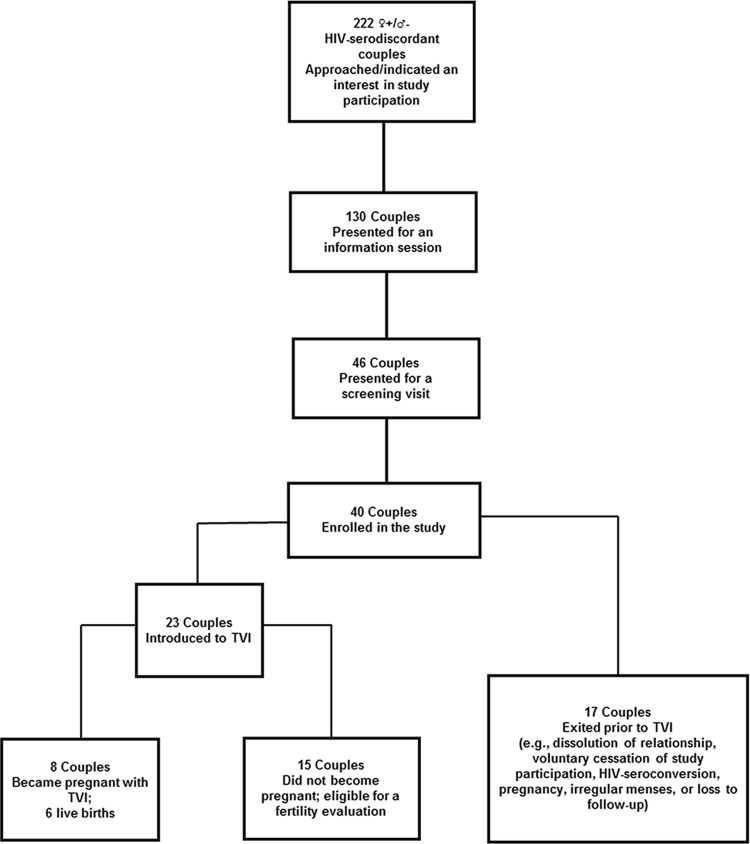
Forty female positive/male negative HIV-serodiscordant couples were enrolled; 17 (42.5%) exited prior to timed vaginal insemination. Twenty-three couples (57.5%) were introduced to timed vaginal insemination; eight (34.8%) achieved pregnancy, and six live births resulted without a case of HIV transmission. Seven couples completed a fertility evaluation. Four women had no demonstrable tubal patency bilaterally; one male partner had decreased sperm motility. Five women had unilateral/bilateral tubal patency; and seven women had an HIV RNA viral load (≥ 400 copies/mL).
Timed vaginal insemination is an acceptable, feasible, and effective method for attempting pregnancy. Given the desire for children and inadequate viral suppression, interventions to support safely becoming pregnant should be integrated into HIV prevention programs.
女性 HIV 阳性/男性 HIV 阴性的 HIV 血清不一致的夫妇表达了生育孩子的愿望,并且可能会进行无保护性行为以怀孕。目前的指南建议对 HIV 血清不一致的夫妇进行抗逆转录病毒治疗,然而,HIV RNA 病毒抑制可能不会常规评估或保证,并且可能无法轻易获得暴露前预防。因此,应该向希望生育孩子的受 HIV 影响的夫妇提供并提供能够怀孕同时限制 HIV 传播的选择。
对希望生育孩子的女性 HIV 阳性/男性 HIV 阴性的 HIV 血清不一致的夫妇进行了一项前瞻性试点研究,以评估定时阴道内授精的可接受性、可行性和有效性。符合条件的女性年龄在 18-34 岁之间,月经规律。在进行定时阴道内授精之前,夫妇观察了两个月,并进行了性传播感染的检测和治疗。定时阴道内授精最多进行六个月经周期。对于未怀孕的夫妇提供了生育评估和 HIV RNA 病毒载量评估。
共有 40 对女性 HIV 阳性/男性 HIV 阴性的 HIV 血清不一致的夫妇入组;17 对(42.5%)在进行定时阴道内授精之前退出。23 对夫妇(57.5%)接受了定时阴道内授精;8 对(34.8%)成功怀孕,并且 6 例活产,没有发生 HIV 传播的病例。有 7 对夫妇完成了生育评估。4 名女性双侧输卵管均无明显通畅;1 名男性伴侣精子活动力下降。5 名女性单侧/双侧输卵管通畅;7 名女性 HIV RNA 病毒载量(≥400 拷贝/ml)。
定时阴道内授精是一种可接受、可行且有效的尝试怀孕的方法。鉴于对孩子的渴望和病毒抑制不足,应该将支持安全怀孕的干预措施纳入 HIV 预防计划中。