Department of Basic and Clinical Neuroscience, Maurice Wohl Clinical Neuroscience Institute, Institute of Psychiatry, Psychology and Neuroscience, King's College London, London, SE5 9RX, UK.
Department of Biomedical Sciences, University of Padova, Padova, Italy.
Acta Neuropathol Commun. 2019 Mar 6;7(1):35. doi: 10.1186/s40478-019-0688-4.
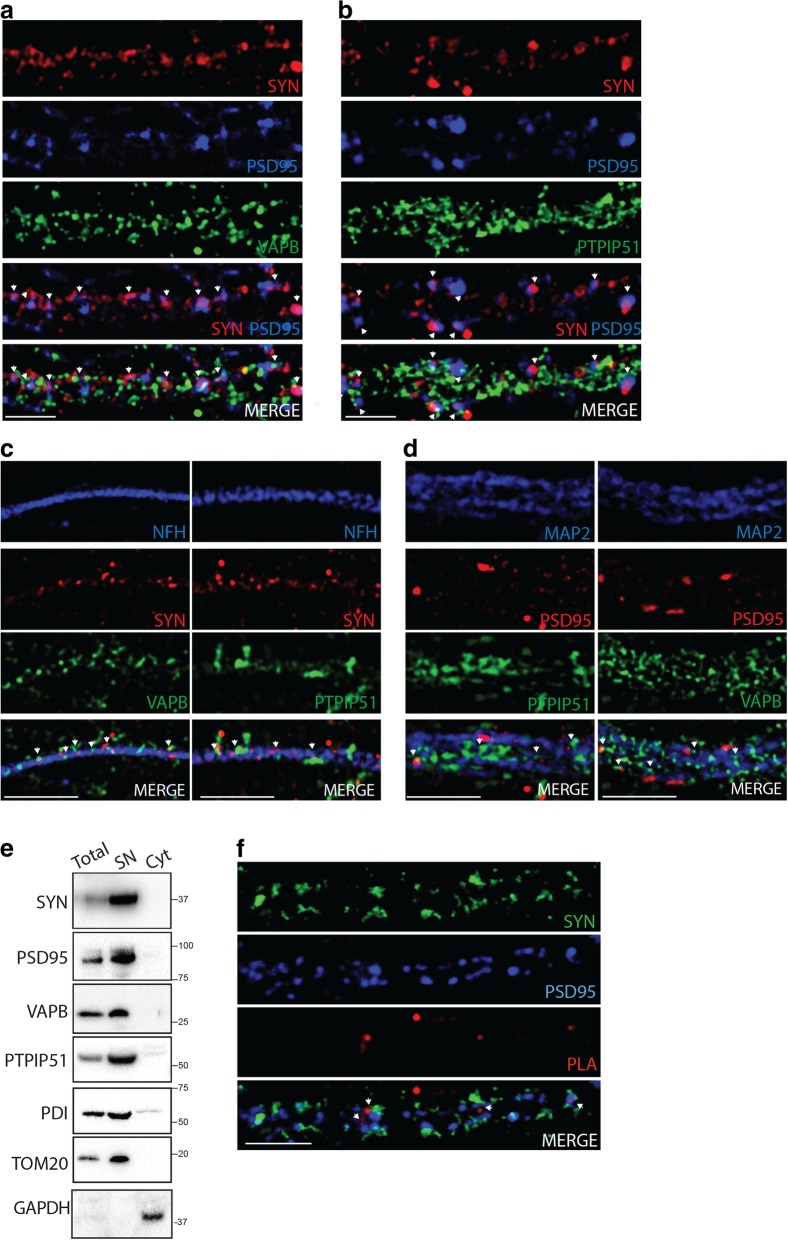
Signaling between the endoplasmic reticulum (ER) and mitochondria regulates a number of key neuronal functions. This signaling involves close physical contacts between the two organelles that are mediated by "tethering proteins" that function to recruit regions of ER to the mitochondrial surface. The ER protein, vesicle-associated membrane protein-associated protein B (VAPB) and the mitochondrial membrane protein, protein tyrosine phosphatase interacting protein-51 (PTPIP51), interact to form one such tether. Recently, damage to ER-mitochondria signaling involving disruption of the VAPB-PTPIP51 tethers has been linked to the pathogenic process in Parkinson's disease, fronto-temporal dementia (FTD) and related amyotrophic lateral sclerosis (ALS). Loss of neuronal synaptic function is a key feature of Parkinson's disease and FTD/ALS but the roles that ER-mitochondria signaling and the VAPB-PTPIP51 tethers play in synaptic function are not known. Here, we demonstrate that the VAPB-PTPIP51 tethers regulate synaptic activity. VAPB and PTPIP51 localise and form contacts at synapses, and stimulating neuronal activity increases ER-mitochondria contacts and the VAPB-PTPIP51 interaction. Moreover, siRNA loss of VAPB or PTPIP51 perturbs synaptic function and dendritic spine morphology. Our results reveal a new role for the VAPB-PTPIP51 tethers in neurons and suggest that damage to ER-mitochondria signaling contributes to synaptic dysfunction in Parkinson's disease and FTD/ALS.
内质网(ER)和线粒体之间的信号转导调节许多关键的神经元功能。这种信号转导涉及到两个细胞器之间的紧密物理接触,这些接触是由“ tethering proteins ”介导的,这些蛋白的功能是将 ER 的区域募集到线粒体表面。ER 蛋白囊泡相关膜蛋白相关蛋白 B(VAPB)和线粒体膜蛋白蛋白酪氨酸磷酸酶相互作用蛋白 51(PTPIP51)相互作用形成一种这样的连接体。最近,涉及 VAPB-PTPIP51 连接体破坏的 ER-线粒体信号转导的损伤与帕金森病、额颞叶痴呆(FTD)和相关的肌萎缩侧索硬化症(ALS)的致病过程有关。神经元突触功能的丧失是帕金森病和 FTD/ALS 的一个关键特征,但 ER-线粒体信号转导和 VAPB-PTPIP51 连接体在突触功能中的作用尚不清楚。在这里,我们证明 VAPB-PTPIP51 连接体调节突触活性。VAPB 和 PTPIP51 在突触处定位并形成接触,刺激神经元活性增加 ER-线粒体接触和 VAPB-PTPIP51 相互作用。此外,siRNA 敲低 VAPB 或 PTPIP51 会扰乱突触功能和树突棘形态。我们的结果揭示了 VAPB-PTPIP51 连接体在神经元中的新作用,并表明 ER-线粒体信号转导的损伤导致帕金森病和 FTD/ALS 中的突触功能障碍。