• 文献检索
  • 文档翻译
  • 深度研究
  • 学术资讯
  • Suppr Zotero 插件Zotero 插件
  • 邀请有礼
  • 套餐&价格
  • 历史记录
应用&插件
Suppr Zotero 插件Zotero 插件浏览器插件Mac 客户端Windows 客户端微信小程序
定价
高级版会员购买积分包购买API积分包
服务
文献检索文档翻译深度研究API 文档MCP 服务
关于我们
关于 Suppr公司介绍联系我们用户协议隐私条款
关注我们

Suppr 超能文献

核心技术专利:CN118964589B侵权必究
粤ICP备2023148730 号-1Suppr @ 2026

文献检索

告别复杂PubMed语法,用中文像聊天一样搜索,搜遍4000万医学文献。AI智能推荐,让科研检索更轻松。

立即免费搜索

文件翻译

保留排版,准确专业,支持PDF/Word/PPT等文件格式,支持 12+语言互译。

免费翻译文档

深度研究

AI帮你快速写综述,25分钟生成高质量综述,智能提取关键信息,辅助科研写作。

立即免费体验

从预制临时住房到东日本大地震后的公共重建住房和社会隔离:使用倾向评分匹配的纵向研究。

Moving from prefabricated temporary housing to public reconstruction housing and social isolation after the Great East Japan Earthquake: a longitudinal study using propensity score matching.

机构信息

Department of Orthopaedic Surgery, Iwate Prefectural Central Hospital, Morioka, Japan.

Department of Orthopaedic Surgery, Tohoku University Graduate School of Medicine, Sendai, Japan.

出版信息

BMJ Open. 2019 Mar 7;9(3):e026354. doi: 10.1136/bmjopen-2018-026354.

DOI:10.1136/bmjopen-2018-026354
PMID:30850417
原文链接:https://pmc.ncbi.nlm.nih.gov/articles/PMC6429936/
Abstract

OBJECTIVES

After the Great East Japan Earthquake (GEJE) of 2011, many survivors have been forced to live in prefabricated temporary housing, which is uncomfortable and insufficiently durable for permanent living. Public reconstruction housing has been built to improve their living conditions; however, those moving have to rebuild personal relationships and adapt to a new environment. This study examined whether survivors moving to public reconstruction housing became more socially isolated than those remaining in prefabricated temporary housing.

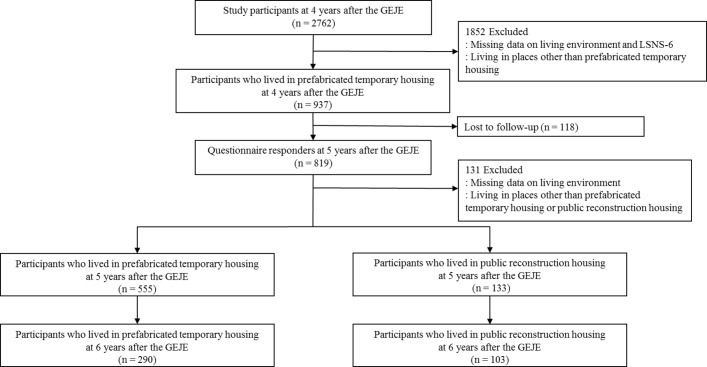
DESIGN, SETTING AND PARTICIPANTS: Self-report questionnaire data collected in 2015 (4 years after the GEJE) were used as the baseline for follow-up surveys in 2016 and 2017, as many survivors moved from prefabricated temporary housing to public reconstruction housing from 2015. We analysed longitudinal data from 393 survivors, distinguishing those who moved to public reconstruction housing during the 5th year after the disaster from those who remained in prefabricated temporary housing. Participants were assessed using the Lubben Social Network Scale-6 (LSNS-6) in all three surveys, with social isolation defined by a score of <12/30. To reduce the effect of selection bias, propensity score analysis was performed (178 of 393 participants were retained). We used a generalised estimated equation to evaluate the association between moving from prefabricated temporary housing to public reconstruction housing and changes in social isolation over 2 years.

RESULTS

LSNS-6 scores of the reconstruction housing group were worse than those of the prefabricated housing group between 4 and 6 years after the GEJE (P=0.006). Over the same period, social isolation worsened in the reconstruction housing group but improved in the prefabricated housing group (P=0.002).

CONCLUSIONS

Social isolation should be monitored while supporting survivors who moved to public reconstruction housing, and further longitudinal research is needed to clarify the risk of social isolation.

摘要

目的

2011 年东日本大地震后,许多幸存者被迫居住在预制临时住房中,这种住房不舒适,也不适合长期居住。为改善他们的生活条件而建造了公共重建住房;然而,那些搬入的人不得不重建人际关系并适应新的环境。本研究旨在探讨搬到公共重建住房的幸存者是否比留在预制临时住房中的幸存者更加孤立。

设计、地点和参与者:2015 年(地震发生后 4 年)收集的自我报告问卷调查数据被用作 2016 年和 2017 年随访调查的基线,因为许多幸存者在 2015 年从预制临时住房搬到公共重建住房。我们分析了 393 名幸存者的纵向数据,将在灾难发生后的第 5 年搬到公共重建住房的幸存者与留在预制临时住房的幸存者区分开来。在所有三次调查中,参与者都使用 Lubben 社会网络量表-6(LSNS-6)进行评估,社会隔离的定义为<12/30。为了减少选择偏差的影响,进行了倾向评分分析(393 名参与者中有 178 名保留)。我们使用广义估计方程评估了从预制临时住房搬到公共重建住房与 2 年内社会隔离变化之间的关系。

结果

在东日本大地震后 4 至 6 年,重建住房组的 LSNS-6 评分比预制住房组差(P=0.006)。在同一时期,重建住房组的社会隔离状况恶化,而预制住房组则有所改善(P=0.002)。

结论

在支持搬到公共重建住房的幸存者时,应监测社会隔离情况,需要进一步的纵向研究来阐明社会隔离的风险。
https://cdn.ncbi.nlm.nih.gov/pmc/blobs/2364/6429936/67890153087f/bmjopen-2018-026354f01.jpg

相似文献

1
Moving from prefabricated temporary housing to public reconstruction housing and social isolation after the Great East Japan Earthquake: a longitudinal study using propensity score matching.从预制临时住房到东日本大地震后的公共重建住房和社会隔离:使用倾向评分匹配的纵向研究。
BMJ Open. 2019 Mar 7;9(3):e026354. doi: 10.1136/bmjopen-2018-026354.
2
Period of residence in prefabricated temporary housing and psychological distress after the Great East Japan Earthquake: a longitudinal study.在东日本大地震后居住在预制临时住房中的时间与心理困扰:一项纵向研究。
BMJ Open. 2018 May 5;8(5):e018211. doi: 10.1136/bmjopen-2017-018211.
3
Longitudinal association between time-varying social isolation and psychological distress after the Great East Japan Earthquake.东日本大地震后随时间变化的社会隔离与心理困扰之间的纵向关联。
Soc Sci Med. 2016 Mar;152:96-101. doi: 10.1016/j.socscimed.2016.01.037. Epub 2016 Jan 26.
4
Association between continued residence in temporary prefabricated housing and musculoskeletal pain in survivors of the Great East Japan Earthquake: a longitudinal study.东日本大地震幸存者继续居住在临时预制房屋与肌肉骨骼疼痛之间的关联:一项纵向研究。
BMJ Open. 2019 Oct 3;9(10):e030761. doi: 10.1136/bmjopen-2019-030761.
5
Does the Type of Temporary Housing Make a Difference in Social Participation and Health for Evacuees of the Great East Japan Earthquake and Tsunami? A Cross-Sectional Study.临时住所类型对东日本大地震和海啸灾民的社会参与和健康有影响吗?一项横断面研究。
J Epidemiol. 2019 Oct 5;29(10):391-398. doi: 10.2188/jea.JE20180080. Epub 2018 Oct 20.
6
[Environmental risks to housing and living arrangements among older survivors of the Great East Japan Earthquake and their relationships with housing type: The RIAS Study].[东日本大地震老年幸存者的住房与居住安排面临的环境风险及其与住房类型的关系:RIAS研究]
Nihon Koshu Eisei Zasshi. 2023 Mar 2;70(2):99-111. doi: 10.11236/jph.21-146. Epub 2022 Oct 28.
7
[Trajectory of evacuees' health condition after the Great East Japan Earthquake: Health survey of residents in prefabricated temporary housing and private rented housing in the Miyagi prefecture].[东日本大地震后避难者健康状况的轨迹:宫城县预制临时住房和私人出租住房居民的健康调查]
Nihon Koshu Eisei Zasshi. 2020;67(1):26-32. doi: 10.11236/jph.67.1_26.
8
High prevalence of toothache among Great East Japan Earthquake survivors living in temporary housing.在临时住房中居住的东日本大地震幸存者中,牙痛的患病率很高。
Community Dent Oral Epidemiol. 2019 Apr;47(2):119-126. doi: 10.1111/cdoe.12433. Epub 2018 Nov 15.
9
Association between housing type and γ-GTP increase after the Great East Japan Earthquake.大地震后住房类型与γ-GTP 升高的关联。
Soc Sci Med. 2017 Sep;189:76-85. doi: 10.1016/j.socscimed.2017.07.020. Epub 2017 Jul 25.
10
Five-Year Psychosocial Impact of Living in Postdisaster Prefabricated Temporary Housing.灾后临时板房居住五年的心理社会影响
Disaster Med Public Health Prep. 2022 Oct;16(5):1966-1974. doi: 10.1017/dmp.2021.214. Epub 2021 Aug 20.

引用本文的文献

1
Associations between housing and psychological damage by earthquake and modifiable risk factors for dementia in general older adults: Tohoku Medical Megabank community-based cohort study.老年人群体中住房与地震造成的心理创伤和可改变的痴呆风险因素之间的关联:东北医疗大数据项目基于社区的队列研究。
Geriatr Gerontol Int. 2024 Jun;24(6):509-516. doi: 10.1111/ggi.14867. Epub 2024 May 3.
2
Association between sense of coherence and health and well-being among older survivors of a natural disaster: a prospective outcome-wide study.灾难后老年人的健康和幸福感与领悟社会支持的相关性:一项前瞻性全结局研究。
Sci Rep. 2023 Sep 29;13(1):16385. doi: 10.1038/s41598-023-43672-z.
3

本文引用的文献

1
Influence of subjective economic hardship on new onset of neck pain (so-called: katakori) in the chronic phase of the Great East Japan Earthquake: A prospective cohort study.东日本大地震慢性期主观经济困难对新发颈部疼痛(所谓“斜颈”)的影响:一项前瞻性队列研究。
J Orthop Sci. 2018 Sep;23(5):758-764. doi: 10.1016/j.jos.2018.04.011. Epub 2018 Jun 20.
2
Period of residence in prefabricated temporary housing and psychological distress after the Great East Japan Earthquake: a longitudinal study.在东日本大地震后居住在预制临时住房中的时间与心理困扰:一项纵向研究。
BMJ Open. 2018 May 5;8(5):e018211. doi: 10.1136/bmjopen-2017-018211.
3
Longitudinal changes in depressive symptoms associated with social isolation after the Great East Japan Earthquake in Iwate Prefecture: findings from the TMM CommCohort study.
岩手县东日本大地震后与社交隔离相关的抑郁症状的纵向变化:来自 TMM CommCohort 研究的结果。
BMC Public Health. 2023 Jun 20;23(1):1154. doi: 10.1186/s12889-023-16082-z.
4
Paradoxical Impacts of Social Relationship on Well-Being During the COVID-19 Pandemic.新冠疫情期间社会关系对幸福感的矛盾影响
J Happiness Stud. 2023;24(2):745-767. doi: 10.1007/s10902-022-00614-2. Epub 2023 Jan 11.
5
Lessons learned from psychosocial support and mental health surveys during the 10 years since the Great East Japan Earthquake: Establishing evidence-based disaster psychiatry.从东日本大地震后的 10 年中进行的心理社会支持和精神卫生调查中吸取的经验教训:建立基于证据的灾害精神病学。
Psychiatry Clin Neurosci. 2022 Jun;76(6):212-221. doi: 10.1111/pcn.13339. Epub 2022 Mar 1.
6
Practical Report of Disaster-Related Mental Health Interventions Following the Great East Japan Earthquake during the COVID-19 Pandemic: Potential for Suicide Prevention.《大東日本大震災からの災害関連メンタルヘルス介入と新型コロナウイルス感染症(COVID-19)流行下における自殺予防への波及効果:実践報告》
Int J Environ Res Public Health. 2021 Oct 3;18(19):10424. doi: 10.3390/ijerph181910424.
7
Association of decreased physical activity due to the COVID-19 pandemic with new-onset neck pain in survivors of the Great East Japan Earthquake: a prospective cohort study.由于 COVID-19 大流行导致的体力活动减少与东日本大地震幸存者新发颈痛的关联:一项前瞻性队列研究。
BMJ Open. 2021 Aug 23;11(8):e051751. doi: 10.1136/bmjopen-2021-051751.
Longitudinal association between time-varying social isolation and psychological distress after the Great East Japan Earthquake.
东日本大地震后随时间变化的社会隔离与心理困扰之间的纵向关联。
Soc Sci Med. 2016 Mar;152:96-101. doi: 10.1016/j.socscimed.2016.01.037. Epub 2016 Jan 26.
4
Influence of living environments and working status on low back pain for survivors of the Great East Japan Earthquake.东日本大地震幸存者的生活环境和工作状况对腰痛的影响。
J Orthop Sci. 2016 Mar;21(2):138-42. doi: 10.1016/j.jos.2015.12.015. Epub 2016 Jan 25.
5
Social support improves mental health among the victims relocated to temporary housing following the Great East Japan Earthquake and Tsunami.在东日本大地震及海啸后被安置到临时住房的受灾民众中,社会支持改善了他们的心理健康状况。
Tohoku J Exp Med. 2014 Nov;234(3):241-7. doi: 10.1620/tjem.234.241.
6
Disaster health after the 2011 great East Japan earthquake.2011 年东日本大地震后的灾害健康。
Prehosp Disaster Med. 2014 Feb;29(1):54-9. doi: 10.1017/S1049023X14000028. Epub 2014 Jan 22.
7
Social relationships and depression: ten-year follow-up from a nationally representative study.社会关系与抑郁:一项全国代表性研究的十年随访。
PLoS One. 2013 Apr 30;8(4):e62396. doi: 10.1371/journal.pone.0062396. Print 2013.
8
The Great East-Japan Earthquake and devastating tsunami: an update and lessons from the past Great Earthquakes in Japan since 1923.《东日本大地震及毁灭性海啸:1923 年以来日本历次大地震的最新情况和教训》。
Tohoku J Exp Med. 2013 Apr;229(4):287-99. doi: 10.1620/tjem.229.287.
9
Social isolation, loneliness, and all-cause mortality in older men and women.社会隔离、孤独感与老年人全因死亡率。
Proc Natl Acad Sci U S A. 2013 Apr 9;110(15):5797-801. doi: 10.1073/pnas.1219686110. Epub 2013 Mar 25.
10
[Reliability and validity of the Japanese version of the abbreviated Lubben Social Network Scale].[日语版简化版鲁本社会网络量表的信度与效度]
Nihon Ronen Igakkai Zasshi. 2011;48(2):149-57. doi: 10.3143/geriatrics.48.149.