School of Life Sciences, Kyungpook National University, Daegu, 41566, Republic of Korea.
Graduate School of East-West Medical Science, Kyung Hee University, Yongin, Gyeonggi-do, 17104, Republic of Korea.
Sci Rep. 2019 Mar 8;9(1):3994. doi: 10.1038/s41598-019-40670-y.
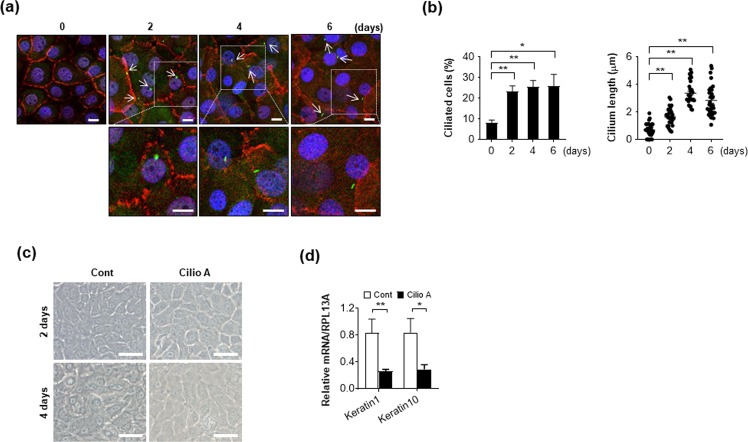
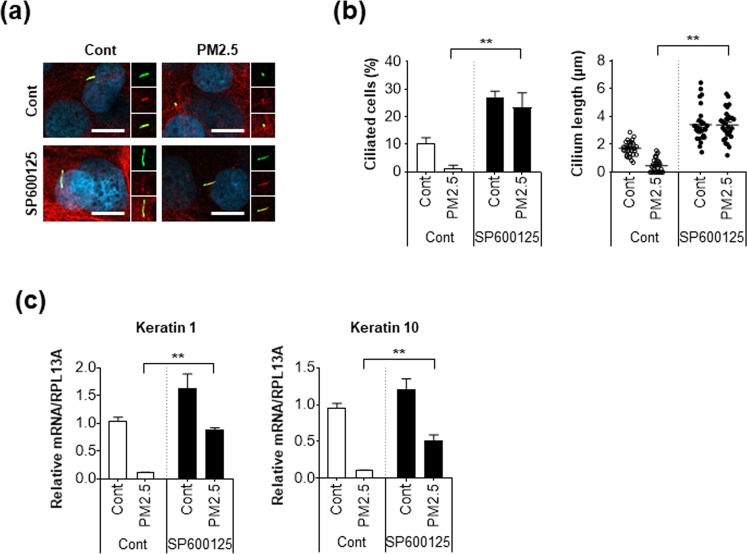
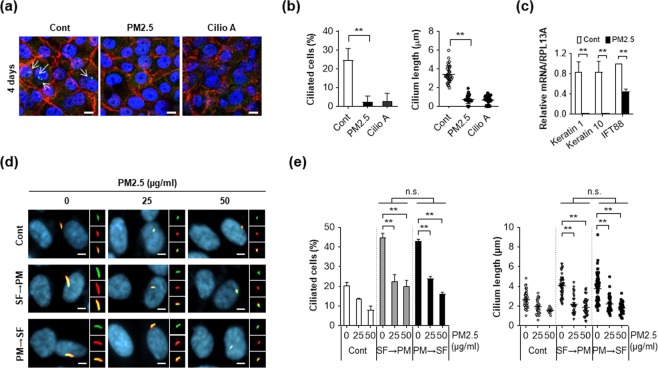
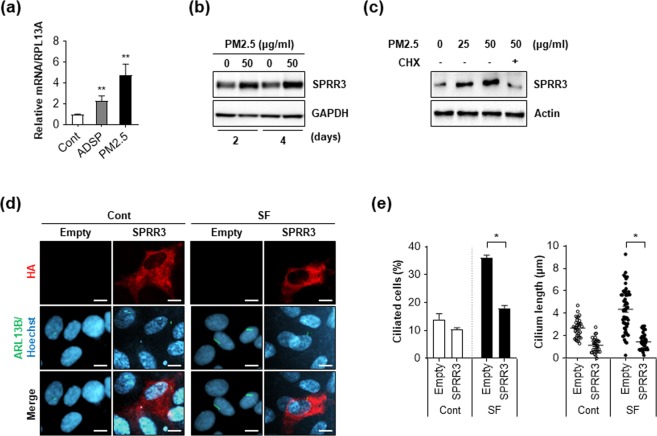
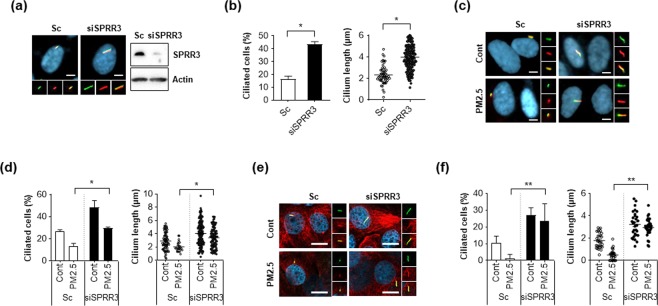
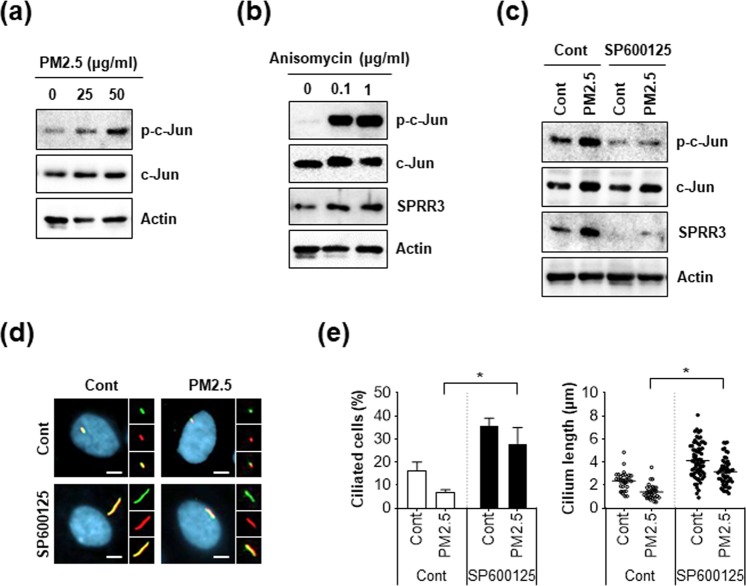
Exposure to fine particulate matter (PM) with diameter <2.5 µm (PM2.5) causes epithelium injury and endothelial dysfunction. Primary cilia are sensory organelles that transmit extracellular signals into intracellular biochemical responses and have roles in physiology. To date, there have been no studies investigating whether PM2.5 affects primary cilia in skin. We addressed this in the present study using normal human epidermal keratinocytes (NHEKs) and retinal pigment epithelium (RPE) cells. We found that formation of primary cilium is increased in differentiated NHEKs. However, treatment with PM2.5 blocked increased ciliogenesis in NHEKs and RPE cells. Furthermore, PM2.5 transcriptionally upregulated small proline rich protein 3 (SPRR3) expression by activating c-Jun, and ectopic expression of SPRR3 inhibits suppressed the ciliogenesis. Accordingly, treatment with c-Jun activator (anisomycin) induced SPRR3 expression, whereas the inhibitor (SP600125) recovered the ciliated cells and cilium length in PM2.5-treated cells. Moreover, c-Jun inhibitor suppressed upregulation of SPRR3 in PM2.5-treated cells. Taken together, our finding suggested that PM2.5 inhibits ciliogenesis by increasing SPRR3 expression via c-Jun activation in RPE cells and keratinocytes.
暴露于直径<2.5μm 的细颗粒物(PM2.5)会导致上皮损伤和血管内皮功能障碍。初级纤毛是将细胞外信号传递到细胞内生化反应的感觉器官,在生理中具有作用。迄今为止,尚无研究调查 PM2.5 是否会影响皮肤中的初级纤毛。本研究使用正常的人表皮角质形成细胞(NHEK)和视网膜色素上皮(RPE)细胞对此进行了研究。我们发现,分化的 NHEK 中初级纤毛的形成增加。然而,PM2.5 处理会阻止 NHEK 和 RPE 细胞中纤毛发生的增加。此外,PM2.5 通过激活 c-Jun 转录上调小脯氨酸丰富蛋白 3(SPRR3)的表达,而过表达 SPRR3 抑制纤毛发生。因此,用 c-Jun 激活剂(放线菌酮)处理会诱导 SPRR3 的表达,而抑制剂(SP600125)则会恢复 PM2.5 处理细胞中的有纤毛细胞和纤毛长度。此外,c-Jun 抑制剂抑制了 PM2.5 处理细胞中 SPRR3 的上调。总之,我们的研究结果表明,PM2.5 通过激活 c-Jun 增加 SPRR3 的表达来抑制 RPE 细胞和角质形成细胞中的纤毛发生。