School of Health Sciences, City University of London, London, UK.
Institute of Pharmaceutical Science, King's College London, London, UK.
BMJ Open. 2019 Mar 8;9(3):e026421. doi: 10.1136/bmjopen-2018-026421.
Transitioning to secondary progressive multiple sclerosis (SPMS) is demanding for both patients and healthcare professionals. The particular challenges and the ways patients cope are poorly understood. The present study examines what challenges people face when diagnosed with SPMS by exploring experiences of people who have transitioned recently (up to 5 years).
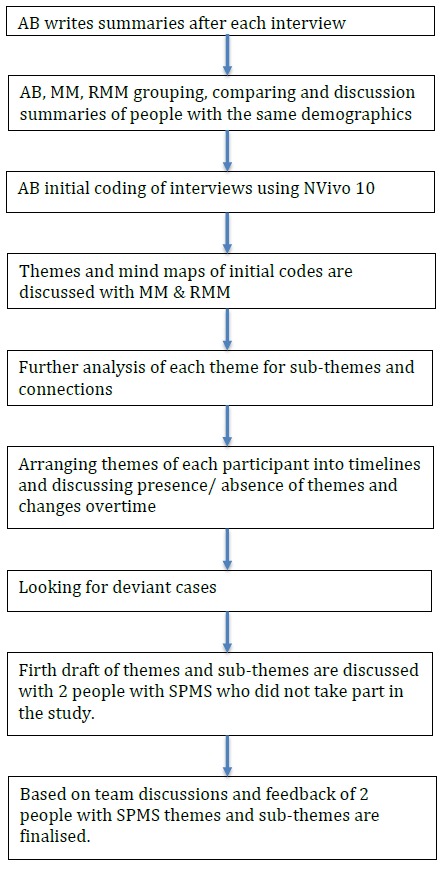
Semistructured qualitative interviews at two time points a year apart. Interviews were analysed using inductive thematic analysis.
UK.
We interviewed 21 people at baseline and 17 participated in the follow-up interviews.
The majority of participants reported expecting to transition to SPMS, and the diagnosis did not make much difference to them. Participants described increasing emotional and physical challenges after transitioning to SPMS and between the first and second interviews. Planning, using distractions and maintaining social roles helped participants cope with the increased challenges. The same coping strategies were used between the two interviews. Participants felt there was not much left to do regarding the management of their symptoms. A key theme was the sense of abandonment from healthcare services after transitioning to SPMS.
After transitioning to SPMS, people are faced with multiple challenges. Participants described a lack of directions for symptoms management and lack of support from the healthcare system. An integrated multidisciplinary healthcare approach is crucial at the progressive stage of the disease to alleviate feelings of helplessness and promote symptom management.
向继发进展型多发性硬化症(SPMS)过渡对患者和医疗保健专业人员都是一个挑战。人们对患者面临的特殊挑战和应对方式知之甚少。本研究通过探讨最近(最多 5 年)过渡到 SPMS 的患者的经验,来研究人们在被诊断为 SPMS 时面临的挑战。
在两年时间内进行两次半结构式定性访谈。使用归纳主题分析对访谈进行分析。
英国。
我们在基线时采访了 21 人,有 17 人参加了随访访谈。
大多数参与者表示预计会过渡到 SPMS,而且诊断对他们没有太大影响。参与者在过渡到 SPMS 后和两次访谈之间描述了越来越多的情绪和身体挑战。规划、分散注意力和维持社会角色有助于参与者应对增加的挑战。在两次访谈之间使用了相同的应对策略。参与者觉得在管理症状方面已经没有太多事情可做了。一个关键主题是过渡到 SPMS 后,他们感到自己被医疗保健服务抛弃了。
过渡到 SPMS 后,人们面临着多种挑战。参与者描述了缺乏症状管理指导和缺乏医疗保健系统支持的情况。在疾病的进展阶段,采用综合的多学科医疗保健方法至关重要,以减轻无助感并促进症状管理。