Vernooij M W, Pizzini F B, Schmidt R, Smits M, Yousry T A, Bargallo N, Frisoni G B, Haller S, Barkhof F
Department of Radiology & Nuclear Medicine, Erasmus MC University Medical Center, Rotterdam, The Netherlands.
Department of Epidemiology, Erasmus MC University Medical Center, Rotterdam, The Netherlands.
Neuroradiology. 2019 Jun;61(6):633-642. doi: 10.1007/s00234-019-02188-y. Epub 2019 Mar 9.
Through a European-wide survey, we assessed the current clinical practice of imaging in the primary evaluation of dementia, with respect to standardised imaging, evaluation and reporting.
An online questionnaire was emailed to all European Society of Neuroradiology (ESNR) members (n = 1662) and non-members who had expressed their interest in ESNR activities in the past (n = 6400). The questionnaire featured 42 individual items, divided into multiple choice, single best choice and free text answers. Information was gathered on the context of the practices, available and preferred imaging modalities, applied imaging protocols and standards for interpretation, reporting and communication.
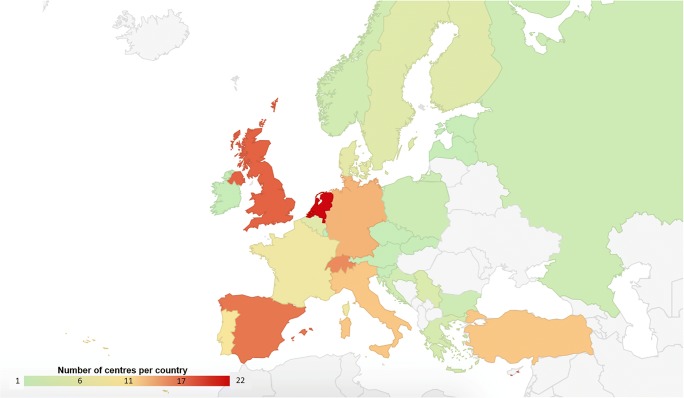
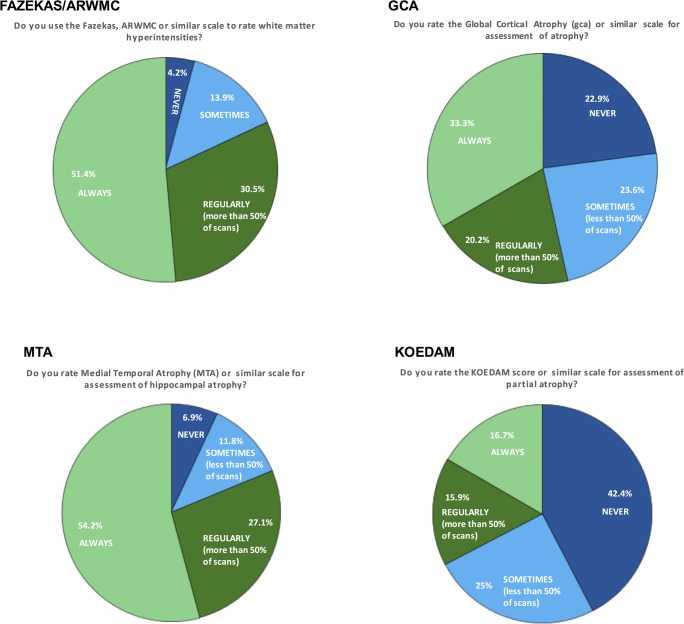
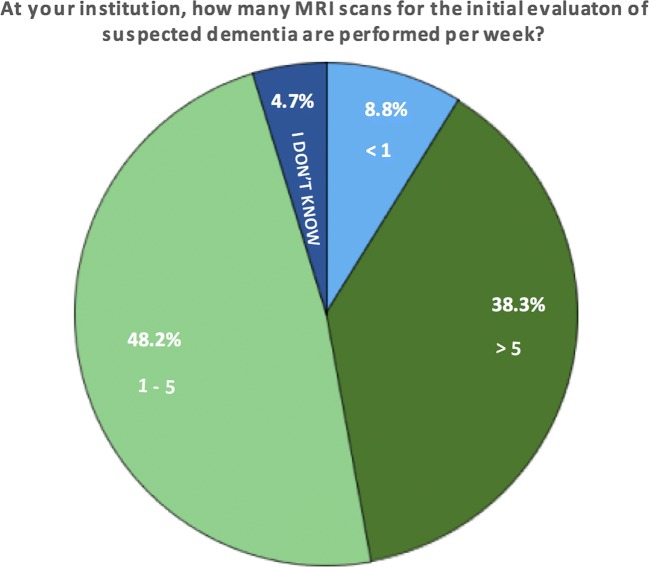
A total of 193 unique (non-duplicate) entries from the European academic and non-academic institutions were received from a total of 28 countries. Of these, 75% were neuroradiologists, 12% general radiologists and 11% (neuro) radiologists in training. Of responding centres, 38% performed more than five scans/week for suspected dementia. MRI was primarily used in 72% of centres. Over 90% of centres acquired a combination of T2w, FLAIR, T1w, DWI and T2*w sequences. Visual rating scales were used in 75% of centres, most often the Fazekas and medial temporal atrophy scale; 32% of respondents lacked full confidence in their use. Only 23% of centres performed volumetric analysis. A minority of centres (28%) used structured reports.
Current practice in dementia imaging is fairly homogeneous across Europe, in terms of image acquisition and image interpretation. Hurdles identified include training on the use of visual rating scales, implementation of volumetric assessment and structured reporting.
通过一项全欧洲范围的调查,我们评估了在痴呆症初步评估中影像检查的当前临床实践,涉及标准化影像检查、评估及报告。
向所有欧洲神经放射学会(ESNR)成员(n = 1662)以及过去曾表示对ESNR活动感兴趣的非成员(n = 6400)发送了一份在线调查问卷。该问卷包含42个单独项目,分为多项选择题、单项最佳选择题和自由文本答案。收集了有关实践背景、可用及首选的影像检查方式、应用的影像检查方案以及解读、报告和沟通标准的信息。
共收到来自28个国家的欧洲学术机构和非学术机构的193份独特(无重复)回复。其中,75%为神经放射科医生,12%为普通放射科医生,11%为正在接受培训的(神经)放射科医生。在做出回复的中心中,38%每周对疑似痴呆症患者进行超过5次扫描。72%的中心主要使用磁共振成像(MRI)。超过90%的中心采集了T2加权像、液体衰减反转恢复序列(FLAIR)、T1加权像、弥散加权成像(DWI)和T2*加权像序列的组合。75%的中心使用视觉评分量表,最常用的是法泽卡斯量表和内侧颞叶萎缩量表;32%的受访者对其使用缺乏充分信心。只有23%的中心进行了容积分析。少数中心(28%)使用结构化报告。
在影像采集和影像解读方面,欧洲目前的痴呆症影像检查实践相当一致。发现的障碍包括视觉评分量表使用方面的培训、容积评估的实施以及结构化报告。