Höfling Corinna, Shehabi Emira, Kuhn Peer-Hendrik, Lichtenthaler Stefan F, Hartlage-Rübsamen Maike, Roßner Steffen
Paul-Flechsig-Institute for Brain Research, Leipzig University, Leipzig, Germany.
Institute of Pathology, Technical University of Munich, Munich, Germany.
Front Neurosci. 2019 Feb 22;13:137. doi: 10.3389/fnins.2019.00137. eCollection 2019.
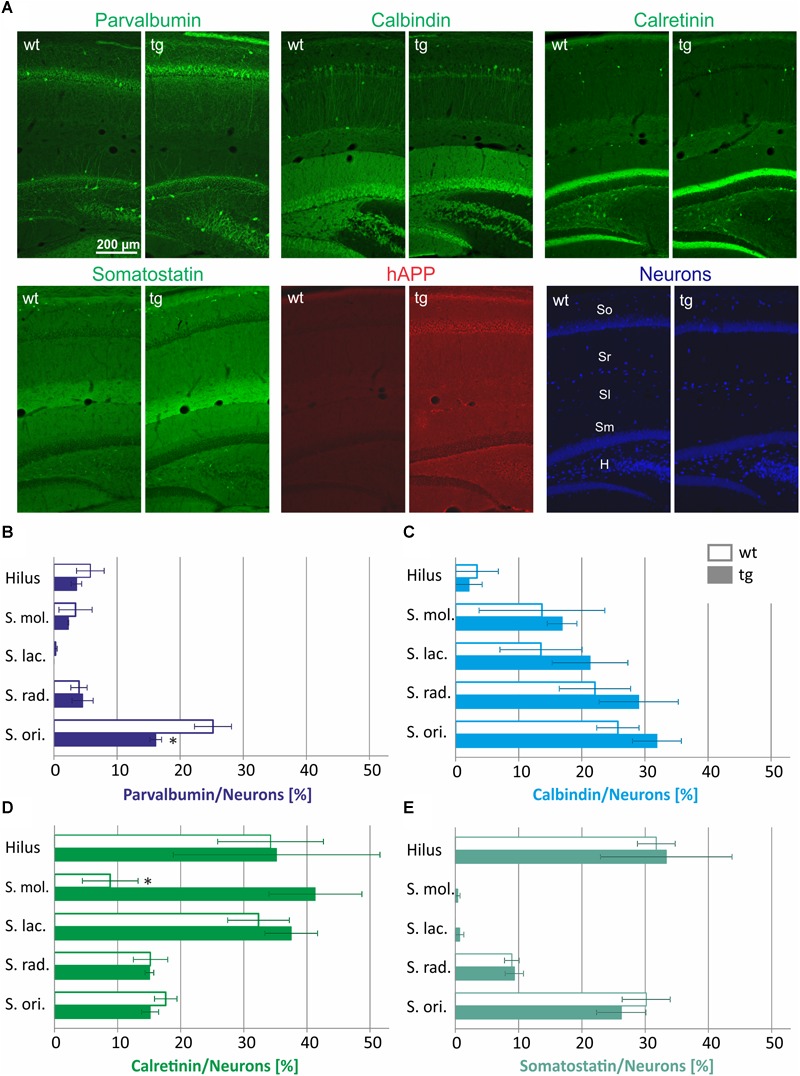
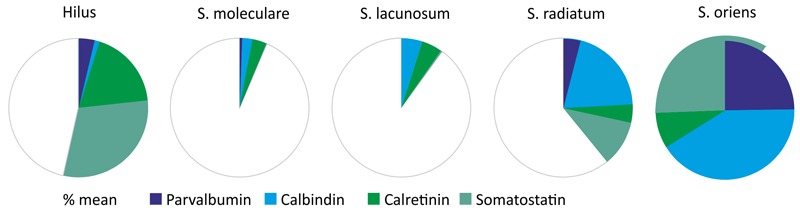
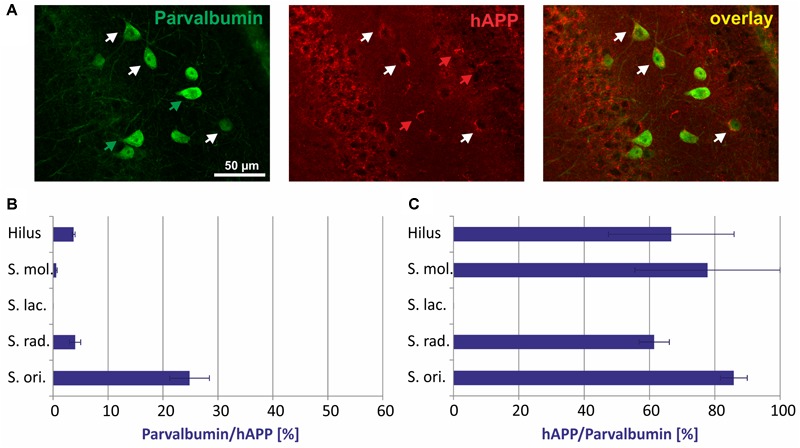
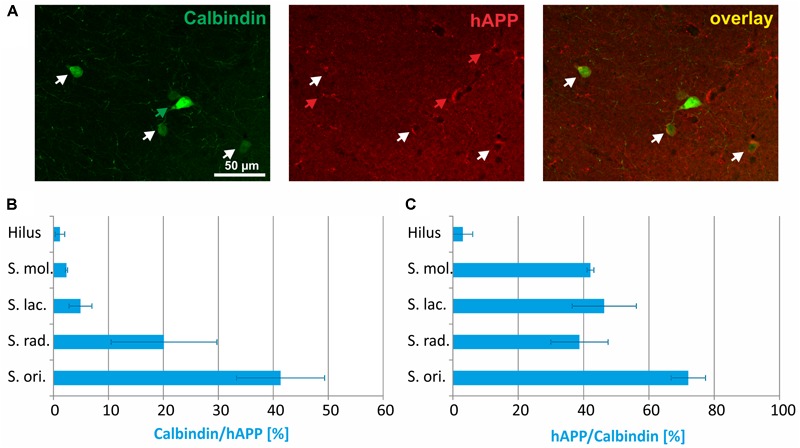
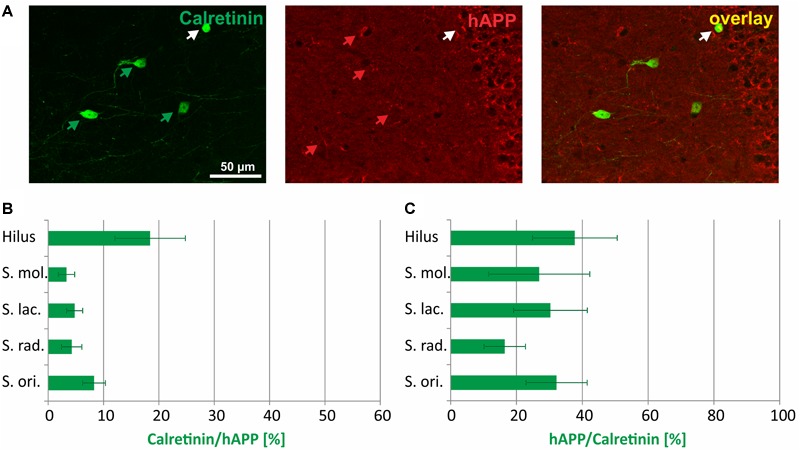
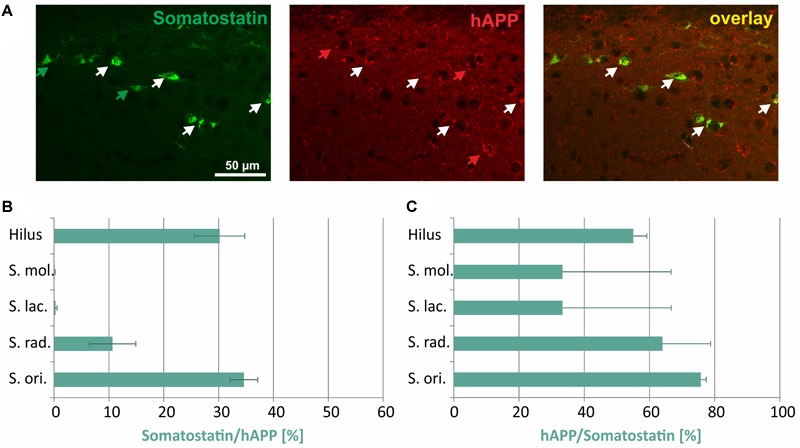
Amyloid precursor protein (APP) transgenic animal models of Alzheimer's disease have become versatile tools for basic and translational research. However, there is great heterogeneity of histological, biochemical, and functional data between transgenic mouse lines, which might be due to different transgene expression patterns. Here, the expression of human APP (hAPP) by GABAergic hippocampal interneurons immunoreactive for the calcium binding proteins parvalbumin, calbindin, calretinin, and for the peptide hormone somatostatin was analyzed in Tg2576 mice by double immunofluorescent microscopy. Overall, there was no GABAergic interneuron subpopulation that did not express the transgene. On the other hand, in no case all neurons of such a subpopulation expressed hAPP. In dentate gyrus molecular layer and in stratum lacunosum moleculare less than 10% of hAPP-positive interneurons co-express any of these interneuron markers, whereas in hAPP-expressing neurons frequently co-express these interneuron markers to different proportions. We conclude that these neurons differentially contribute to deficits in young Tg2576 mice before the onset of Abeta plaque pathology. The detailed analysis of distinct brain region and neuron type-specific APP transgene expression patterns is indispensable to understand particular pathological features and mouse line-specific differences in neuronal and systemic functions.
阿尔茨海默病的淀粉样前体蛋白(APP)转基因动物模型已成为基础研究和转化研究的通用工具。然而,转基因小鼠品系之间的组织学、生化和功能数据存在很大的异质性,这可能是由于不同的转基因表达模式所致。在此,通过双重免疫荧光显微镜分析了Tg2576小鼠中对钙结合蛋白小白蛋白、钙结合蛋白、钙视网膜蛋白以及肽激素生长抑素免疫反应的海马GABA能中间神经元中人类APP(hAPP)的表达。总体而言,不存在不表达转基因的GABA能中间神经元亚群。另一方面,在任何情况下,这样一个亚群的所有神经元都不表达hAPP。在齿状回分子层和分子层隙状层中,不到10%的hAPP阳性中间神经元共表达这些中间神经元标记物中的任何一种,而在hAPP表达神经元中,这些中间神经元标记物经常以不同比例共表达。我们得出结论,在β淀粉样蛋白斑块病理出现之前,这些神经元对年轻Tg2576小鼠的缺陷有不同的影响。对不同脑区和神经元类型特异性APP转基因表达模式的详细分析对于理解神经元和全身功能的特定病理特征以及小鼠品系特异性差异是必不可少的。