Kumar Namrita, Warren Gordon L, Snow Teresa K, Millard-Stafford Melinda
School of Applied Physiology, Georgia Institute of Technology, Atlanta, GA, United States.
Department of Physical Therapy, Georgia State University, Atlanta, GA, United States.
Front Nutr. 2019 Feb 12;6:9. doi: 10.3389/fnut.2019.00009. eCollection 2019.
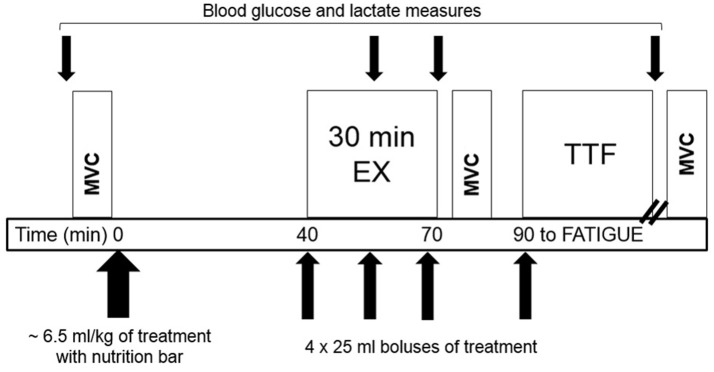
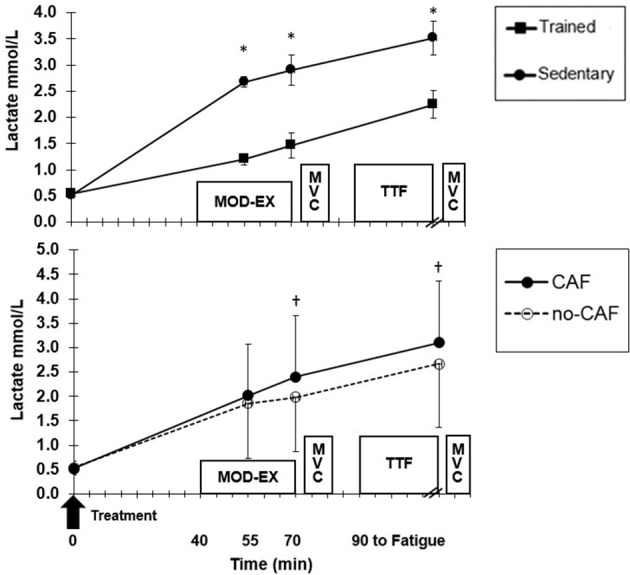
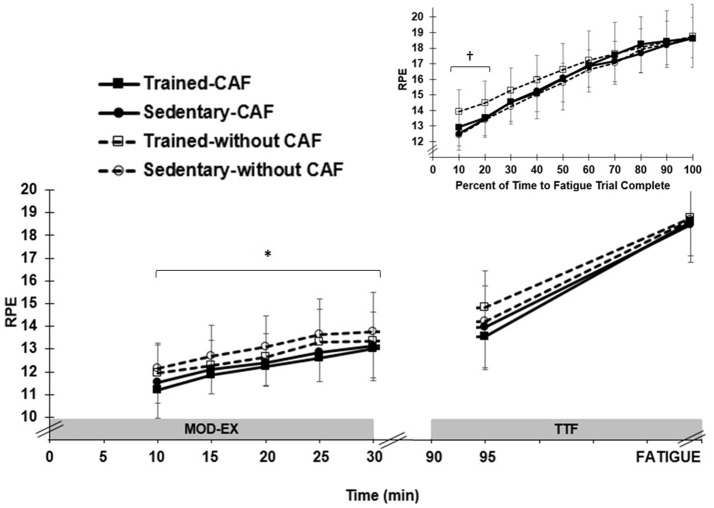
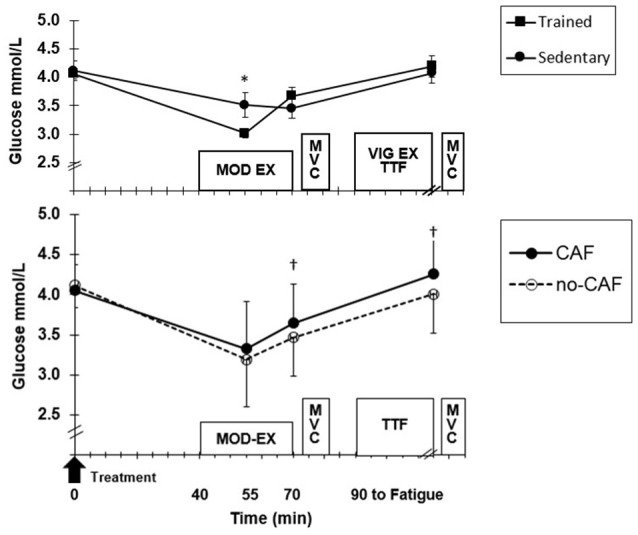
Caffeine (CAF) and carbohydrate (CHO) ingestion delay fatigue during prolonged exercise; however, this is primarily documented in endurance trained (ET) athletes. Our purpose was to determine if these ergogenic aids are also effective to improve exercise tolerance in age-matched sedentary (SED) adults. Using a double-blind crossover design, ET and SED ( = 12 each group) completed four exercise trials consisting of 30 min cycling at standardized matched work rates 10% below lactate threshold (MOD-EX) followed by a time to fatigue (TTF) ride at individually prescribed intensity of 5% above lactate threshold. After standardized breakfast, the following drink treatments were given before and throughout exercise: CAF (3 mg/kg of body mass, equivalent to 1.5 cups premium brewed coffee), low calorie CHO (LCHO) (0.4% solution, 2 g total CHO), CAF+LCHO, and artificially-sweetened placebo (PLA). SED and ET had similar perceived exertion (RPE) during MOD-EX and TTF (23.8 ± 3.1 and 24.1 ± 2.6 min in ET, SED, respectively). LCHO did not benefit exercise tolerance compared to PLA and was less effective ( < 0.05) compared to CAF+LCHO for all participants combined. Thus, the two CAF treatments were averaged, resulting in ~5% lower RPE ( < 0.05) and 21% longer TTF (26.3 ± 10.4 min) compared to the no-CAF (21.7 ± 9.9 min) treatments. Blood glucose and lactate were higher ( < 0.05) with CAF vs. no-CAF. SED and ET only differed in metabolic oxidation rates during exercise (higher overall fat oxidation with ET compared to SED). CAF reduces the perceived effort during exercise and increases the capacity for sedentary individuals, as well as trained athletes, to tolerate higher intensity exercise for greater duration; and, these benefits were not further enhanced by ingesting doses of low carbohydrate regularly during exercise.
摄入咖啡因(CAF)和碳水化合物(CHO)可在长时间运动期间延缓疲劳;然而,这主要是在耐力训练(ET)的运动员中得到证实。我们的目的是确定这些促力辅助剂对于提高年龄匹配的久坐不动(SED)成年人的运动耐力是否也有效。采用双盲交叉设计,ET组和SED组(每组n = 12)完成了四项运动试验,包括在低于乳酸阈值10%的标准化匹配工作强度下进行30分钟的骑行(中度运动),随后在高于乳酸阈值5%的个体规定强度下进行疲劳时间(TTF)骑行。在标准化早餐后,在运动前和运动过程中给予以下饮品处理:CAF(3毫克/千克体重,相当于1.5杯优质煮咖啡)、低热量CHO(LCHO)(0.4%溶液,共2克CHO)、CAF + LCHO和人工甜味安慰剂(PLA)。在中度运动和TTF期间,SED组和ET组的主观用力程度(RPE)相似(ET组为23.8 ± 3.1分钟,SED组为24.1 ± 2.6分钟)。与PLA相比,LCHO对运动耐力没有益处,并且与CAF + LCHO相比,对所有参与者而言效果较差(P < 0.05)。因此,将两种CAF处理进行平均,与无CAF处理相比,RPE降低了约5%(P < 0.05),TTF延长了21%(26.3 ± 10.4分钟)(无CAF处理为21.7 ± 9.9分钟)。与无CAF相比,CAF使血糖和乳酸水平更高(P < 0.05)。SED组和ET组仅在运动期间的代谢氧化率上存在差异(与SED组相比,ET组的总体脂肪氧化更高)。CAF可降低运动期间的主观用力程度,并增加久坐个体以及训练有素的运动员耐受更高强度运动更长时间的能力;并且,在运动期间定期摄入低剂量碳水化合物并不能进一步增强这些益处。