Huang Jia-Lun, Chen Wei-Kung, Lin Cheng-Li, Lai Ching-Yuan, Kao Chia-Hung, Chiang Hsien-Hsiung, Yang Tse-Yen, Shih Hong-Mo
Department of Emergency Medicine, China Medical University Hospital.
School of Medicine, College of Medicine, China Medical University.
Medicine (Baltimore). 2019 Mar;98(10):e14814. doi: 10.1097/MD.0000000000014814.
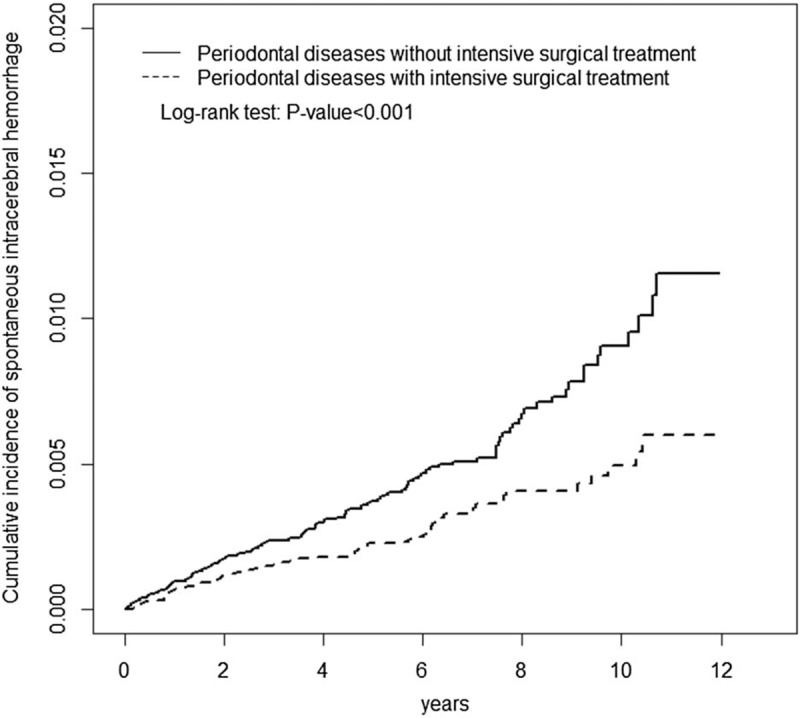
Periodontal disease is a chronic inflammation of periodontium and has a high prevalence. Periodontal disease has been discovered to be a possible risk factor for cerebrovascular diseases. The available evidence are not enough to set up a causal relationship between periodontal disease and cerebrovascular diseases. Patients with spontaneous intracerebral hemorrhage have high mortality rates. The present study investigated whether intensive periodontal treatment is a protective factor of spontaneous intracerebral hemorrhage and can reduce the risk of spontaneous intracerebral hemorrhage.In total, 64,960 patients with a history of periodontal disease were picked out from the National Health Insurance Research Databases as a case-cohort from January 01, 2000 to December 31, 2010. They were divided on the basis of whether periodontal disease patients received intensive surgical treatment (treatment cohort) or not (control cohort). The periodontal disease patients in treatment and control cohorts were selected by propensity score matching at a ratio of 1:1. Incidences of spontaneous intracerebral hemorrhage in both cohorts were analyzed and compared.The total hazard of spontaneous intracerebral hemorrhage was significantly decreased in the treatment cohorts compared with the control cohorts (adjusted hazard ratio = 0.60, 95% confidence interval = 0.45-0.79).Compared with the control cohort, intensive periodontal treatment may reduce the overall incidence of spontaneous intracerebral hemorrhage, particularly in elderly patients, males, and those who received more than 2 intensive treatments.
牙周病是牙周组织的慢性炎症,患病率很高。牙周病已被发现可能是脑血管疾病的一个危险因素。现有证据不足以确立牙周病与脑血管疾病之间的因果关系。自发性脑出血患者的死亡率很高。本研究调查了强化牙周治疗是否为自发性脑出血的保护因素,以及能否降低自发性脑出血的风险。
从2000年1月1日至2010年12月31日的国民健康保险研究数据库中总共挑选出64960例有牙周病史的患者作为病例队列。根据牙周病患者是否接受强化手术治疗(治疗队列)将他们进行分组,未接受强化手术治疗的作为对照队列。治疗队列和对照队列中的牙周病患者通过倾向评分匹配以1:1的比例进行选择。分析并比较了两个队列中自发性脑出血的发生率。
与对照队列相比,治疗队列中自发性脑出血的总风险显著降低(调整后的风险比=0.60,95%置信区间=0.45-0.79)。与对照队列相比,强化牙周治疗可能会降低自发性脑出血总的发生率,尤其是在老年患者、男性以及接受过2次以上强化治疗的患者中。