Department of Biochemistry and Molecular Biology, University of Texas Medical Branch at Galveston, 301 University Boulevard, Galveston, TX 77555-0645, USA.
Viruses. 2019 Mar 8;11(3):235. doi: 10.3390/v11030235.
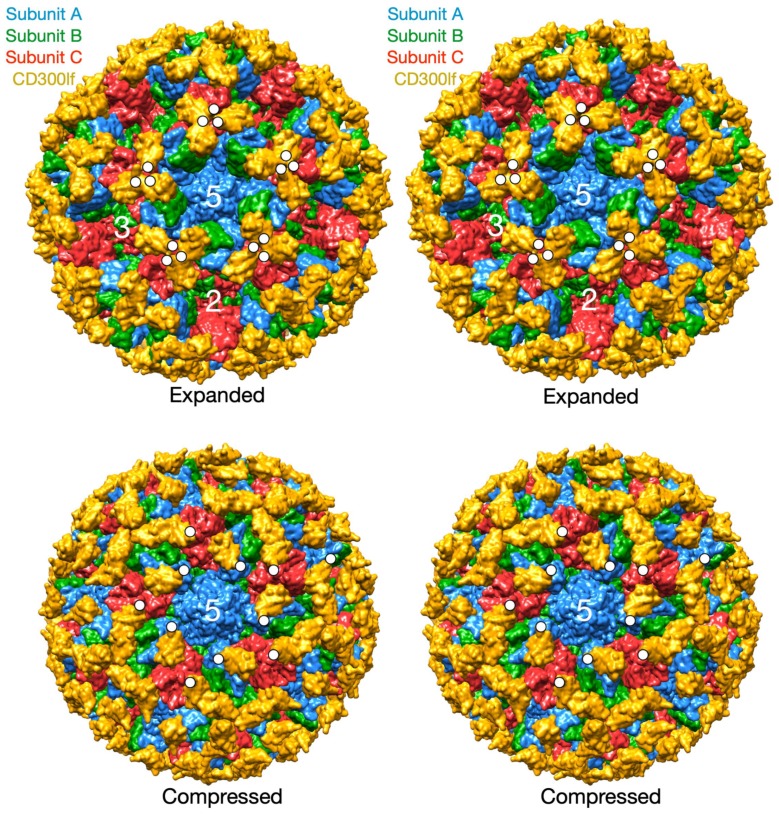
Noroviruses are responsible for almost a fifth of all cases of gastroenteritis worldwide. New strains evolve every 2⁻4 years by escaping herd immunity and cause worldwide epidemics. In the US alone, noroviruses are responsible for ~20 million cases and more than 70,000 hospitalizations of infected children, annually. Efforts towards a vaccine have been hindered by a lack of detailed structural information about antibody binding and the mechanisms of antibody escape. Caliciviruses have 180 copies of the major capsid protein (VP1; ~58 kDa), that is divided into the N-terminus (N), the shell (S) and C-terminal protruding (P) domains. The S domain forms a shell around the viral RNA genome, while the P domains dimerize to form protrusions on the capsid surface. The P domain is subdivided into P1 and P2 subdomains, with the latter containing the binding sites for cellular receptors and neutralizing antibodies. There is increasing evidence that these viruses are extremely dynamic and this flexibility is critical for viral replication. There are at least two modes of flexibility; the entire P domain relative to the shell and within the P domain itself. Here, the details and possible roles for this remarkable flexibility will be reviewed.
诺如病毒是导致全世界近五分之一的胃肠炎病例的罪魁祸首。每隔 2⁻4 年,新的毒株就会通过逃避群体免疫而进化,并引发全球范围内的流行。仅在美国,每年就有2000 万例诺如病毒感染病例和超过 7 万名感染儿童住院。由于缺乏关于抗体结合和抗体逃逸机制的详细结构信息,疫苗的研发工作受到了阻碍。杯状病毒有 180 个主要衣壳蛋白(VP1;58 kDa)拷贝,分为 N 端(N)、壳(S)和 C 端突出(P)结构域。S 结构域围绕病毒 RNA 基因组形成外壳,而 P 结构域二聚化形成衣壳表面的突起。P 结构域进一步分为 P1 和 P2 亚结构域,后者包含细胞受体和中和抗体的结合位点。越来越多的证据表明,这些病毒具有极高的灵活性,这种灵活性对病毒复制至关重要。至少有两种灵活性模式;整个 P 结构域相对于外壳和 P 结构域本身内。在这里,将详细讨论这种显著灵活性的细节和可能的作用。