Lee Jae-Kwang, Hwang Jong-Ha, Kim Chan-Myeong, Lee Jong Kyung, Park Ji-Won
Department of Physical Therapy, College of Medical Science, Catholic University of Daegu: 13-13 Hayang-ro, Hayang-eup, Gyeongsan-si, Gyeongbuk 712-702, Republic of Korea.
J Phys Ther Sci. 2019 Feb;31(2):166-169. doi: 10.1589/jpts.31.166. Epub 2019 Feb 7.
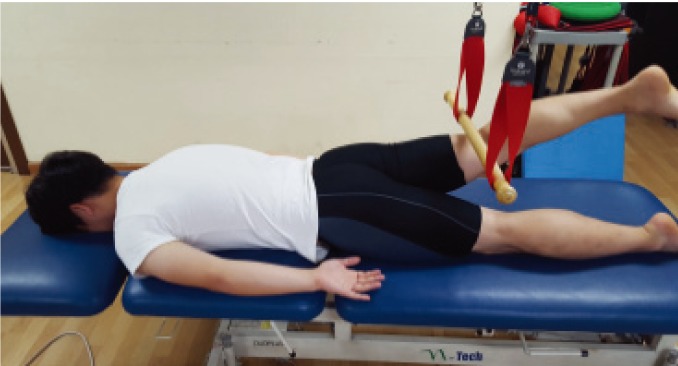
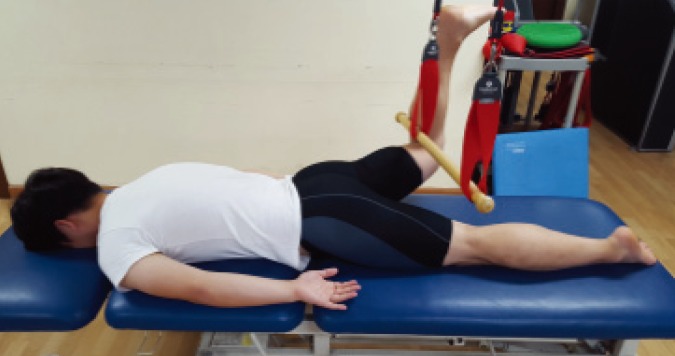
[Purpose] There have been many study ipsilateral erector spinae in regard of prone hip extension (PHE). However, mediating methods have been focusing on the reinforcement of gluteus. Hereupon, this study is intended to identify how an increase of gluteus maximus influences on posterior oblique sling (POS) and suggest a mediating method to effectively reinforce them. This study shows the seclective POS strength exercise. [Participants and Methods] This study has been conducted on normal male (13) and female (13), and participants were asked to proceed PHE exercise and prone hip extension with hip abduction with knee flexion (PHEAKF). Surface electromyography (EMG) was recorded from the contralateral latissimus dorsi, contralateral erector spinae, ipsilateral erector spinae, ipsilateral gluteus maximus, and ipsilateral biceps femoris. A paried t-test was used to compare muscle activity POS. [Results] EMG activity of the contralateral latissimus dorsi, ipsilateral erector spinae, and ipsilateral gluteus maximus was significantly greater performed PHEAKF than PHE. As for ipsilateral biceps femoris, muscle activation was lower in PHEAKF than PHE. [Conclusions] According to the results of this study, increase in muscular activation from the direction of muscular fiber and posterior oblique sling seems to be an important factor that influencontralateral crector spinae on muscular activation of POS.
[目的] 关于俯卧位髋关节伸展(PHE),已有许多针对同侧竖脊肌的研究。然而,调节方法一直侧重于臀肌的强化。因此,本研究旨在确定臀大肌的增加如何影响后斜吊索(POS),并提出一种有效强化它们的调节方法。本研究展示了选择性POS力量训练。[参与者与方法] 本研究对13名正常男性和13名正常女性进行,要求参与者进行PHE运动以及髋关节外展且膝关节屈曲的俯卧位髋关节伸展(PHEAKF)。从对侧背阔肌、对侧竖脊肌、同侧竖脊肌、同侧臀大肌和同侧股二头肌记录表面肌电图(EMG)。采用配对t检验比较肌肉活动的POS。[结果] 与PHE相比,进行PHEAKF时,对侧背阔肌、同侧竖脊肌和同侧臀大肌的EMG活动显著更大。至于同侧股二头肌,PHEAKF时的肌肉激活低于PHE。[结论] 根据本研究结果,从肌纤维方向和后斜吊索增加肌肉激活似乎是影响对侧竖脊肌对POS肌肉激活的一个重要因素。