Pandey Ajay Kumar, Kumar Mohit, Kumari Sonam, Kumari Priya, Yusuf Farnaz, Jakeer Shaik, Naz Sumera, Chandna Piyush, Bhatnagar Ishita, Gaur Naseem A
Yeast Biofuel Group, DBT-ICGEB Center for Advanced Bioenergy Research, International Center for Genetic Engineering and Biotechnology (ICGEB), New Delhi, 110067 India.
Biotechnol Biofuels. 2019 Feb 27;12:40. doi: 10.1186/s13068-019-1379-x. eCollection 2019.
Lignocellulosic hydrolysates contain a mixture of hexose (C6)/pentose (C5) sugars and pretreatment-generated inhibitors (furans, weak acids and phenolics). Therefore, robust yeast isolates with characteristics of C6/C5 fermentation and tolerance to pretreatment-derived inhibitors are pre-requisite for efficient lignocellulosic material based biorefineries. Moreover, use of thermotolerant yeast isolates will further reduce cooling cost, contamination during fermentation, and required for developing simultaneous saccharification and fermentation (SSF), simultaneous saccharification and co-fermentation (SScF), and consolidated bio-processing (CBP) strategies.
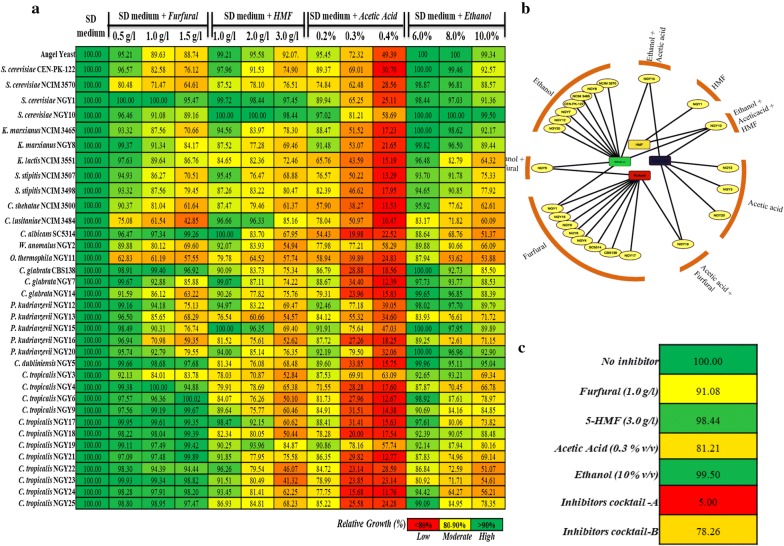
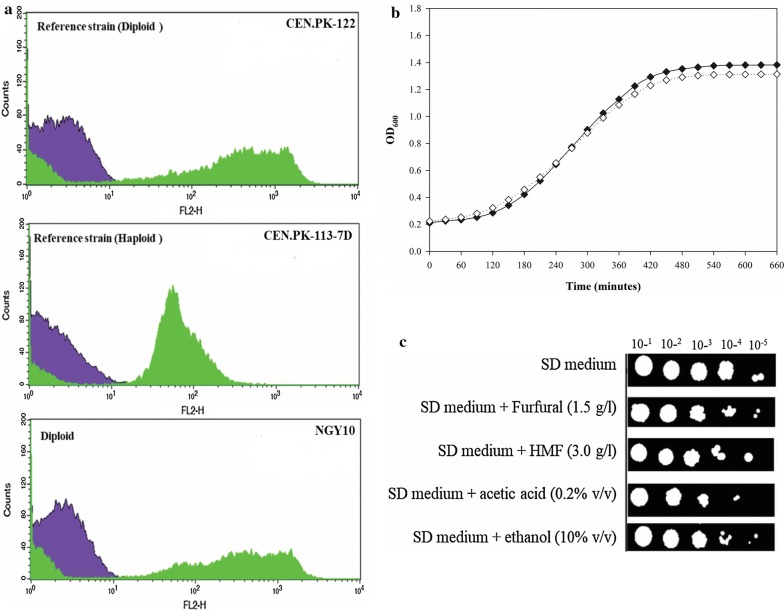
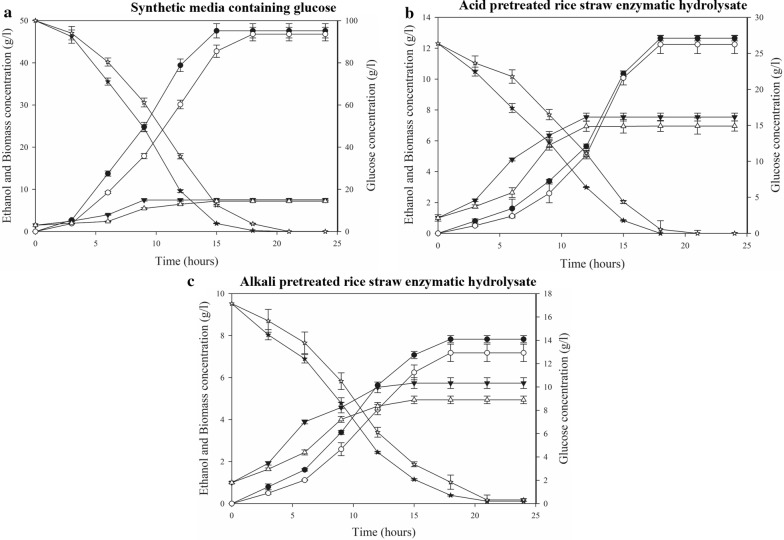
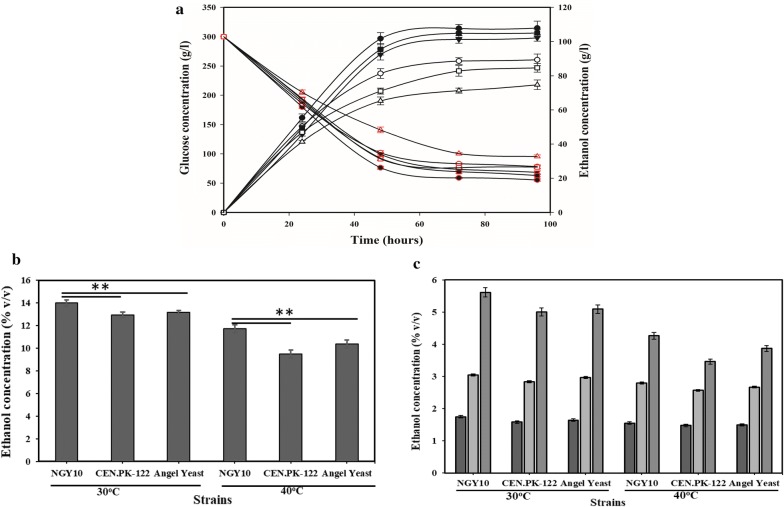
In this study, we evaluated thirty-five yeast isolates (belonging to six genera including , and ) for pretreatment-generated inhibitors {furfural, 5-hydroxymethyl furfural (5-HMF) and acetic acid} and thermotolerant phenotypes along with the fermentation performances at 40 °C. Among them, a sugarcane distillery waste isolate, NGY10 produced maximum 49.77 ± 0.34 g/l and 46.81 ± 21.98 g/l ethanol with the efficiency of 97.39% and 93.54% at 30 °C and 40 °C, respectively, in 24 h using glucose as a carbon source. Furthermore, isolate NGY10 produced 12.25 ± 0.09 g/l and 7.18 ± 0.14 g/l of ethanol with 92.81% and 91.58% efficiency via SHF, and 30.22 g/l and 25.77 g/l ethanol with 86.43% and 73.29% efficiency via SSF using acid- and alkali-pretreated rice straw as carbon sources, respectively, at 40 °C. In addition, isolate NGY10 also produced 92.31 ± 3.39 g/l (11.7% v/v) and 33.66 ± 1.04 g/l (4.26% v/v) ethanol at 40 °C with the yields of 81.49% and 73.87% in the presence of 30% w/v glucose or 4× concentrated acid-pretreated rice straw hydrolysate, respectively. Moreover, isolate NGY10 displayed furfural- (1.5 g/l), 5-HMF (3.0 g/l), acetic acid- (0.2% v/v) and ethanol-(10.0% v/v) tolerant phenotypes.
A sugarcane distillery waste isolate NGY10 demonstrated high potential for ethanol production, C5 metabolic engineering and developing strategies for SSF, SScF and CBP.
木质纤维素水解产物包含己糖(C6)/戊糖(C5)糖的混合物以及预处理产生的抑制剂(呋喃、弱酸和酚类)。因此,具有C6/C5发酵特性且能耐受预处理衍生抑制剂的健壮酵母菌株是高效木质纤维素原料生物精炼厂的先决条件。此外,使用耐热酵母菌株将进一步降低冷却成本、发酵过程中的污染,并有助于开发同步糖化发酵(SSF)、同步糖化共发酵(SScF)和整合生物加工(CBP)策略。
在本研究中,我们评估了35株酵母菌株(属于六个属,包括 、 和 )对预处理产生的抑制剂(糠醛、5-羟甲基糠醛(5-HMF)和乙酸)以及耐热表型,同时评估了它们在40℃下的发酵性能。其中,一株甘蔗酿酒厂废料分离株NGY10在以葡萄糖为碳源、30℃和40℃条件下,24小时内分别产生了最高49.77±0.34 g/l和46.81±21.98 g/l乙醇,效率分别为97.39%和93.54%。此外,分离株NGY10在40℃下通过单步水解发酵(SHF)分别产生了12.25±0.09 g/l和7.18±0.14 g/l乙醇,效率分别为92.81%和91.58%;通过同步糖化发酵(SSF),以酸预处理和碱预处理的稻草为碳源,分别产生了30.22 g/l和25.77 g/l乙醇,效率分别为86.43%和73.29%。此外,分离株NGY10在40℃下,在30% w/v葡萄糖或4倍浓缩酸预处理稻草水解产物存在的情况下,分别产生了92.31±3.39 g/l(11.7% v/v)和33.66±1.04 g/l(4.26% v/v)乙醇,产率分别为81.49%和73.87%。此外,分离株NGY10表现出对糠醛(1.5 g/l)、5-HMF(3.0 g/l)、乙酸(0.2% v/v)和乙醇(10.0% v/v)的耐受表型。
一株甘蔗酿酒厂废料分离株NGY10在乙醇生产、C5代谢工程以及开发SSF、SScF和CBP策略方面显示出巨大潜力。