Schwarzkopf Katharina, Rüschenbaum Sabrina, Barat Samarpita, Cai Chengcong, Mücke Marcus M, Fitting Daniel, Weigert Andreas, Brüne Bernhard, Zeuzem Stefan, Welsch Christoph, Lange Christian M
Department of Internal Medicine 1 Goethe-University Hospital Frankfurt Frankfurt Germany.
Institute of Biochemistry 1 Goethe-University Frankfurt Frankfurt Germany.
Hepatol Commun. 2019 Jan 17;3(3):392-405. doi: 10.1002/hep4.1303. eCollection 2019 Mar.
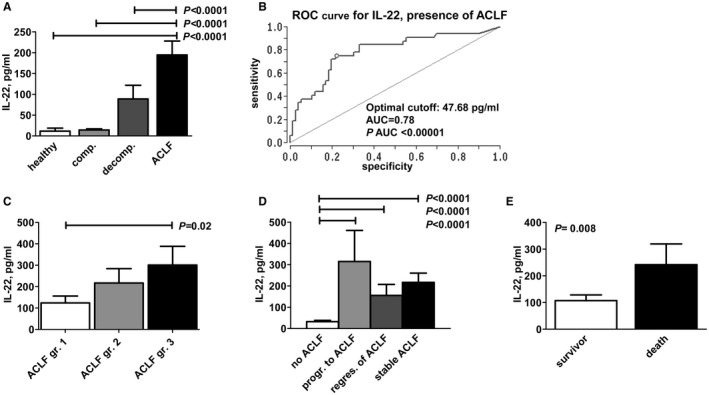
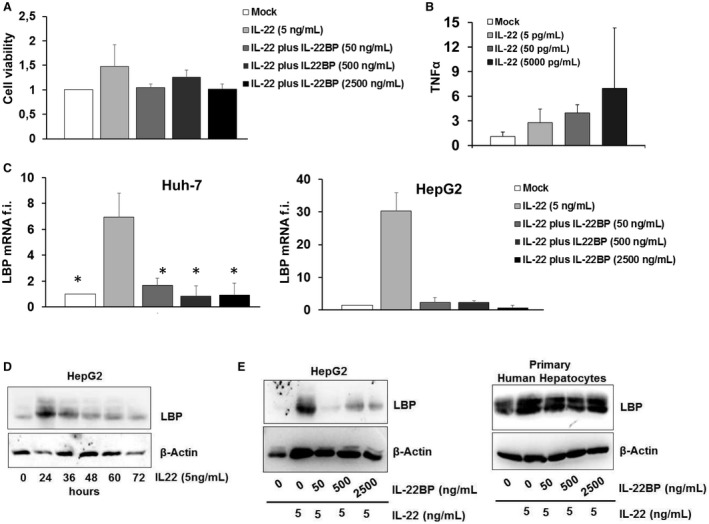
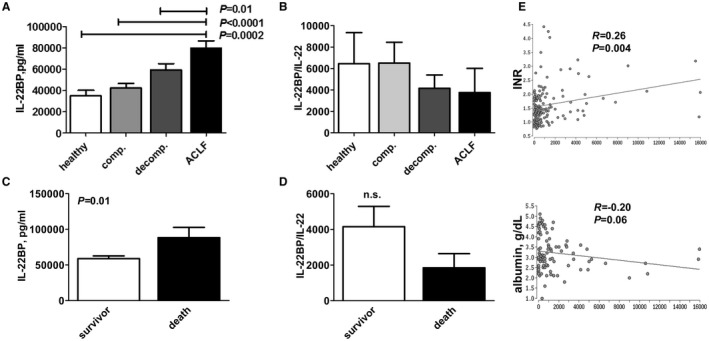
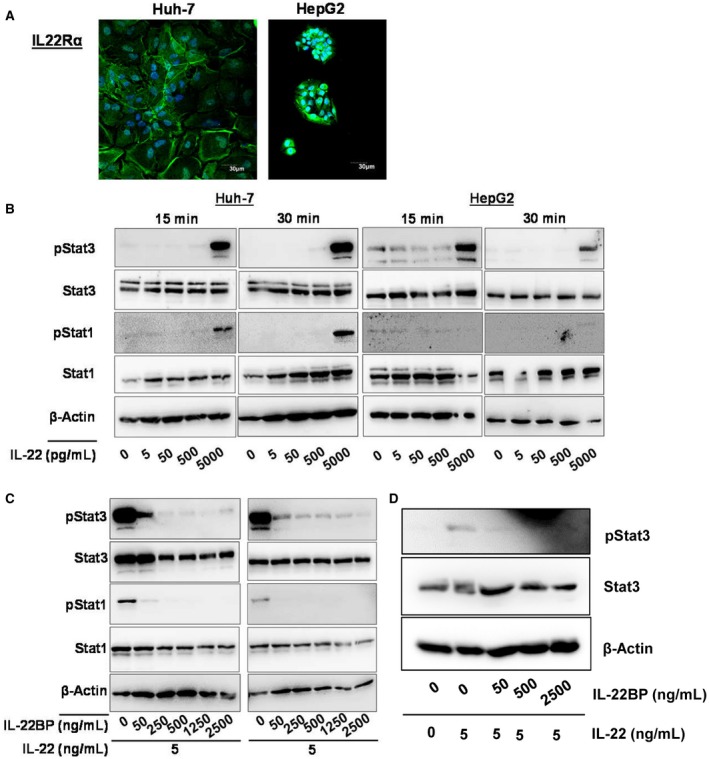
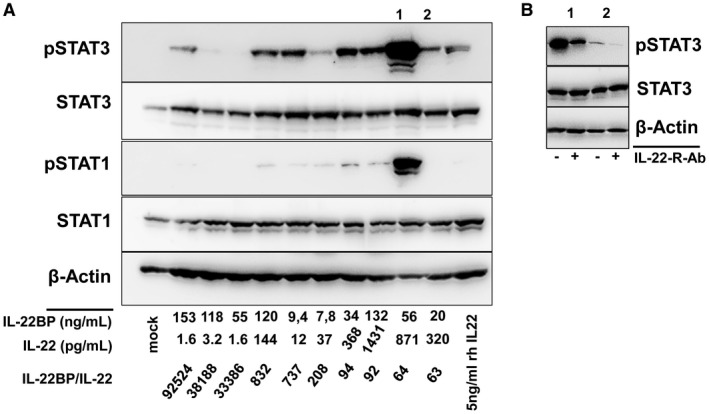
Interleukin-22 (IL-22) has context-dependent hepatoprotective or adverse properties and in animal models. IL-22 binding protein (IL-22BP) is a soluble inhibitor of IL-22 signaling. The role of IL-22 and IL-22BP in patients with acute-on-chronic liver failure (ACLF) is unclear. Beginning in August 2013, patients with liver cirrhosis with and without ACLF were prospectively enrolled and followed at predefined time points. IL-22 and IL-22BP concentrations were quantified and associated with clinical endpoints. The impact of IL-22BP on hepatocellular IL-22 signaling was assessed by functional experiments. A total of 139 patients were analyzed, including 45 (32%), 52 (37%), and 42 (30%) patients with compensated/stable decompensated liver cirrhosis, acute decompensation of liver cirrhosis, and ACLF at baseline, respectively. Serum levels of IL-22 and IL-22BP were strongly associated with the presence of, or progression to, ACLF ( < 0.001), and with mortality ( < 0.01). Importantly, the mean IL-22BP levels exceeded IL-22 levels more than 300-fold. Furthermore, IL-22BP/IL-22 ratios were lowest in patients with adverse outcomes (i.e., ACLF and death). experiments showed that IL-22BP at these concentrations inhibits hepatocellular IL-22 signaling, including the induction of acute-phase proteins. The capacity of patient serum to induce signal transducer and activator of transcription 3 phosphorylation was substantially higher in the presence of low versus high IL-22BP/IL-22 ratios. Our study reveals that high IL-22 levels and low ratios of IL-22BP/IL-22 are associated with ACLF and mortality of patients with cirrhosis. Excessive secretion of IL-22BP can neutralize IL-22 and may prevent-likely in a context-specific manner-hepatoprotective, but also adverse effects, of IL-22 in patients with cirrhosis.
白细胞介素-22(IL-22)在动物模型中具有取决于环境的肝脏保护或不良特性。IL-22结合蛋白(IL-22BP)是IL-22信号传导的可溶性抑制剂。IL-22和IL-22BP在慢加急性肝衰竭(ACLF)患者中的作用尚不清楚。自2013年8月起,对伴有和不伴有ACLF的肝硬化患者进行前瞻性登记,并在预定时间点进行随访。对IL-22和IL-22BP浓度进行定量,并将其与临床终点相关联。通过功能实验评估IL-22BP对肝细胞IL-22信号传导的影响。共分析了139例患者,其中基线时分别有45例(32%)、52例(37%)和42例(30%)为代偿期/稳定失代偿期肝硬化、肝硬化急性失代偿和ACLF患者。血清IL-22和IL-22BP水平与ACLF的存在或进展(P<0.001)以及死亡率(P<0.01)密切相关。重要的是,IL-22BP的平均水平超过IL-22水平300多倍。此外,不良结局(即ACLF和死亡)患者的IL-22BP/IL-22比值最低。功能实验表明,这些浓度的IL-22BP可抑制肝细胞IL-22信号传导,包括急性期蛋白的诱导。在低IL-22BP/IL-22比值与高IL-22BP/IL-22比值的情况下,患者血清诱导信号转导和转录激活因子3磷酸化的能力显著更高。我们的研究表明,高IL-22水平和低IL-22BP/IL-22比值与肝硬化患者的ACLF和死亡率相关。IL-22BP的过度分泌可中和IL-22,并可能以特定于环境的方式预防IL-22对肝硬化患者的肝脏保护作用以及不良影响。