Department of Radiology and Nuclear Medicine, Erasmus MC - University Medical Centre Rotterdam, Rotterdam, The Netherlands.
Centre for Clinical Brain Sciences, University of Edinburgh, Edinburgh, United Kingdom.
Eur Radiol. 2019 Oct;29(10):5148-5159. doi: 10.1007/s00330-019-06061-7. Epub 2019 Mar 11.
This study explored group-wise quantitative measures of tract-specific white matter (WM) microstructure and functional default mode network (DMN) connectivity to establish an initial indication of their clinical applicability for early-stage and follow-up differential diagnosis of Alzheimer's disease (AD) and behavioural variant frontotemporal dementia (bvFTD).
Eleven AD and 12 bvFTD early-stage patients and 18 controls underwent diffusion tensor imaging and resting state functional magnetic resonance imaging at 3 T. All AD and 6 bvFTD patients underwent the same protocol at 1-year follow-up. Functional connectivity measures of DMN and WM tract-specific diffusivity measures were determined for all groups. Exploratory analyses were performed to compare all measures between the three groups at baseline and between patients at follow-up. Additionally, the difference between baseline and follow-up diffusivity measures in AD and bvFTD patients was compared.
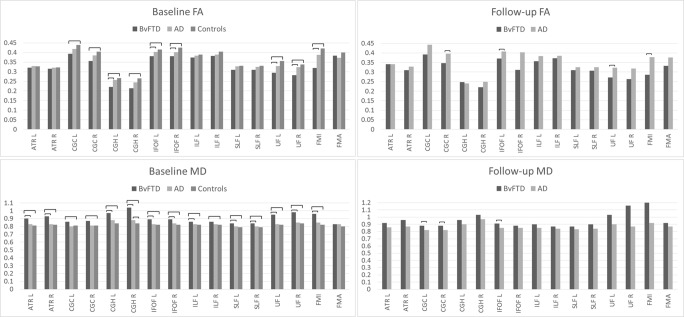
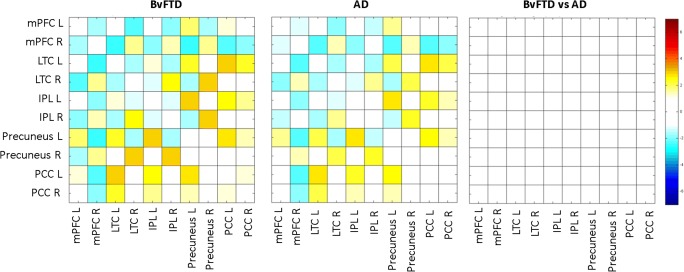
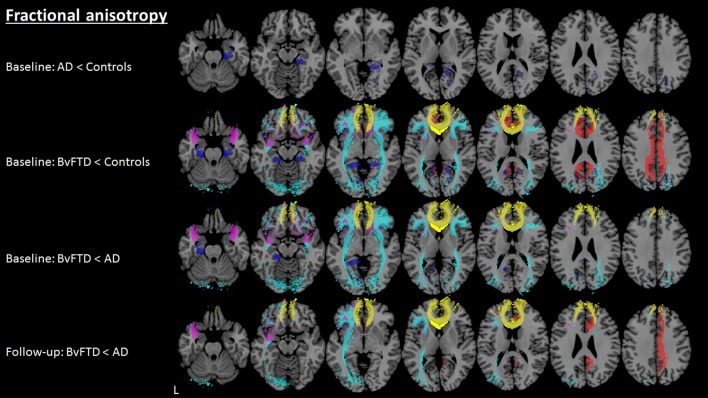
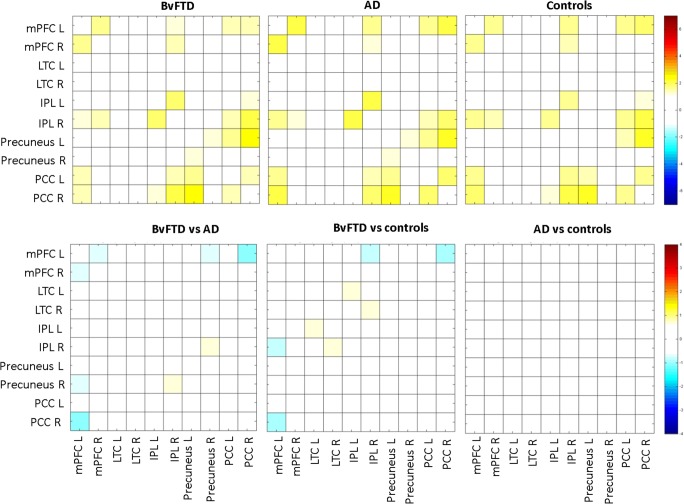
Functional connectivity of the DMN was not different between groups at baseline and at follow-up. Diffusion abnormalities were observed widely in bvFTD and regionally in the hippocampal cingulum in AD. The extent of the differences between bvFTD and AD was diminished at follow-up, yet abnormalities were still more pronounced in bvFTD. The rate of change was similar in bvFTD and AD.
This study provides a tentative indication that quantitative tract-specific microstructural WM abnormalities, but not quantitative functional connectivity of the DMN, may aid early-stage and follow-up differential diagnosis of bvFTD and AD. Specifically, pronounced microstructural changes in anterior WM tracts may characterise bvFTD, whereas microstructural abnormalities of the hippocampal cingulum may characterise AD.
• The clinical applicability of quantitative brain imaging measures for early-stage and follow-up differential diagnosis of dementia subtypes was explored using a group-wise approach. • Quantitative tract-specific microstructural white matter abnormalities, but not quantitative functional connectivity of the default mode network, may aid early-stage and follow-up differential diagnosis of behavioural variant frontotemporal dementia and Alzheimer's disease. • Pronounced microstructural white matter (WM) changes in anterior WM tracts characterise behavioural variant frontotemporal dementia, whereas microstructural WM abnormalities of the hippocampal cingulum in the absence of other WM changes characterise Alzheimer's disease.
本研究旨在探索基于群组的各向异性白质(WM)微观结构和功能默认模式网络(DMN)连接的定量测量,以初步确定其在早期和随访中对阿尔茨海默病(AD)和行为变异型额颞叶痴呆(bvFTD)进行鉴别诊断的临床适用性。
11 名 AD 和 12 名 bvFTD 早期患者以及 18 名对照在 3T 磁共振成像仪上进行弥散张量成像和静息态功能磁共振成像。所有 AD 和 6 名 bvFTD 患者在 1 年随访时进行相同的方案。确定所有组的 DMN 功能连接测量值和 WM 束特定弥散率测量值。进行了探索性分析,以比较基线时三组之间的所有测量值以及随访时患者之间的所有测量值。此外,比较了 AD 和 bvFTD 患者基线和随访时弥散率测量值之间的差异。
DMN 的功能连接在基线和随访时在各组之间没有差异。AD 中观察到弥散异常广泛,而在 bvFTD 中局限于海马扣带回。在随访时,bvFTD 和 AD 之间的差异程度减小,但 bvFTD 中仍然存在更明显的异常。bvFTD 和 AD 的变化率相似。
本研究提供了一个初步的迹象表明,定量的束状微观结构 WM 异常,但不是 DMN 的定量功能连接,可能有助于早期和随访时 bvFTD 和 AD 的鉴别诊断。具体而言,前 WM 束的明显微观结构变化可能是 bvFTD 的特征,而海马扣带回的微观结构异常可能是 AD 的特征。
使用群组方法探讨了定量脑成像测量在痴呆亚型的早期和随访鉴别诊断中的临床适用性。
定量的束状微观结构 WM 异常,但不是 DMN 的定量功能连接,可能有助于早期和随访时 bvFTD 和 AD 的鉴别诊断。
前 WM 束的明显微观结构变化可能是 bvFTD 的特征,而海马扣带回的微观结构异常在没有其他 WM 变化的情况下可能是 AD 的特征。