Leiden Institute of Chemistry, Leiden University, Leiden, The Netherlands.
Swammerdam Institute for Life Sciences, University of Amsterdam, Amsterdam, The Netherlands.
Photochem Photobiol. 2019 Jul;95(4):959-968. doi: 10.1111/php.13093. Epub 2019 Apr 8.
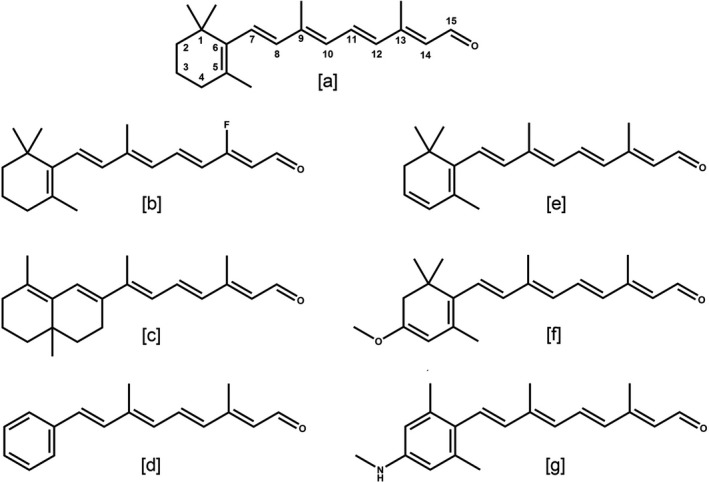
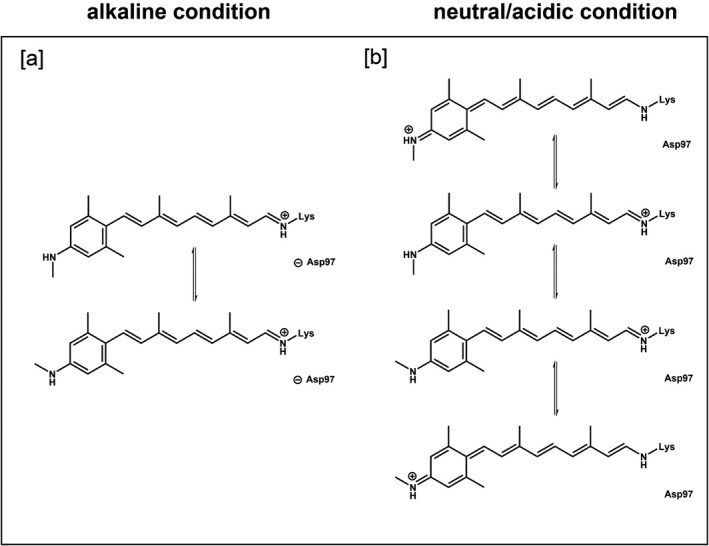
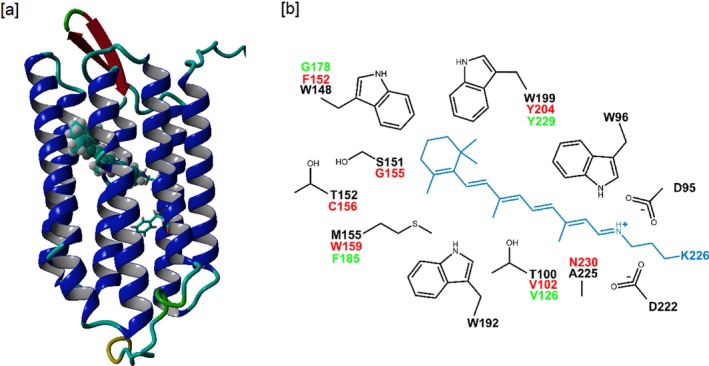
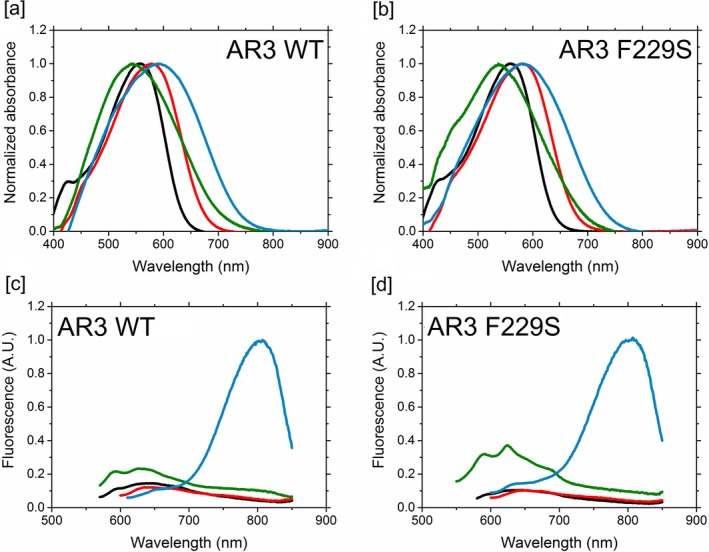
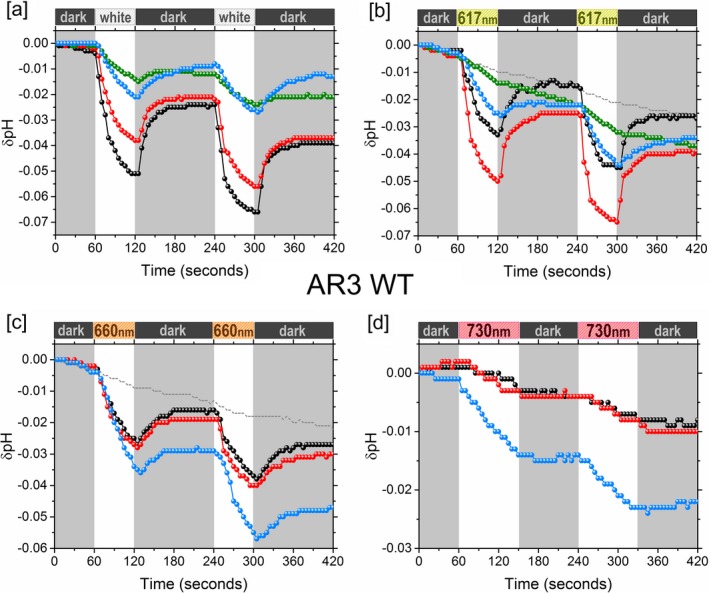
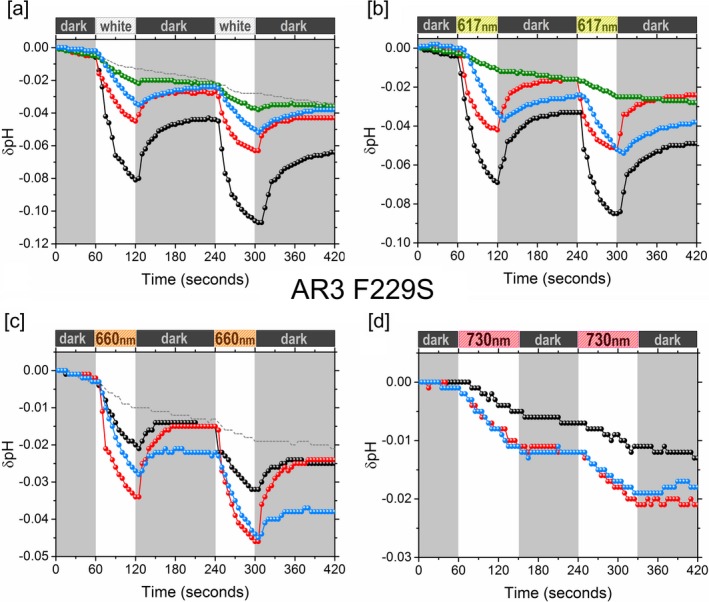
Archaerhodopsin-3 (AR3) is a member of the microbial rhodopsin family of hepta-helical transmembrane proteins, containing a covalently bound molecule of all-trans retinal as a chromophore. It displays an absorbance band in the visible region of the solar spectrum (λmax 556 nm) and functions as a light-driven proton pump in the archaeon Halorubrum sodomense. AR3 and its mutants are widely used in neuroscience as optogenetic neural silencers and in particular as fluorescent indicators of transmembrane potential. In this study, we investigated the effect of analogs of the native ligand all-trans retinal A1 on the spectral properties and proton-pumping activity of AR3 and its single mutant AR3 (F229S). While, surprisingly, the 3-methoxyretinal A2 analog did not redshift the absorbance maximum of AR3, the analogs retinal A2 and 3-methylamino-16-nor-1,2,3,4-didehydroretinal (MMAR) did generate active redshifted AR3 pigments. The MMAR analog pigments could even be activated by near-infrared light. Furthermore, the MMAR pigments showed strongly enhanced fluorescence with an emission band in the near-infrared peaking around 815 nm. We anticipate that the AR3 pigments generated in this study have widespread potential for near-infrared exploitation as fluorescent voltage-gated sensors in optogenetics and artificial leafs and as proton pumps in bioenergy-based applications.
细菌视紫红质 3(AR3)是七螺旋跨膜蛋白微生物视紫红质家族的成员,含有作为生色团的共价结合的全反式视黄醛分子。它在太阳光谱的可见光区域显示出吸收带(λmax 556nm),并在古菌盐沼盐杆菌中作为光驱动质子泵发挥作用。AR3 及其突变体在神经科学中被广泛用作光遗传学神经沉默剂,特别是作为跨膜电位的荧光指示剂。在这项研究中,我们研究了天然配体全反式视黄醛 A1 的类似物对 AR3 及其单突变体 AR3(F229S)光谱性质和质子泵活性的影响。虽然令人惊讶的是,3-甲氧基视黄醛 A2 类似物没有使 AR3 的吸收最大值红移,但视黄醛 A2 和 3-甲基氨基-16-去甲-1,2,3,4-二脱氢视黄醛(MMAR)类似物确实产生了活性红移的 AR3 色素。MMAR 类似物色素甚至可以被近红外光激活。此外,MMAR 色素表现出强烈增强的荧光,发射带在近红外区峰值约为 815nm。我们预计,本研究中产生的 AR3 色素具有广泛的近红外利用潜力,可作为光遗传学和人工叶片中的荧光电压门控传感器,以及生物能源应用中的质子泵。